



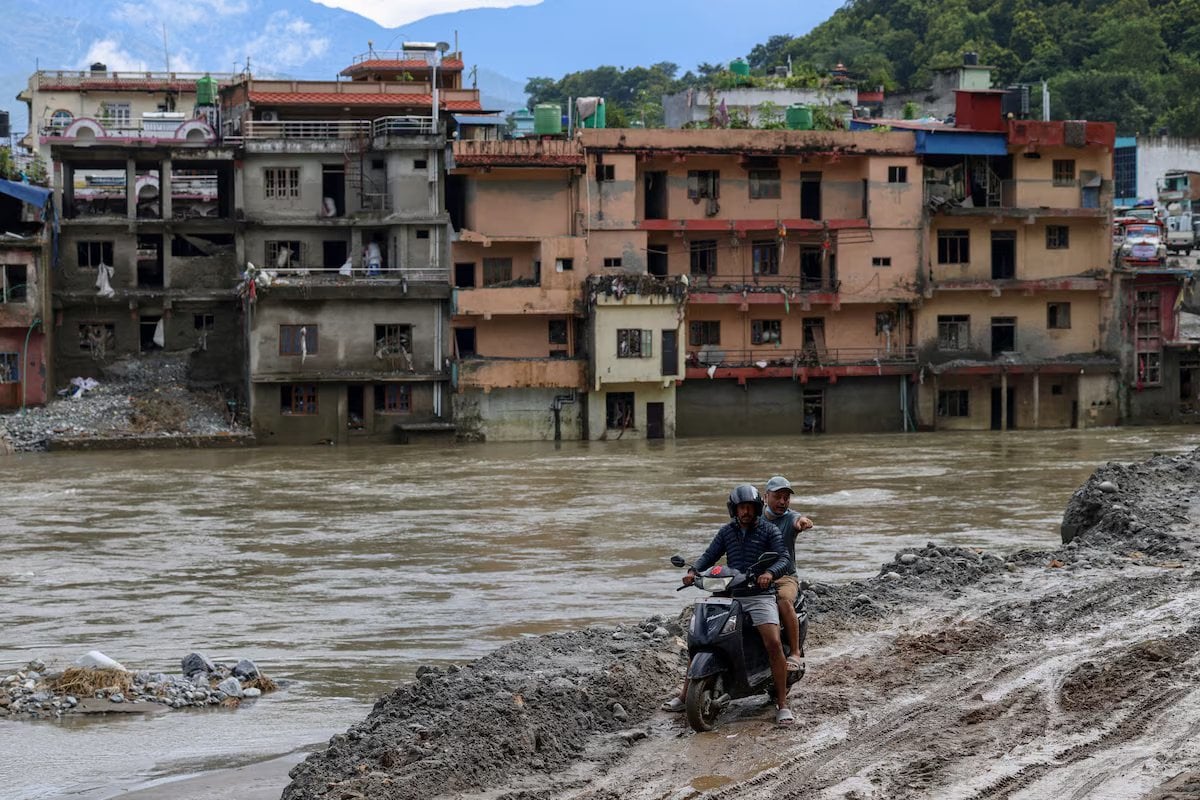

A study has concluded that human-driven climate change contributed to the glacier collapse that triggered catastrophic floods on the Nepal–Tibet border.
More than 1,400 people were killed and thousands were reported missing after the floods on 26 August, which swept through border towns and villages in Nepal and Tibet. Houses were destroyed, energy infrastructure was damaged and mass landslides followed the initial surge of water.
Climate Change Helped Set Up the Disaster
In findings published on Thursday, the World Weather Attribution (WWA) team said there was “absolutely no doubt” that climate change played a role in “the preconditioning of the disaster”.
Friederike Otto, a climatologist at Imperial College London and a co-author of the study, said human-induced warming helped make the conditions more likely for the glacier collapse that unleashed the flooding.
The WWA study described the episode as a “compound event”, shaped by multiple factors including rising temperatures, thinning glaciers, thawing permafrost and pre-existing geological weaknesses.
Rising Temperatures, Thinner Ice and Meltwater
Scientists previously said the floods began after a glacier slope collapsed near the peak of Langtang Lirung on the Nepal side of the Himalayas.
US Geological Survey data cited in the report said the large mass of ice struck the bottom of a valley with such force that it registered as a magnitude 5.2 earthquake.
According to the WWA study, the effects of climate change were not the only driver, but they acted as a “destabilising factor” over a pre-existing vulnerable slope.
The researchers estimated that July and August temperatures in the area were around 1.5C warmer (34.7F), compared with what would have occurred without human influence on the climate.
They also found that glaciers in the region had been thinning by about half a metre (1.6ft) each year, potentially widening existing fractures and increasing instability in the ice and surrounding rock.
Heavy snowfall in October and November, the study said, added to the volume of meltwater early this year, feeding conditions for a larger flood response when the glacier failed.
The report said the combination of heat, meltwater and ongoing ice loss “may have interacted to amplify the compound event”.
Past Earthquake May Have Further Weakened the Slope
The study also pointed to earlier tectonic damage. It said a magnitude 7.8 earthquake that hit the area in 2015, and triggered a rock-ice avalanche, could have weakened the underlying rock mass.
However, it noted that authorities could not confirm the earthquake’s exact impact on the glacier collapse last month.
Walter Immerzeel, a mountain hydrologist at Utrecht University and another co-author of the report, told reporters that the area was a “geologically vulnerable slope”. He said it was potentially weakened by the 2015 earthquake and later destabilised further as glaciers retreated and permafrost thawed.
In the aftermath of the disaster, Nepali authorities called for global action to tackle climate change. They said Nepal is among the lowest contributors to greenhouse emissions while also being one of the most exposed countries to the impacts of global warming.
Balendra Shah, who began his role as Nepali prime minister recently, is expected to travel on his first foreign trip as prime minister to attend the United Nations General Assembly in New York next week. He will discuss the disaster and climate justice, according to plans for his appearance.
Join the discussion? 

18 September 2026
Recommended Comments
Create an account or sign in to comment