



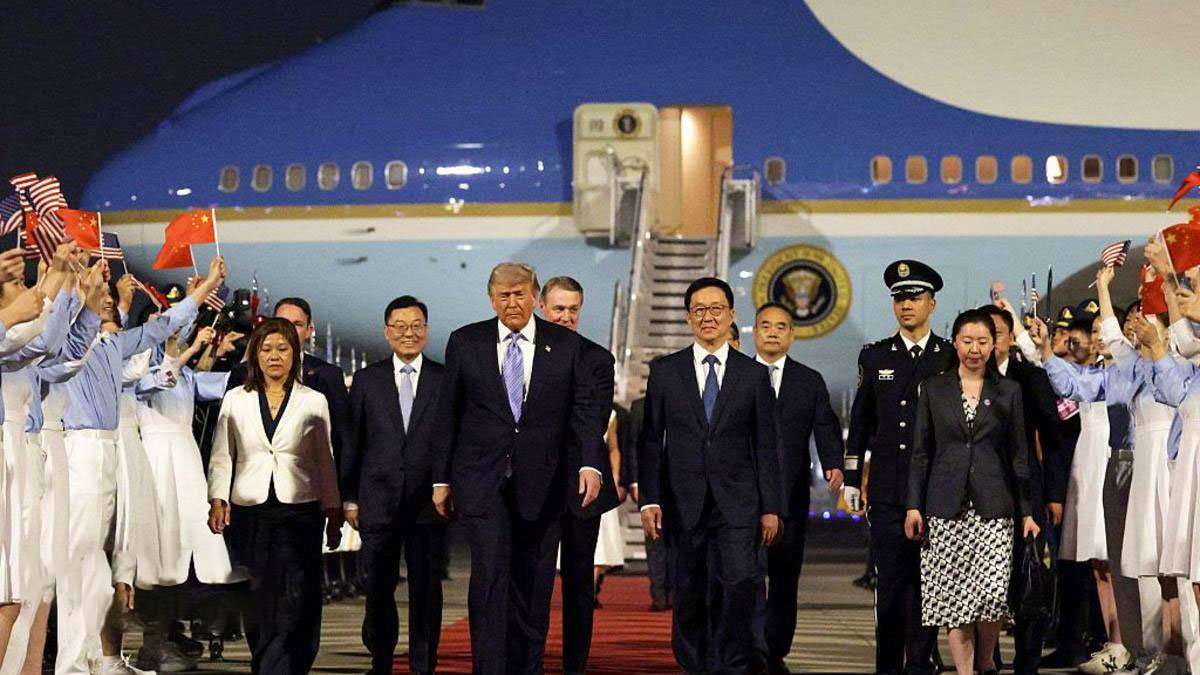

US President Donald Trump arrived in Beijing on Wednesday for a two-day visit that will focus on trade tensions, the war in Iran and the future of Taiwan, as he prepares for high-level talks with Chinese leader Xi Jinping.
Get today's headlines by email 
Trump stepped off Air Force One to a formal reception in the Chinese capital, where he was welcomed by Vice-President Han Zheng and greeted with a red-carpet ceremony. The reception included a brass band and groups waving Chinese and American flags as the US president acknowledged the crowd.
The meeting comes at a time of strained relations between the world’s two largest economies and amid ongoing conflict in the Middle East that has unsettled global markets.
Trade tensions in focus
Trade is expected to dominate the discussions between Washington and Beijing.
Economic ties between the two countries have weakened in recent years following an escalating tariff dispute and other trade restrictions. Bilateral trade reached $414.7bn last year, down sharply from $690.4bn recorded in 2022.
The US is also seeking to reduce its trade deficit with China. In the most recent figures, the United States imported more than $200bn more in goods from China than it exported to the country.
Ahead of the trip, Trump said he would urge Xi to further open China’s economy to American companies. Writing on social media before landing in Beijing, he described Xi as a leader of “extraordinary distinction” and said expanding market access for US firms would be his first request.
Several senior business leaders travelled with the president, including Elon Musk of Tesla, Jensen Huang of Nvidia, Tim Cook of Apple, Larry Fink of BlackRock and Kelly Ortberg of Boeing.
Washington is expected to push for increased Chinese purchases of American agricultural products, while Beijing is likely to press the US to ease tariffs imposed on Chinese goods.
Technology competition will also feature prominently. China has expanded its ambitions in artificial intelligence and increased demand for advanced computing chips produced by US companies. At the same time, Washington has tightened export controls amid concerns that Chinese firms could gain access to sensitive technologies.
China may also use its control over rare earth metals—critical components in many high-tech products—as leverage in negotiations, a tactic it has previously employed in response to US tariffs.
Iran war adds pressure
The conflict involving Iran is another key issue expected to be discussed.
China relies heavily on Iranian oil, and shipments have been disrupted as the fighting has affected shipping through the strategically important Strait of Hormuz. The disruption has contributed to higher oil prices and added pressure on China’s economy.
The United States has urged Beijing to use its political and economic influence with Tehran. China and Iran have maintained close ties for decades.
Shortly before leaving Washington, Trump said he expected a lengthy discussion with Xi about the war but indicated the United States did not need assistance to resolve the conflict.
China has also signalled it wants the fighting to end, partly because of the impact of rising energy costs.
Taiwan tensions remain
Relations over Taiwan are also likely to cast a shadow over the meeting.
The Trump administration has taken a mixed approach toward the island, approving a large arms deal while appearing to soften commitments about defending Taiwan in the event of Chinese military action.
Last week, a bipartisan group of US senators wrote to Trump urging him to reaffirm Washington’s support for Taiwan. The letter also referenced a $14bn arms sale to Taipei approved by Congress last year.
The lawmakers said Trump should make clear that US backing for Taiwan is not negotiable as Washington pursues economic discussions with Beijing.
Packed diplomatic schedule
Trump’s schedule includes a formal welcome ceremony with Xi at the Great Hall of the People, followed by a state banquet and several bilateral meetings.
Events will also include a ceremonial “friendship photo” in Zhongnanhai, the leadership compound in the Chinese capital.
The US president is due to depart on Friday after further talks and a working lunch with Xi.
Join the discussion? 
Already a member? 
 Adapted by ASEAN Now. Source 14 May 2026
Recommended Comments
Create an account or sign in to comment