



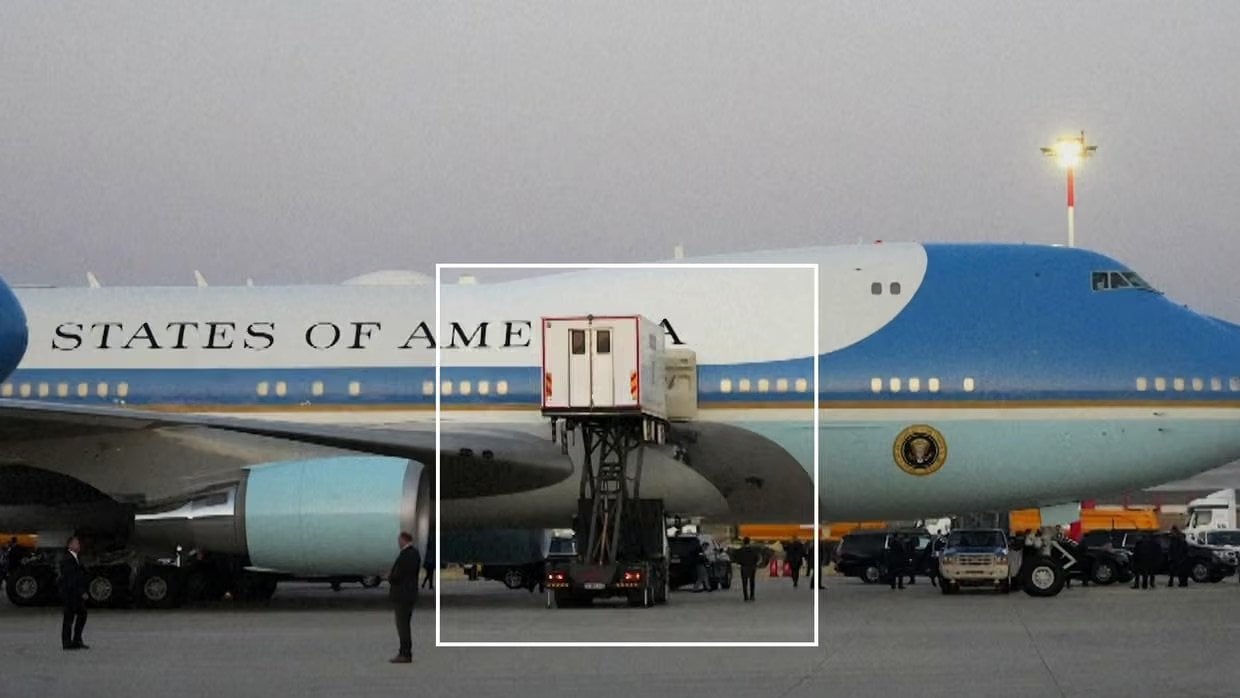

The US administration’s decision last month to move Donald Trump off Air Force One using a reported ruse in Turkey has raised concerns in Washington about the credibility and seriousness of an Iranian assassination threat, experts said.
The episode comes after joint US and Israeli strikes in February killed Iran’s supreme leader, Ayatollah Ali Khamenei, and scores of other senior Iranian officials on the first day of the war. In that context, a reported revenge plot against Trump was not expected to be far-fetched, analysts said, particularly given the long-running US warnings about Iran targeting Trump and people close to him.
Turkey escape and surprise in Washington
The reported plan to remove Trump from the aircraft involved measures that left some aides and journalists on the plane, according to the account discussed by experts. The episode has been seen by some in Washington as notable because it suggested that protecting the president may have required unusual steps while others near him could still have been exposed to risk.
Colin P Clarke, executive director of The Soufan Center, said the approach could make the administration’s posture look poor. He described the actions as “not a good look” and said they risked making Trump appear “weak”, while also stressing that threats should not be discounted even if they have not previously succeeded on US soil.
Previous threat allegations
US officials have accused Iran of seeking to assassinate Trump for years.
In 2024, Manhattan federal prosecutors said Iranian authorities had ordered an operative to kill Trump while he was a presidential candidate, linking the alleged order to Trump’s role in the killing of Qassem Suleimani, the Islamic Revolutionary Guard Corps commander, during his first term.
In July this year, Israel shared intelligence with the US saying Iran had drawn up a new plan to kill Trump. Separately, an Iraqi militant arrested earlier this year was alleged to have close ties to Iranian officials and was said to be considering an attack targeting Ivanka Trump.
Senior figures including Mike Pompeo, Trump’s former secretary of state, and John Bolton, a national security adviser, were also reported to have been under threat.
Bruce Hoffman, a senior fellow on counter-terrorism and homeland security at the Council on Foreign Relations, said the February strikes had set the stage for further threats. He said that, for Iran, revenge “is something that’s taken very seriously” and that the killing of Suleimani “has set in motion very serious threats”. Hoffman also said humiliation can be treated as a form of revenge from Iran’s perspective.
He added that, in view of the reported Turkey operation, Iran may benefit from the episode regardless of how imminent the threat was “from the Iranian point of view”.
Capability and implications for talks
Experts pointed to a broader historical pattern in which Iran and its networks have used terrorism as part of foreign policy. Hoffman cited the 1992 Buenos Aires car bombing outside the Israeli embassy, which killed 29 after Abbas al-Musawi, the then secretary general of Hezbollah, was assassinated. He also cited a bombing two years later on a Jewish community centre in Buenos Aires that killed 85 people and injured more than 300.
While the current risk has been widely discussed since the war began, Matthew Levitt, a senior fellow at the Washington Institute for Near East Policy, wrote in May for War on the Rocks that authorities had not reported a single homeland plot specifically tied to Iran. He noted that lone attackers angered by the war had killed Americans, but that those cases were not directly linked to Iranian intelligence or security agencies.
Levitt argued that Iran’s ability to execute attacks may have been “somewhat diminished” by strikes targeting senior figures involved in external operations, including Rahman Moqadam, head of special operations in the IRGC’s intelligence organisation, and Majid Khademi, head of the IRGC Intelligence Organisation.
Clarke said Iran’s past patience in assembling complex attacks—citing the 1994 Buenos Aires attack—also suggested the conflict may not be winding down as some may assume. Hoffman said Iran’s readiness to try to kill a sitting US president would likely complicate the White House’s calculations and could affect negotiations to end the war, arguing it showed Iran was not backing down.
Join the discussion? 

13 August 2026
-
 2
2
Recommended Comments
Create an account or sign in to comment