



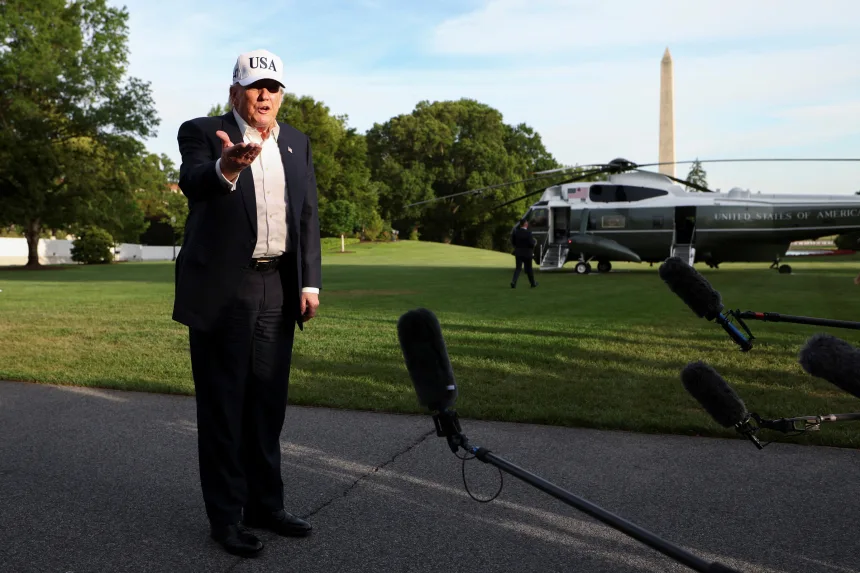

U.S. President Donald Trump returned to Washington on Friday without any clear progress toward ending the conflict with Iran after talks with Chinese leader Xi Jinping, leaving his administration weighing whether to intensify military action or continue pursuing diplomacy.
Get today's headlines by email 
Officials had closely watched Trump’s trip to China, hoping Beijing’s ties with Tehran might help unlock negotiations over the war and the closure of the Strait of Hormuz, a key global oil route. However, Trump appeared to come away with little new to report.
Speaking to reporters while traveling back to the United States, Trump said Xi had expressed support for reopening the strategic waterway and agreed that Iran should not develop a nuclear weapon — positions China had already stated publicly.
“He would like to see it end. He would like to help,” Trump said in an interview with Fox News journalist Bret Baier. “If he wants to help, that’s great. But we don’t need help.”
Administration officials had waited to assess the outcome of the meeting before determining the next steps on Iran policy. With the trip concluded and no breakthrough secured, Trump now faces decisions about how to proceed in a conflict that has already lasted longer than he originally predicted.
Debate Inside the Administration
The war has stretched well beyond the six weeks Trump initially projected, while rising fuel costs and economic concerns have put pressure on the administration.
In a message posted Friday on Truth Social, Trump signaled the military campaign would continue, writing that operations against Iran are “to be continued!”
Behind the scenes, officials remain divided over the best strategy. Some within the Pentagon favor a tougher approach, including targeted strikes aimed at forcing Iran to make concessions at the negotiating table.
Others argue the United States should maintain its focus on diplomacy. Trump himself has recently leaned toward that path, hoping a combination of direct talks and economic pressure could persuade Tehran to accept a deal.
So far, however, Iranian negotiators have shown little willingness to change their position since Trump announced a ceasefire in April.
“Well, I looked at it and if I don’t like the first sentence, I just throw it away,” Trump told reporters aboard Air Force One when discussing Iran’s latest proposal.
Vice President JD Vance said earlier in the week that diplomatic discussions were continuing. He said he had spoken with senior envoys including Jared Kushner and Steve Witkoff, as well as contacts in Arab countries involved in the talks.
“I think that we are making progress,” Vance said, adding that the key question was whether negotiations would satisfy the president’s conditions.
Pressure Mounts Over Economy
Trump’s impatience with Iran has grown as the conflict drags on. Officials say he has been particularly frustrated by the ongoing closure of the Strait of Hormuz, which has pushed oil and gas prices higher.
Iran’s latest response to U.S. proposals, combined with increasingly confrontational rhetoric from Tehran, has also raised doubts among American officials about whether Iranian leaders are committed to reaching a deal.
White House spokeswoman Anna Kelly said the administration still prefers diplomacy but warned the president had multiple options available.
“President Trump has every option at his disposal,” she said, adding that any agreement would need to protect U.S. national security.
Outside analysts say Trump is searching for a way to break the deadlock. Ivo Daalder, a former U.S. ambassador to NATO, said the president had tried both confrontational rhetoric and negotiations without achieving results.
Political Stakes Rising
At the same time, the domestic political stakes are increasing as the United States approaches midterm elections.
Average gasoline prices have climbed above $4.50 per gallon and could rise further if the Strait of Hormuz remains closed. Inflation has also accelerated, outpacing wage growth in April for the first time in three years.
Business leaders have privately urged the administration to find a way to end the conflict, according to people familiar with those conversations.
Trump has largely dismissed concerns about the economic impact. Asked earlier this week about Americans struggling with rising costs, he said his focus remained on preventing Iran from obtaining nuclear weapons.
Pressed later on those comments, Trump told Fox News he stood by the remark, calling it “a perfect statement.”
Even so, advisers acknowledge the administration faces increasing pressure to resolve the situation quickly.
“They just want the war over,” one adviser said of discussions with corporate executives, describing their message as a call to end the conflict as soon as possible.
Join the discussion? 
Already a member? 
 Adapted by ASEAN Now. Source 17 May 2026
Recommended Comments
Create an account or sign in to comment