



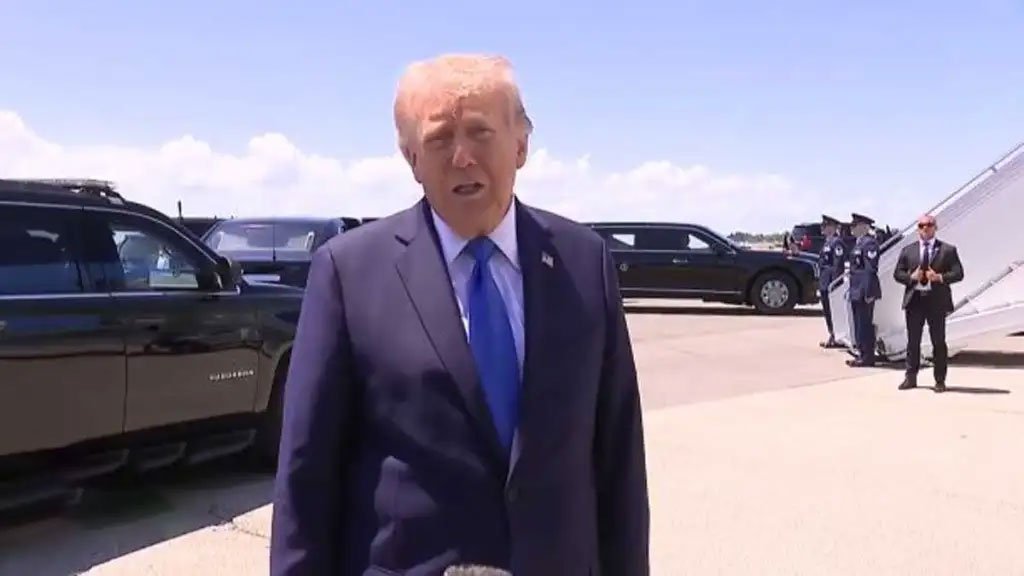

US President Donald Trump said he is reviewing a new proposal from Iran aimed at ending the ongoing conflict with the United States, but expressed doubt that it would lead to an agreement.
Get today's headlines by email 
Speaking to reporters on Saturday before boarding Air Force One, Trump said he would examine the plan in more detail once its final wording had been delivered.
“I’ll let you know about it later,” he said, adding that Iranian officials were expected to provide the exact text shortly.
Shortly after the remarks, Trump wrote on social media that he struggled to see how the proposal could be acceptable. He argued that Iran had “not yet paid a big enough price for what they have done to Humanity, and the World, over the last 47 years.”
Two semi-official Iranian news agencies, Tasnim and Fars, reported that Tehran had submitted a 14-point proposal in response to a nine-point plan put forward by the United States. The proposal was reportedly sent via Pakistan, which has previously hosted discussions between the two sides.
Iran’s state-run media have not yet reported on the proposal. Earlier this week Trump rejected a separate Iranian plan, though diplomatic contacts have continued and a three-week ceasefire between the sides remains in place.
Trump has also floated the possibility of reopening the Strait of Hormuz, the narrow waterway linking the Persian Gulf with global shipping routes. Roughly a fifth of the world’s oil and natural gas trade normally passes through the strait.
Concern over jailed activist’s health
Meanwhile, concerns have grown over the health of imprisoned Iranian human rights lawyer Narges Mohammadi.
Her family and foundation said on Saturday that her condition was at “very high risk”, accusing Iran’s Intelligence Ministry of blocking her transfer to the capital, Tehran, for treatment by doctors of her choosing.
Mohammadi, a Nobel Peace Prize laureate in her early 50s, was urgently taken to hospital in the north-western city of Zanjan on Friday after suffering a cardiac episode and fainting.
Her relatives say her health has deteriorated partly because of injuries sustained during her arrest in December.
Doctors in Zanjan have asked for her medical records before providing treatment and have recommended that she be moved to Tehran. However, her husband, Taghi Rahmani, said the Intelligence Ministry opposed the transfer for angiography, a medical imaging procedure used to examine blood vessels.
The Norwegian Nobel Committee called on Iranian authorities to allow Mohammadi to be transferred immediately to her medical team, warning that her life was at risk.
Before her arrest on 12 December, Mohammadi had been serving a sentence of 13 years and nine months on charges including collusion against state security and propaganda against the government. She had been temporarily released on furlough since late 2024 because of medical concerns.
Shipping sanctions warning
The United States has also warned shipping companies that they could face sanctions if they pay Iran to pass safely through the Strait of Hormuz.
Tehran effectively closed the strait after attacking or threatening vessels following the start of the war between the United States, Israel and Iran on 28 February.
Iran later allowed some ships to use routes closer to its coastline in exchange for fees.
Washington warned that payments could include not only cash but also “digital assets, offsets, informal swaps, or other in-kind payments”, such as charitable donations or payments made through Iranian embassies.
The US has imposed a naval blockade on Iranian ports since 13 April in an effort to restrict the country’s oil revenue. United States Central Command said on Saturday that 48 commercial vessels had been ordered to turn back.
Iran executes men accused of spying
Iranian authorities also announced the execution of two men accused of spying for Israel.
According to the judiciary’s news outlet Mizanonline, Yaghoub Karimpour was convicted of sending sensitive information to an officer in Israel’s Mossad intelligence agency. Another man, Nasser Bekrzadeh, was accused of providing information about government and religious figures as well as details relating to the nuclear facility in the city of Natanz.
Iran has executed more than a dozen people in recent weeks on charges of espionage or terrorism. Human rights groups say such cases often involve closed trials where defendants cannot properly challenge the accusations against them.
Join the discussion? 
Already a member? 
 Adapted by ASEAN Now. Source 3 May 2026
Recommended Comments
Create an account or sign in to comment