



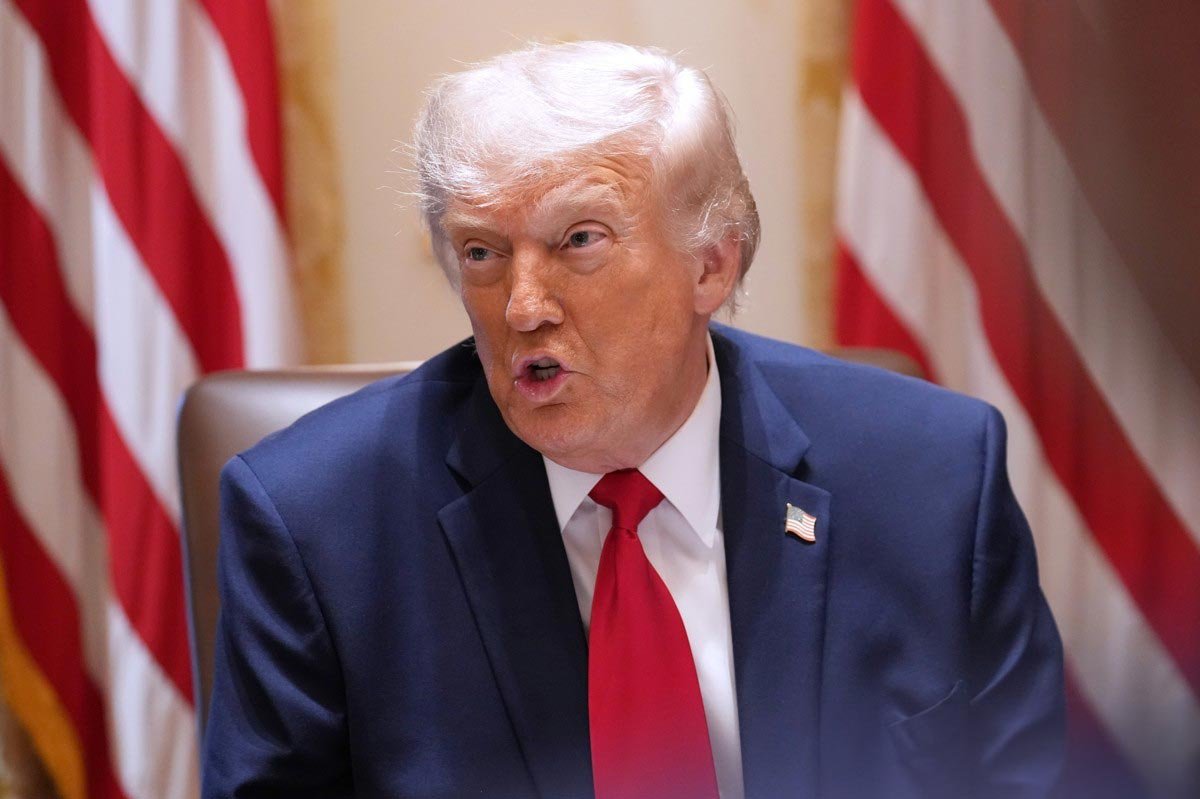

US President Donald Trump has said Washington is still not fully satisfied with the terms of a proposed agreement with Iran, despite signs of progress in negotiations aimed at ending months of regional conflict.
Get today's headlines by email 
Speaking during a cabinet meeting on Wednesday, Trump said Tehran was eager to secure an agreement but warned that talks had not yet produced acceptable terms for the United States.
“They just want to make a deal - I don’t think they have a choice,” Trump told reporters. He added that Iran was “very much intent” on reaching an agreement, but said “so far, they haven’t gotten there and we’re not satisfied with it”.
The president repeated that the US remained prepared to resume military action if negotiations failed, saying Washington would either reach a deal or “have to just finish the job”.
Draft agreement disputed
Trump’s comments came after Iranian state television reported details of what it described as a draft agreement between the two sides.
According to the report, the proposed framework included reopening the Strait of Hormuz and withdrawing US forces from the region. It also claimed the US would lift its naval blockade of Iranian ports.
Under the reported terms, Iran would restore commercial shipping through the Strait of Hormuz to pre-war levels within a month, with vessel routing and management overseen jointly by Iran and Oman.
However, the White House rejected the reported document, describing it as a “complete fabrication”.
The reported framework also made no mention of Iran abandoning its nuclear programme or surrendering its stockpile of highly enriched uranium, both of which remain key concerns for Washington and its allies.
BBC News said it had not independently seen the reported draft agreement.
US denies sanctions relief claims
Asked whether he would accept the reported terms, Trump dismissed the suggestion that Iran would control access to the Strait of Hormuz, saying “nobody” would exercise such authority and that the waterway would reopen “immediately”.
He also denied reports that his administration was considering easing sanctions on Tehran or allowing Russia and China to remove Iran’s enriched uranium stockpile. Any such concessions would likely face strong political opposition in the United States.
Secretary of State Marco Rubio said there had been “some progress and some interest” in negotiations, but cautioned that it remained unclear whether a final breakthrough could be achieved in the coming days.
“We’ll see over the next few hours and days whether progress could be made,” Rubio said.
Neither Trump nor Rubio provided details about the remaining disputes in the negotiations.
Conflict and ceasefire tensions
The latest diplomatic efforts follow a sharp escalation in regional tensions after the US and Israel launched large-scale strikes against Iran on 28 February.
Iran responded with attacks on Israel and Gulf states allied with Washington, while also effectively shutting the Strait of Hormuz, a key global shipping route. The disruption caused oil prices to surge worldwide.
A ceasefire agreed on 8 April has mostly held, although tensions have continued.
Earlier this week, the US carried out what it described as “self-defence strikes” against Iranian missile sites and boats in southern Iran. Washington said the operations were intended to protect American troops from threats posed by Iranian forces, including attempts to place naval mines.
Tehran condemned the attacks as a “gross violation” of the ceasefire agreement.
Despite the renewed military activity, both Washington and Tehran have continued to signal that negotiations remain active, even as uncertainty persists over whether a final deal can be reached.
Join the discussion? 
Already a member? 
 Adapted by ASEAN Now. Source 28 May 2026
Recommended Comments
Create an account or sign in to comment