



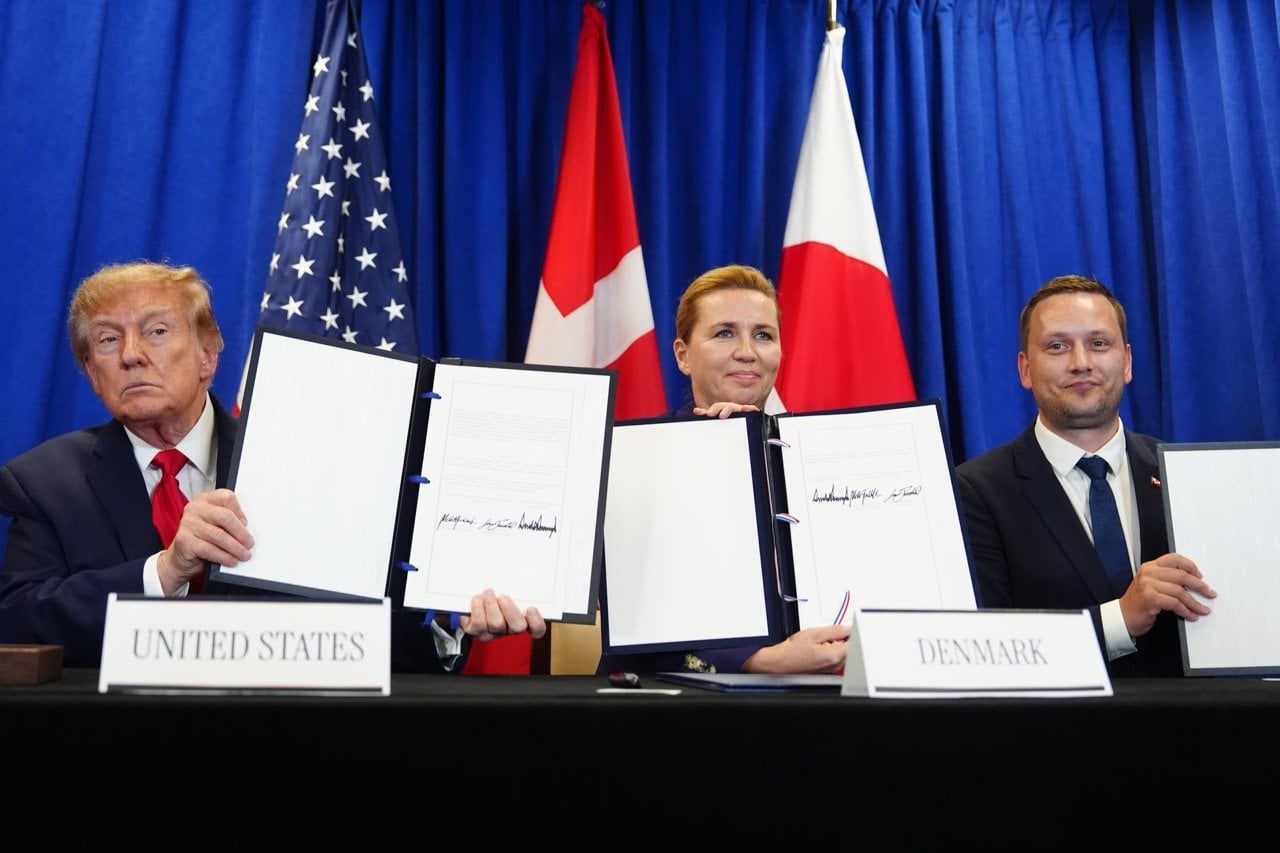

President Donald Trump has signed an agreement with Denmark and Greenland to strengthen Arctic and North Atlantic security, aiming to ease tensions after his repeated calls for Greenland to join the United States.
Trump signed the deal on Tuesday on the sidelines of the UN General Assembly in New York. It comes days after he announced an arrangement intended to bolster the US military presence on the island while keeping Greenland under Danish control, and it would still apply if Greenland later chooses independence.
“We’re doing something tremendous,” Trump said shortly before the signing, adding that the move would be significant for Greenland.
Security Deal Keeps Denmark In Control
For months, US, Greenland and Danish officials have been working on the terms behind the scenes, seeking ways to address Trump’s security concerns about the mineral-rich island.
Trump has signalled interest in Greenland since at least 2019 and, during his second term, has issued threats to seize the semiautonomous territory from Denmark, a NATO ally. On Tuesday, he did not answer questions about whether acquiring Greenland was off the table.
The plan has strained relations within NATO. Denmark’s Prime Minister Mette Frederiksen previously warned that a US takeover would amount to the end of the Atlantic alliance, while the dispute also unsettled Greenland’s population and widened gaps between the United States and Denmark, as well as between Washington and European Union partners. European governments responded by stepping up security exercises in the region and increasing financial support for the island.
US Footprint On Greenland Scales Up
The United States has maintained a presence in Greenland for decades, but the size of its military presence has fallen since 1945. The US role has reduced from thousands of soldiers operating across 17 bases and installations to about 200 troops at the remote Pituffik Space Base in northwest Greenland.
Pituffik supports missile warning and missile defence, as well as space surveillance operations for the US and NATO.
Ahead of the signing, Trump told the UN General Assembly the US would “immediately begin the process” of developing a larger military presence in the “appropriate locations”, including the construction of two major military bases.
Denmark’s parliament approved a bill last year allowing US bases on Danish territory. It follows a 2023 arrangement with the Biden administration that gave US troops broad access to Danish air bases.
Trump has also argued that US involvement was necessary to prevent Russia or China from moving into Greenland, though he said he would prefer a negotiated agreement rather than force.
Key Terms: Bases, Mobility And No Clear End Date
Under the agreement released after the signing, Washington will be able to “modernize and expand” its activities at Pituffik. It also provides for “defense areas” in Greenland at Narsarsuaq in the south and Mestersvig in the east, and says the US “may establish additional defense areas in Greenland” and strengthen military operations or facilities.
The accord calls for wide-ranging US military mobility on Greenland’s territory, including “undersea access”. It also states that contracts for goods and services linked to setting up, running or dismantling bases should go “to Greenlandic sources to the maximum extent possible”.
The agreement bars any non-NATO country from placing “its own manned or unmanned military installations” in Greenland or maintaining a “persistent” military presence unless the signatories agree otherwise.
It contains no end date. If Greenland becomes independent, the parties will agree for Greenland to remain in NATO and to assume Denmark’s rights and obligations under the deal.
Reactions From Denmark, Greenland And NATO
Frederiksen described the accord as a “deal that can last forever”, saying it benefits the US, Greenland, Denmark and NATO. Jens-Frederik Nielsen, Greenland’s prime minister, called it a “win-win-win agreement”, adding that security for Greenland and security for Denmark and others are linked.
NATO Secretary-General Mark Rutte, who had helped cool the situation during a peak in the crisis in January, said the agreement would enhance collective security and support a safer and more stable future.
Naaja Nathanielsen, one of Greenland’s two lawmakers in Denmark’s parliament, told the Associated Press that trust had been tested and that many people in Greenland felt worried about losing the country and livelihoods. She nevertheless called the deal a significant step and said it was the first binding agreement Greenland has signed as a country.
Join the discussion? 

23 September 2026
Recommended Comments
Create an account or sign in to comment