



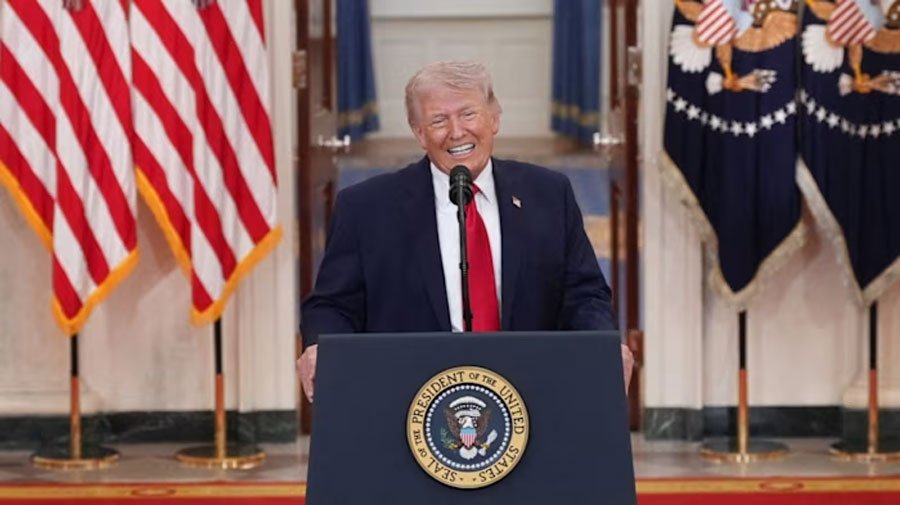

US President Donald Trump has warned that the United States could launch new attacks on Iran within days if Tehran does not agree to major concessions in negotiations aimed at ending the conflict in the Middle East.
Get today's headlines by email 
Speaking on Tuesday, Trump said he had been close to ordering a fresh round of strikes but ultimately decided against it. The US had been “an hour away” from launching the attacks, he said, which would have broken a ceasefire that has been in place since early April.
The decision followed the submission of another peace proposal from Tehran, reportedly passed to Washington through Pakistani mediators.
Ceasefire under strain
Trump suggested that if negotiations fail to produce a breakthrough soon, the US could act quickly.
“Well, I mean, I’m saying two or three days, maybe Friday, Saturday, Sunday, something, maybe early next week,” he said, adding that the timeframe for a decision was limited because the US could not allow Iran to obtain a nuclear weapon.
The remarks come as the conflict appears to have reached a stalemate. Trump has issued several warnings in recent weeks, but no further military action has followed.
Analysts say both Washington and Tehran appear reluctant to return to open hostilities, even though negotiations have yet to deliver progress.
Neil Quilliam of Chatham House said the repeated threats have begun to lose credibility. He argued that both sides remain too far apart on key issues but are also unwilling to bear the political cost of concessions needed to reach a settlement.
Strait of Hormuz tensions
Meanwhile, Iran continues to restrict much of the shipping traffic through the strategically vital Strait of Hormuz, through which about one-fifth of the world’s oil and liquefied natural gas supplies previously passed.
The United States has responded by maintaining a naval blockade of Iranian ports.
Iranian officials have rejected Washington’s demands, describing them as excessive. According to Iran’s ISNA news agency, military spokesperson Mohammed Akraminia said Tehran would continue to manage activity in the strait and urged the US to respect what he called the “legitimate rights” of the Islamic Republic.
On Monday, Iran announced the creation of a new body, the Persian Gulf Strait Authority, to oversee maritime traffic through the waterway. The Islamic Revolutionary Guard Corps has also threatened to introduce permit requirements for internet fibre-optic cables running beneath the strait.
Akraminia warned that if the US launched new attacks, Iran would open “new fronts” against American forces in the region, where Washington has assembled significant military assets. He added that Tehran had used the ceasefire period to strengthen its military capabilities.
Competing proposals
Iranian state media reported that Tehran’s latest proposal calls for a complete end to hostilities across the region, including in Lebanon. It also seeks the withdrawal of US forces from areas near Iran and compensation for damage caused by US-Israeli strikes.
According to Iranian reports, Deputy Foreign Minister Kazem Gharibabadi said Tehran is also demanding the lifting of sanctions, the release of frozen assets and an end to the US naval blockade.
However, the proposal appears largely unchanged from an earlier offer rejected by Trump last week, which he dismissed as “garbage”.
Economic and political pressure
The disruption to shipping through the Strait of Hormuz and the threat of renewed fighting have pushed global oil prices higher, contributing to inflation and raising concerns about a wider economic slowdown.
A further escalation could send energy costs even higher and unsettle financial markets.
The conflict also carries domestic political risks in the United States. White House officials are concerned that a prolonged war, which has limited public support among voters, could affect Republican prospects in congressional elections as economic pressures remain high.
Iran is also facing mounting strain. The country’s economy has been hit hard by sanctions and conflict, with rising inflation and growing fears among some officials of increased public dissatisfaction.
Human rights organisations say Iran has executed 26 men since the war began, including several linked to protests and opposition groups. Monitoring group Human Rights Activists News Agency reported more than 4,000 arrests between late February and early May.
The group also documented at least 3,636 deaths in Iran from US-Israeli attacks, including 1,701 civilians.
Separately, Brad Cooper, commander of United States Central Command, told a congressional panel that an investigation was continuing into a strike on a school in Minab on the first day of the conflict.
Iranian state media said the attack killed 155 people, including dozens of students and teachers. Cooper said the school was located on what he described as an active missile base run by the Islamic Revolutionary Guard Corps, making the inquiry “more complex than the average strike”.
Join the discussion? 
Already a member? 
 Adapted by ASEAN Now. Source 20 May 2026
Recommended Comments
Create an account or sign in to comment