



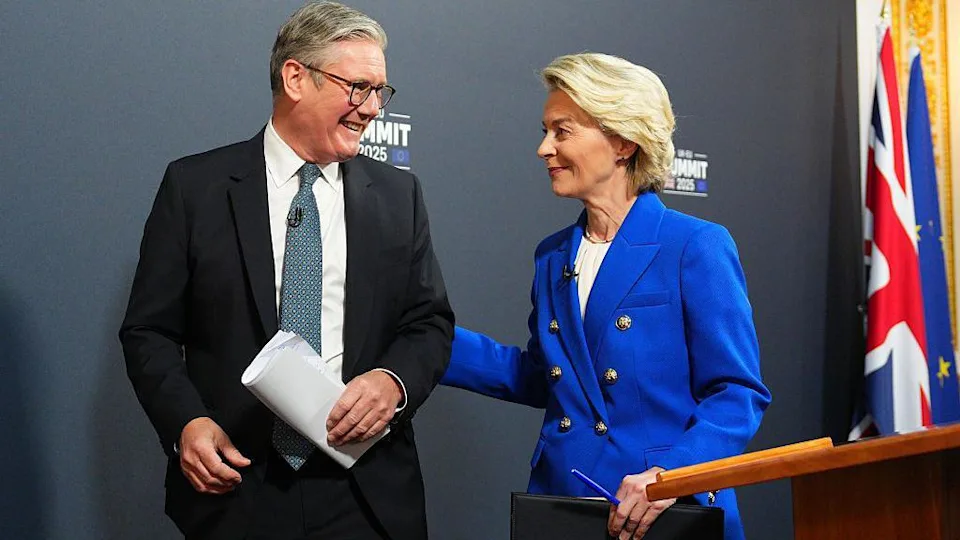

The United Kingdom is seeking deeper cooperation with the European Union as geopolitical tensions and economic pressures reshape international alliances, nearly a decade after the country voted to leave the bloc.
Get today's headlines by email 
According to Nick Thomas-Symonds, the UK’s minister responsible for relations with Europe, the government is pursuing what he described as an “ambitious” and “ruthlessly pragmatic” strategy to strengthen ties with European partners in areas considered vital to British interests.
Speaking in Brussels at the residence of the UK ambassador to the EU, Thomas-Symonds said growing instability around the world had shifted public attitudes toward closer cooperation with Europe.
“The world is in a dangerous situation,” he said, pointing to ongoing conflict in Ukraine, economic strain linked to the war involving Iran, and deteriorating relations with the United States.
Security Cooperation Already Deepening
Cooperation between Britain and European nations has already expanded in areas such as defence and security. The UK has taken a prominent role in supporting Ukraine during its war with Russia and has worked closely with European partners on defence planning.
European governments have also signalled a willingness to collaborate more closely on the joint procurement of military equipment, particularly after calls for Europe to shoulder a greater share of its own defence responsibilities.
Beyond defence, the UK government is now focusing on rebuilding economic links with the EU, which remains Britain’s largest export market.
Prime Minister Keir Starmer has pledged to reduce the bureaucratic barriers created by Brexit that complicate trade between British businesses and EU countries.
Plans for Post-Brexit Agreements
Officials say several agreements could be reached in the coming months ahead of the next UK–EU summit scheduled for later this year.
Negotiations are under way on a food and agricultural safety agreement intended to ease checks on products traded between the UK and the EU, including goods moving to Northern Ireland.
Other proposed arrangements include linking carbon emissions trading systems and establishing a youth mobility programme allowing young people from both sides to work or study temporarily in each other’s countries.
The two sides also confirmed that the UK would rejoin the Erasmus+ student exchange scheme, enabling more British students to study at universities across the EU.
The government says these steps do not undermine the result of the 2016 Brexit referendum and remain within its pledge not to rejoin the EU, its single market or its customs union.
Political Criticism at Home
Opposition politicians have criticised the strategy, arguing that closer alignment with EU standards could force Britain to follow rules set in Brussels.
Nigel Farage, leader of Reform UK, described plans for new legislation allowing ministers to fast-track laws that match EU regulations as a “backdoor attempt” to place Britain back under EU influence.
Kemi Badenoch, leader of the Conservative Party (UK), said the government should be open if it intends to move the country closer to EU membership.
Meanwhile, Liberal Democrats (UK) and the Green Party of England and Wales argue the government has not gone far enough to repair economic ties with Europe.
Costs and Trade-Offs
Any deeper relationship with Brussels could also involve financial or regulatory compromises.
Participation in Erasmus+ is expected to cost Britain about £570 million in its first year, while involvement in the EU’s research programme Horizon Europe costs roughly £2.2 billion annually. Supporters note that British institutions have already benefited significantly from research funding through the scheme.
EU officials have also suggested that the closer Britain wants to be to the EU’s single market, the more it may need to align with EU regulations. In some areas, that could include financial contributions to EU programmes.
For example, negotiations over access to the EU’s internal electricity market could involve payments into the EU’s cohesion fund, which supports economic development in poorer regions of the bloc.
Thomas-Symonds said such proposals represented opening positions in negotiations and insisted the government would only agree to arrangements that serve the UK’s national interest.
Balancing EU Ties and Global Relations
The push to rebuild links with Europe also raises questions about Britain’s global trade strategy.
One of the central arguments for Brexit was that the UK would gain greater freedom to negotiate trade agreements independently. However, closer alignment with EU rules in certain sectors could complicate future trade negotiations with other partners.
This includes relations with the United States. In May, Donald Trump and Starmer announced a limited bilateral trade agreement expanding agricultural market access and reducing some U.S. tariffs on British cars, although broader tariffs remain in place.
Trump has recently threatened to cancel the agreement after Britain declined to support U.S. military action against Iran.
Despite the tensions, Thomas-Symonds said the UK continues to maintain strong ties with Washington while also strengthening cooperation with Europe.
Join the discussion? 
Already a member? 
 Adapted by ASEAN Now. Source 18 April 2026
Recommended Comments
Create an account or sign in to comment