



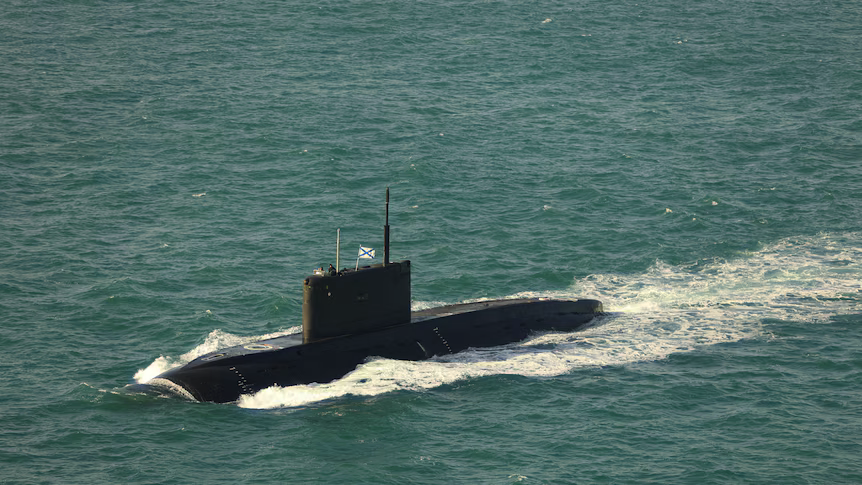

Britain’s defence secretary has accused Russia of carrying out a covert submarine operation close to vital undersea cables and pipelines north of the United Kingdom, warning Moscow that any attempt to damage critical infrastructure would bring serious consequences.
Get today's headlines by email 
John Healey said three Russian submarines had been operating in waters near the UK, prompting the Royal Navy to deploy ships and aircraft to monitor and deter the activity. He said there was no evidence that any British infrastructure had been damaged.
Speaking at a Downing Street press conference on Thursday, Healey said the UK had detected what he described as “malign” activity by Moscow and had tracked the vessels throughout their deployment.
“We see you,” Healey said, addressing Russian President Vladimir Putin. “We see your activity over our cables and our pipelines, and you should know that any attempt to damage them will not be tolerated and will have serious consequences.”
Russia’s embassy in London denied the allegations, according to the state news agency Tass. It said Moscow was not threatening infrastructure that is critical to the UK.
Submarine activity monitored
Healey said the Russian operation involved an Akula-class attack submarine as well as two vessels belonging to Russia’s secretive deep-sea intelligence unit, known as GUGI.
According to the defence secretary, the attack submarine acted as a diversion while the two GUGI submarines conducted surveillance of underwater infrastructure.
He said the Akula submarine later left UK waters and returned to Russia after being tracked, while the two spy vessels remained in the area.
The Royal Navy responded by deploying the frigate HMS St Albans, the tanker RFA Tidespring and anti-submarine Merlin helicopters to follow the submarines’ movements.
Healey said the monitoring operation made clear to Moscow that its actions had been detected.
“Our armed forces left [Russia] in no doubt that they were being monitored,” he said. “Their movements were not covert, as President Putin planned, and their attempted secret operation had been exposed.”
He added that sonar buoys had been dropped to signal to the submarines that they were under continuous observation.
Other countries also helped track the activity, though Healey mentioned only Norway by name.
Concerns over critical infrastructure
Undersea cables and pipelines form a crucial part of the UK’s communications and energy systems.
Around 60 submarine data cables reach the British coastline, particularly in areas such as East Anglia and south-west England. More than 90% of the country’s daily internet traffic passes through these cables.
Globally, more than 600 undersea cables stretch roughly 870,000 miles (1.4 million kilometres) across oceans and seas.
Britain also relies heavily on underwater pipelines for natural gas supplies from the North Sea and Norway. One of the largest is the 724-mile (1,166km) Langeled pipeline linking Norway to the UK.
About 77% of Britain’s imported gas arrives via pipelines from Norway beneath the North Sea.
Russian deep-sea capabilities
The Russian submarines involved are believed to belong to the Main Directorate for Deep Sea Research, known by its Russian acronym GUGI. The organisation is part of the Russian navy but reports directly to the defence minister and the president.
Specialists say GUGI focuses on deep-sea surveillance, reconnaissance and sabotage missions.
The unit operates miniature unmanned submarines capable of reaching extreme depths and performing tasks such as mapping infrastructure or potentially cutting communication cables.
Analysts say these mini-submersibles are often launched from larger support vessels or “motherships”.
Dr Sidharth Kaushal of the Royal United Services Institute said such submarines are designed to be difficult to detect by minimising noise, water displacement and magnetic signatures.
Even when monitored by naval forces, he said, they may still gather valuable intelligence on the layout of undersea cable networks.
Debate over Britain’s naval capacity
Healey said Russia remained the “primary threat” to UK security and suggested Moscow may have been seeking to exploit global attention focused on conflict in the Middle East.
Prime Minister Sir Keir Starmer said Britain would continue exposing what he called Russia’s destabilising actions.
The episode has also prompted criticism from opposition politicians about the state of the UK’s armed forces.
Conservative leader Kemi Badenoch urged the government to publish its defence investment plan, while Reform UK leader Nigel Farage said the situation highlighted concerns about the Royal Navy’s operational strength.
A former UK defence attaché in Moscow, John Foreman, told the BBC the threat from Russia was well known but questioned whether Britain had sufficient resources to respond effectively.
Hybrid warfare concerns
Western officials have increasingly warned about so-called hybrid warfare — covert actions that fall short of open military conflict.
These operations can include surveillance, sabotage or cyber attacks aimed at undermining infrastructure without triggering a direct military response.
British officials believe Russia may be mapping undersea cables and pipelines so that they could be disrupted quickly if a wider conflict were to occur.
Join the discussion? 
Already a member? 
 Adapted by ASEAN Now. Source 10 April 2026
Recommended Comments
Create an account or sign in to comment