



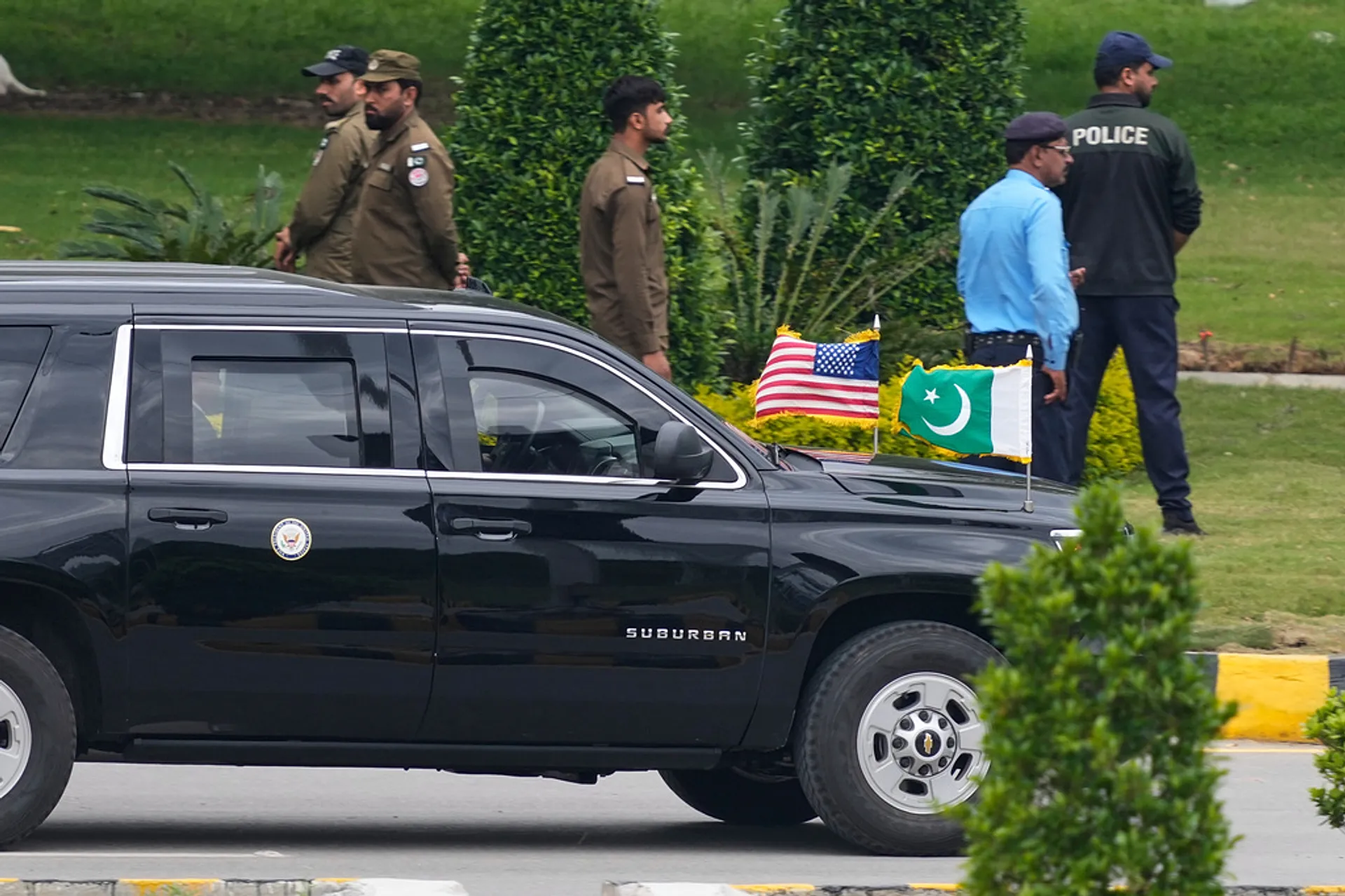

US and Iranian officials have begun high-level negotiations in Pakistan aimed at ending the conflict between the two countries and stabilising shipping through the strategically vital Strait of Hormuz.
Get today's headlines by email 
The talks, held in Islamabad, follow earlier indirect discussions and a two-week truce between Washington and Tehran. Officials say the meetings represent the first formal attempt to turn that temporary pause into a broader agreement that could reopen global shipping routes and prevent further escalation in the region.
Delegations meet in Islamabad
The US delegation is led by Vice President JD Vance, who arrived in the Pakistani capital on Saturday. He is joined by President Donald Trump’s special envoy Steve Witkoff and Trump’s adviser and son-in-law Jared Kushner.
Iran’s delegation is headed by parliament speaker Mohammad Bagher Qalibaf, who had already arrived in Islamabad ahead of the talks.
Both delegations met separately with Pakistani Prime Minister Shehbaz Sharif before negotiations began, though neither Iran’s team nor the Pakistani government released details of those discussions.
Before departing for Pakistan, Vance warned Tehran against attempting to mislead US negotiators, saying Washington would not tolerate what he described as attempts to “play” the United States during the talks.
The three-party meeting was reportedly made possible after several preconditions were met, including a reduction in Israeli strikes in southern Lebanon.
Competing proposals and key disputes
While negotiations are under way, the specific terms under discussion remain unclear.
Reports suggest Iran has drafted a 10-point proposal for a settlement, while the United States has circulated a separate 15-point plan. Neither proposal has been publicly released, though President Donald Trump described the Iranian plan as “a workable basis on which to negotiate”.
Several major issues are expected to dominate the talks, including economic sanctions on Iran, the status of the Strait of Hormuz, Iran’s nuclear enrichment programme, and Israeli military operations in Lebanon.
The United States has demanded that Iran reopen the Strait of Hormuz, one of the world’s most important shipping lanes. Tehran has effectively restricted passage since US and Israeli attacks on Iran on 28 February that triggered the current war.
Iran has proposed allowing ships to pass in exchange for transit fees and wants recognition of its authority over the narrow waterway. Washington has rejected the idea, arguing that the strait must remain open to international navigation.
Trump has floated the possibility of a joint US-Iran mechanism to impose tolls on shipping in the strait, a suggestion that has prompted concern in Europe.
A spokesperson for the European Commission said earlier this week that the Strait of Hormuz must remain open to all vessels, describing freedom of navigation as essential.
Distrust and ongoing violence
Iranian officials have said progress in the talks will depend on two conditions: a ceasefire in Lebanon and the release of Iranian financial assets that have been frozen abroad.
However, reports early on Saturday indicated that Israeli strikes were continuing in southern Lebanon, where at least three people were reported killed.
Iran’s foreign minister, Abbas Araghchi, said Tehran entered the talks with “deep distrust” following two attacks on Iran during earlier negotiations over its nuclear programme.
In a statement on social media, his office also warned that Iran would respond if further attacks were carried out.
Trump, meanwhile, used social media on Saturday to dismiss claims that Iran had gained the upper hand in the conflict. He said Iranian military capabilities had been heavily damaged during the war.
Heavy toll of the conflict
The war has disrupted trade throughout the Persian Gulf and driven up global oil prices as shipping routes have been restricted.
Regional infrastructure has also suffered damage across several Gulf states.
According to available figures, the conflict has killed at least 3,000 people in Iran. Israeli attacks in Lebanon have killed 1,953 people, while 23 deaths have been reported in Israel and more than a dozen in Gulf Arab states following Iranian strikes.
Negotiators in Islamabad now face the challenge of turning the fragile truce into a longer-term agreement capable of ending the fighting and restoring shipping through the Strait of Hormuz.
Join the discussion? 
Already a member? 
 Adapted by ASEAN Now. Source 12 April 2026
Recommended Comments
Create an account or sign in to comment