



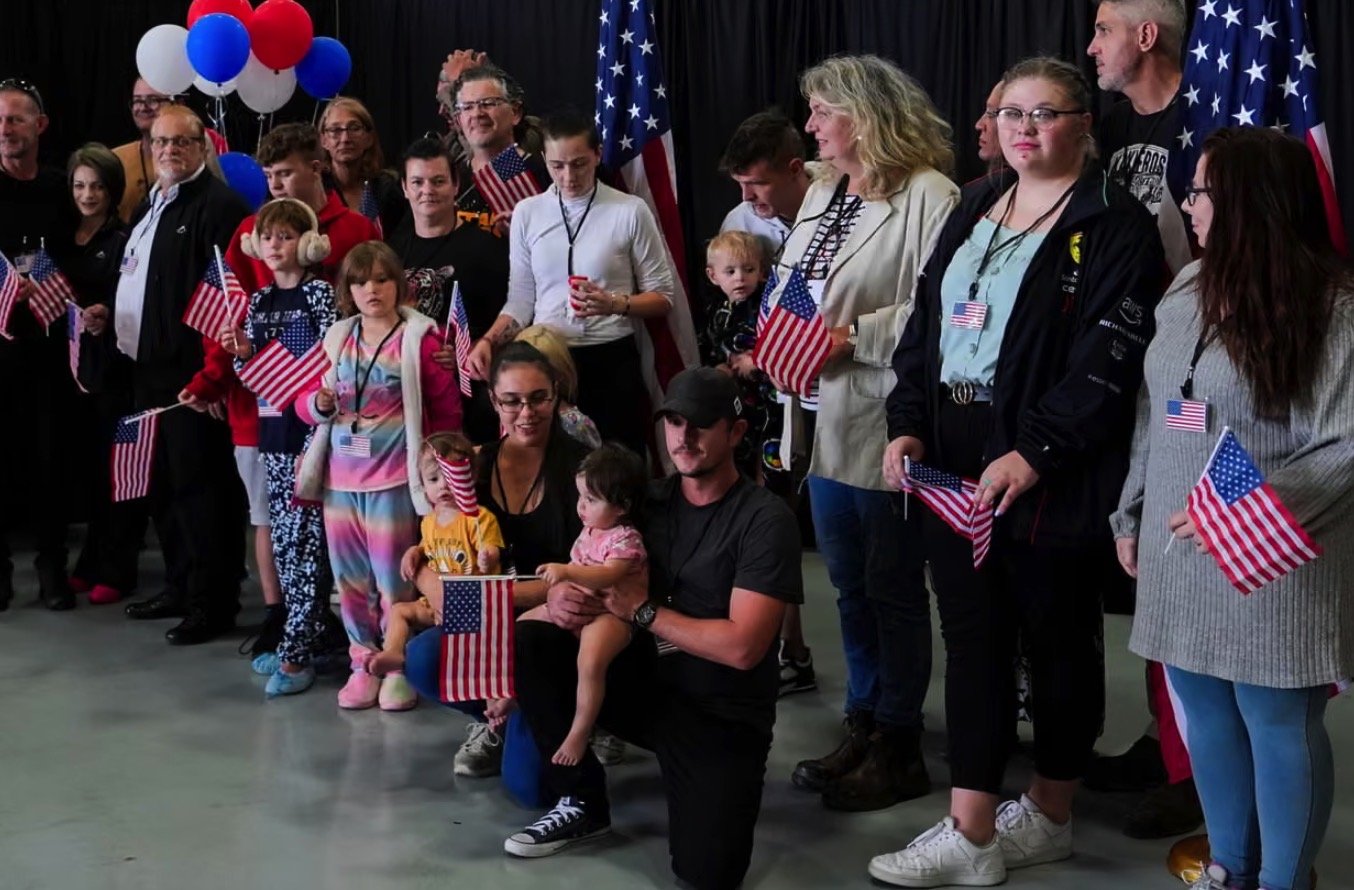

The United States plans to admit 10,000 additional white South Africans as refugees this year, with the Trump administration describing the move as a response to what it called an “emergency refugee situation” in South Africa.
Get today's headlines by email 
The decision raises the planned intake of mostly white Afrikaner refugees from about 7,500 to 17,500 for the fiscal year ending in September.
Since returning to office last year, President Donald Trump has repeatedly claimed that white Afrikaners in South Africa are being racially targeted and face a “white genocide”. South Africa’s government has strongly rejected those accusations.
Claims of discrimination
The administration has also taken several diplomatic steps against South Africa, including cutting aid, boycotting last year’s G20 summit in Johannesburg and excluding the country from this year’s G20 gathering, which is due to take place at one of Trump’s resorts in Miami.
The US began accepting white South Africans as refugees in May 2025, even as it suspended refugee admissions for people fleeing conflicts and persecution in countries such as Afghanistan, Sudan and the Democratic Republic of the Congo.
In the fiscal year ending September 2024, before Trump returned to office, the US admitted more than 100,000 refugees overall.
Emergency notice to Congress
On Monday, the US state department sent Congress an emergency notification outlining the expanded refugee programme.
According to the Associated Press, which reviewed the document, the cost of resettling the additional 10,000 Afrikaners is estimated at around $100m (£75m).
The notice said “unforeseen developments in South Africa created an emergency refugee situation” and accused South African officials and political parties of undermining the US refugee programme.
It also referred to a December raid by South African authorities on a US refugee processing centre. At the time, Washington described the action as “unacceptable”.
South Africa’s government said the operation targeted seven Kenyan nationals who were allegedly working in the country illegally without permits.
The state department argued that growing hostility toward the programme increased risks for Afrikaners, whom it described as facing “government-sponsored race-based discrimination”.
South Africa’s inequality debate
Afrikaners are descendants of mainly Dutch and French settlers who dominated South Africa during apartheid, the system of racial segregation that ended in the early 1990s.
Under apartheid, the white minority held political and economic power while the black majority faced severe restrictions and widespread poverty.
Since the election of Nelson Mandela as South Africa’s first black president, governments have introduced affirmative action and “black economic empowerment” policies aimed at addressing historic inequalities.
Despite those reforms, South Africa remains one of the world’s most unequal societies.
Official figures show unemployment among white South Africans stands at about 12%, compared with roughly 48% among black South Africans.
Some white South Africans argue that affirmative action policies now unfairly disadvantage them, while high crime levels have contributed to feelings of insecurity across communities.
Far-right conspiracy theory
Claims of a “white genocide” in South Africa have long circulated among far-right groups internationally, often focusing on attacks against white farmers.
The theory has repeatedly been dismissed by experts and South African authorities, who say there is no evidence of a coordinated campaign targeting white citizens.
In recent years, the narrative has also been promoted by South Africa-born billionaire Elon Musk and conservative media figure Tucker Carlson.
Join the discussion? 
Already a member? 
 Adapted by ASEAN Now. Source 21 May 2026
Recommended Comments
Create an account or sign in to comment