



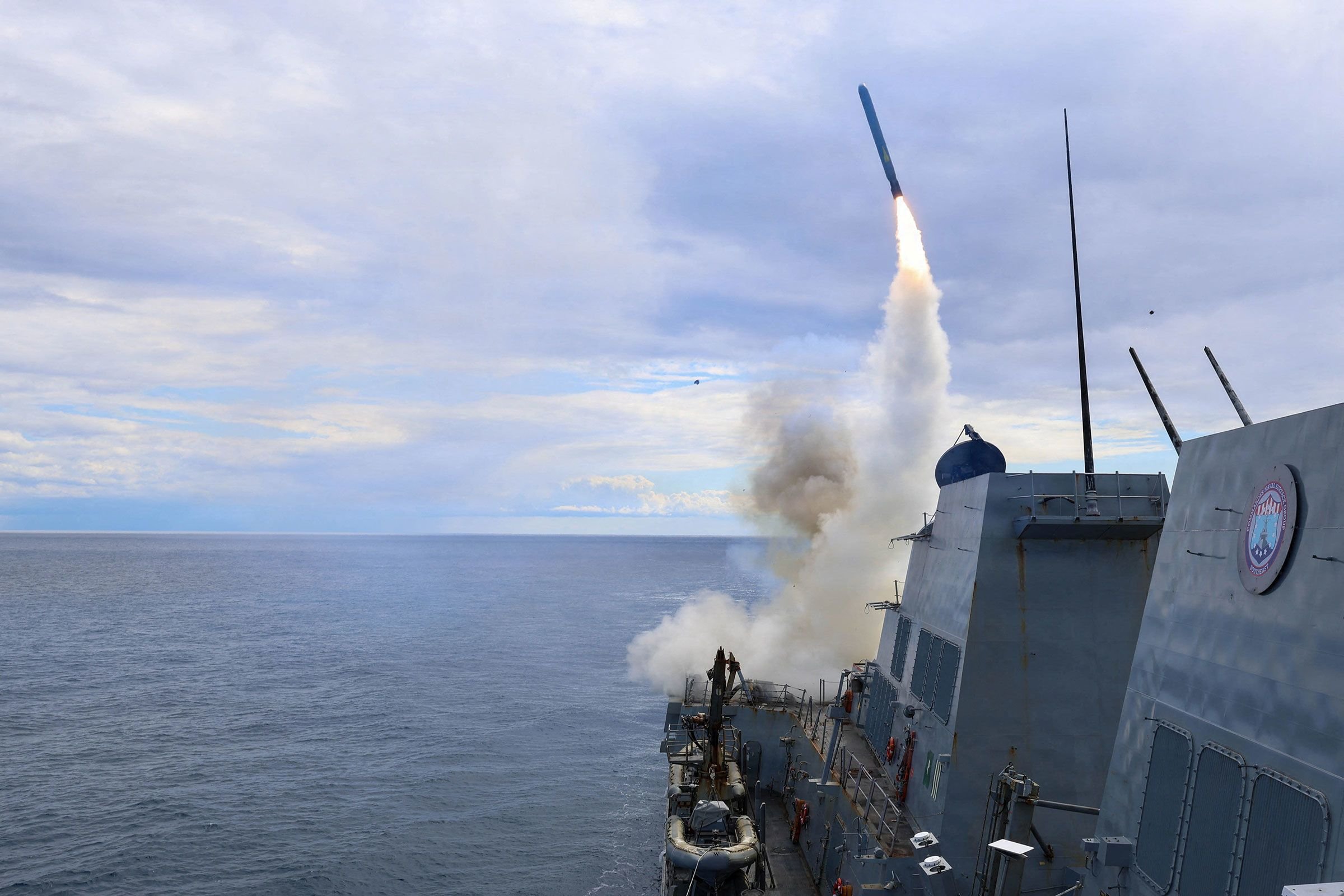

The United States could take years to rebuild key weapons stockpiles depleted during the Iran war, according to a new analysis that warns of a temporary gap in military readiness if another major conflict were to emerge, particularly in the western Pacific.
Get today's headlines by email 
The report, released Wednesday by the Washington-based think tank Center for Strategic and International Studies, said U.S. defense contractors would need at least three years to replenish supplies of Tomahawk cruise missiles, Patriot interceptors and THAAD missile defense systems used heavily during the conflict with Iran.
The study said the drawdown had created “a window of vulnerability” for the United States, especially in relation to a possible future confrontation with China.
Military stockpiles under pressure
Tomahawk missiles, designed for long-range strikes deep inside enemy territory, were among the systems used extensively during the war. The report estimates that the United States fired more than 1,000 Tomahawks at Iran and may not fully restore prewar inventory levels until late 2030.
Production capacity remains limited. Fewer than 200 Tomahawks are currently manufactured each year, although manufacturer RTX, formerly known as Raytheon, aims to raise output to more than 1,000 annually.
The analysis also examined air defense systems. It said replacing up to 290 THAAD interceptors used against Iranian missiles and drones could take until the end of 2029, while replenishing more than 1,000 Patriot interceptors may take until mid-2029.
Manufacturer Lockheed Martin said it was increasing production capacity and investing billions of dollars through 2030, including new facilities in Alabama and other parts of the country.
Concerns over future conflicts
The report comes amid growing concern in Washington over U.S. preparedness for a possible conflict involving China and Taiwan.
Chinese President Xi Jinping has repeatedly warned against what Beijing views as U.S. interference in Taiwan, while China has set a goal for its military to be capable of taking the island by force if necessary by 2027.
CSIS said the United States still possessed enough munitions for any likely Iran-related scenario, but rebuilding inventories had become a pressing issue because of the time needed to expand production and strengthen supply chains.
“The problem today isn’t money; it’s time,” the report said, despite the Trump administration proposing a record $1.5 trillion defense budget for 2027.
President Donald Trump and Defense Secretary Pete Hegseth have argued that the U.S. military remains fully capable of handling multiple threats. Pentagon spokesman Sean Parnell said the armed forces maintained “a deep arsenal of capabilities” and could carry out operations wherever required.
Debate over stockpile strategy
Some analysts and lawmakers have questioned whether current inventories are sufficient after years of supplying weapons to Ukraine following Russia’s 2022 invasion.
Virginia Burger, a former Marine officer now with the watchdog group Project On Government Oversight, said Pentagon officials were likely aware that stockpiles could fall to critical levels during a prolonged conflict.
CSIS co-author Mark Cancian said the issue stemmed partly from post-Cold War assumptions that future wars would be short and regional, reducing the need for large reserves of advanced weapons.
That thinking changed after Russia’s war in Ukraine demonstrated how quickly modern conflicts can consume munitions supplies.
Cancian said both the Biden and Trump administrations had increased efforts to expand production, but rebuilding inventories would still require years because of the complexity of defense manufacturing and supply chains.
The report added that China’s lack of recent combat experience could still act as a deterrent while U.S. stockpiles recover.
Join the discussion? 
Already a member? 
 Adapted by ASEAN Now. Source 28 May 2026
-
 1
1
Recommended Comments
Create an account or sign in to comment