



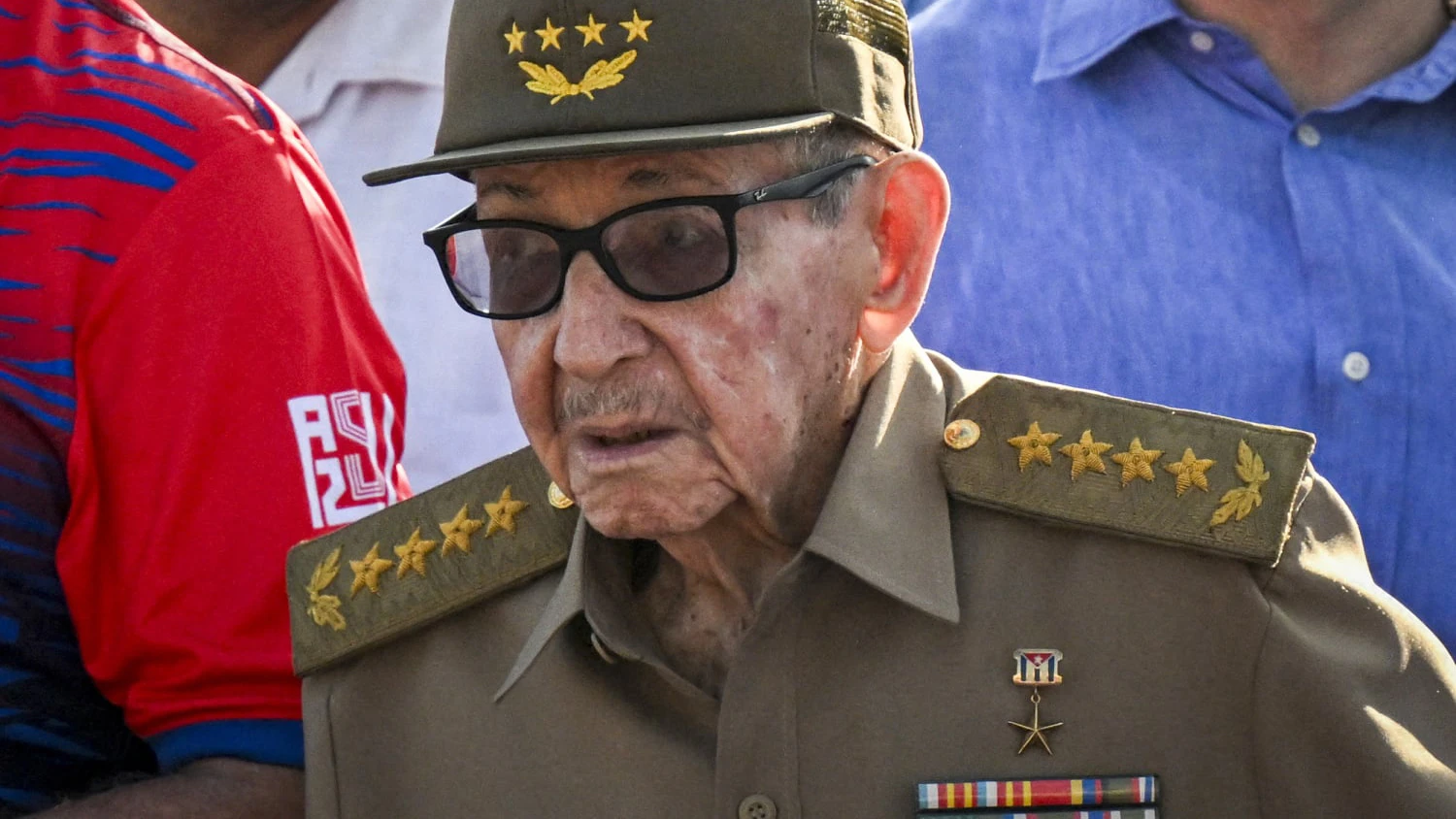

The administration of US President Donald Trump has indicted former Cuban President Raul Castro over the 1996 shooting down of two aircraft operated by the Miami-based exile organisation Brothers to the Rescue, escalating tensions between Washington and Havana.
Get today's headlines by email 
Federal prosecutors unsealed the indictment on Wednesday, accusing Castro, who was Cuba’s defence minister at the time, of helping direct the attack in which Cuban fighter jets destroyed two civilian planes on February 24, 1996.
US authorities charged Castro with conspiracy to kill US nationals, four counts of murder and two counts of destroying an aircraft. Five additional defendants were also named in the case.
Four men were killed in the attack: Carlos Costa, Armando Alejandre Jr, Mario de la Pena and Pablo Morales.
US frames charges as long-awaited justice
Announcing the indictment at Miami’s Freedom Tower, acting Attorney General Todd Blanche said the families of the victims had waited nearly three decades for accountability.
Blanche described the victims as “unarmed civilians” carrying out humanitarian missions aimed at helping Cuban migrants crossing the Florida Straits.
“Nations and their leaders cannot be permitted to target Americans, kill them, and not face accountability,” he said.
Kash Patel called the indictment “a major step toward accountability”.
Brothers to the Rescue was founded in 1991 by Cuban exile Jose Basulto during a period of increased migration from Cuba to the United States. The group used aircraft to search for Cuban rafters at sea and alert the US Coast Guard.
The United States and international investigators concluded the planes were shot down over international waters. Cuba has long maintained the aircraft violated or approached its airspace.
Former Cuban leader Fidel Castro previously denied that he or Raul Castro directly ordered the attack.
Havana rejects accusations
Cuba’s current president, Miguel Diaz-Canel, dismissed the indictment as politically motivated and accused the Trump administration of distorting the events of 1996.
Writing on social media, Diaz-Canel said the case was intended to justify possible military action against Cuba.
Foreign Minister Bruno Rodriguez Parrilla also criticised the White House after it issued a statement marking Cuba’s independence day and condemning the island’s communist leadership.
Deputy Foreign Minister Carlos de Cossio accused the administration of catering to anti-Castro Cuban exiles in South Florida, a key Republican support base.
Analysts see broader pressure campaign
Political analysts said the indictment appeared to fit within a wider US campaign to increase pressure on Havana.
Orlando Perez, a political science professor at the University of North Texas at Dallas, said Washington seemed to be pursuing both private negotiations and public confrontation with Cuba’s leadership.
Perez pointed to recent reports involving alleged Cuban interest in drone and asymmetric warfare capabilities, including possible threats targeting the US naval base at Guantanamo Bay and nearby areas in Florida.
He warned that the indictment could strengthen hardline elements within Cuba’s ruling establishment rather than weaken them.
William Leogrande, a specialist in Latin American politics at American University School of Public Affairs, said the move would likely be popular among Cuban Americans in South Florida but could further damage prospects for diplomacy between the two countries.
“It appears that the Trump administration is trying to lay the political groundwork for military action against Cuba,” he said.
Debate grows over possible military action
The Trump administration has repeatedly threatened military action against Cuba in recent months, though critics argue such a move would face broad opposition in the United States.
Lee Schlenker of the Quincy Institute for Responsible Statecraft said Cuba posed little direct threat to US national security and warned harsher sanctions or military action could trigger a humanitarian crisis and increased migration.
Some Democrats in Congress have already sought to restrict potential military action. Senators Ruben Gallego, Tim Kaine and Adam Schiff introduced a Senate war powers resolution earlier this year requiring congressional approval before any aggressive action against Cuba.
The lawmakers renewed those efforts following Wednesday’s announcement.
Join the discussion? 
Already a member? 
 Adapted by ASEAN Now. Source 21 May 2026
Recommended Comments
Create an account or sign in to comment