



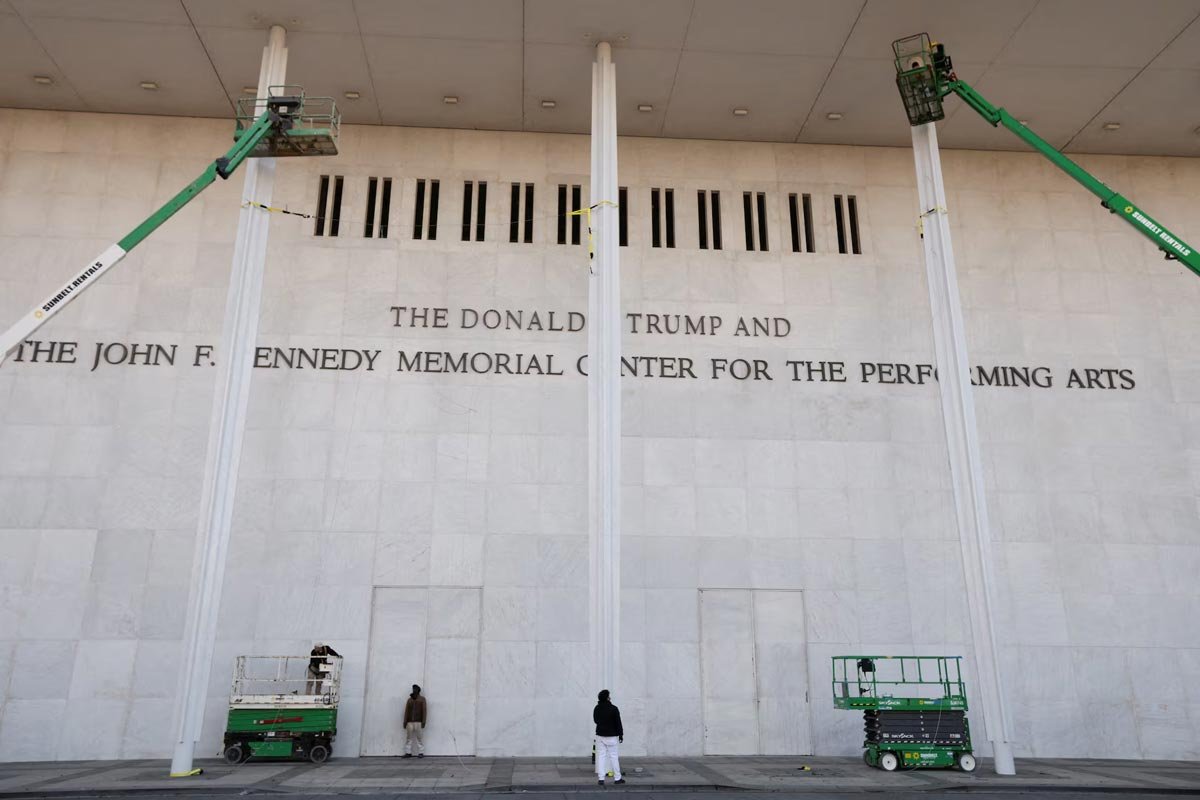

A federal judge has ordered the removal of Donald Trump’s name from the John F. Kennedy Center for the Performing Arts, ruling that the Washington DC institution cannot be formally renamed without approval from Congress.
Get today's headlines by email 
US District Judge Christopher Cooper directed the Trump administration to remove all signage bearing Trump’s name and delete references to a “Trump Kennedy Center” from official materials within 14 days.
Court Says Congress Controls the Name
In his ruling, Cooper said federal law clearly establishes the venue as a memorial to former President John F. Kennedy and leaves no authority for the center’s board to change its name on its own.
“The Kennedy Center’s organic statute makes crystal clear that the Center is to be named for President Kennedy,” Cooper wrote. He added that Congress originally gave the institution its name and only Congress has the power to alter it.
The judge concluded that the board had exceeded its legal authority by approving the renaming.
The decision came in a lawsuit filed by Joyce Beatty, a Democratic congresswoman from Ohio who serves on the Kennedy Center’s board through her position in Congress.
The White House did not immediately comment on the ruling.
Renaming Followed Trump Takeover
The dispute stemmed from changes made after Trump returned to office. In February last year, he appointed himself chairman of the Kennedy Center’s board of trustees, describing the move as a “take-over”.
He subsequently removed existing board members and installed new appointees. In December, the restructured board voted to add Trump’s name to the institution, a move seen as part of a broader effort by the administration to reshape cultural organisations in the US capital.
At the time, Joe Kennedy III, a former Massachusetts congressman and great-nephew of President Kennedy, questioned whether such a change was legally possible.
He argued that the venue was established by federal law as a memorial to Kennedy and could not simply be renamed by board action.
Backlash From Arts Community
The renaming effort prompted significant opposition within the arts sector.
Several performers and organisations cancelled appearances at the venue in protest, including a scheduled run of the award-winning musical Hamilton.
Leadership changes also followed. National Symphony Orchestra executive director Jean Davidson left to lead the Wallis Annenberg Center for the Performing Arts in Los Angeles. Richard Grenell, a Trump ally who played a prominent role in efforts to reshape the institution and challenge what he described as “woke” culture, later stepped down as president of the center.
The Kennedy Center remains one of the United States’ most prominent cultural institutions and receives federal funding. It has traditionally enjoyed support from both major political parties.
Wider Plans Face Challenges
Under Trump, the venue increasingly became a platform for administration initiatives. It hosted events including an appearance by FIFA president Gianni Infantino ahead of the World Cup draw and other White House-linked functions.
The center is also preparing for a two-year closure after trustees approved a major renovation programme. Officials said the project would begin following Independence Day celebrations in July, with a reopening planned once work is completed.
The Kennedy Center case is one of several legal disputes involving Trump’s plans for Washington. Other proposals, including a large ballroom at the White House site and a “Victory Arch” near national monuments, have also faced court challenges. Congressional Republicans have additionally proposed renaming the Kennedy Center’s Opera House after First Lady Melania Trump.
Join the discussion? 
Already a member? 
 Adapted by ASEAN Now. Source 30 May 2026
Recommended Comments
Create an account or sign in to comment