



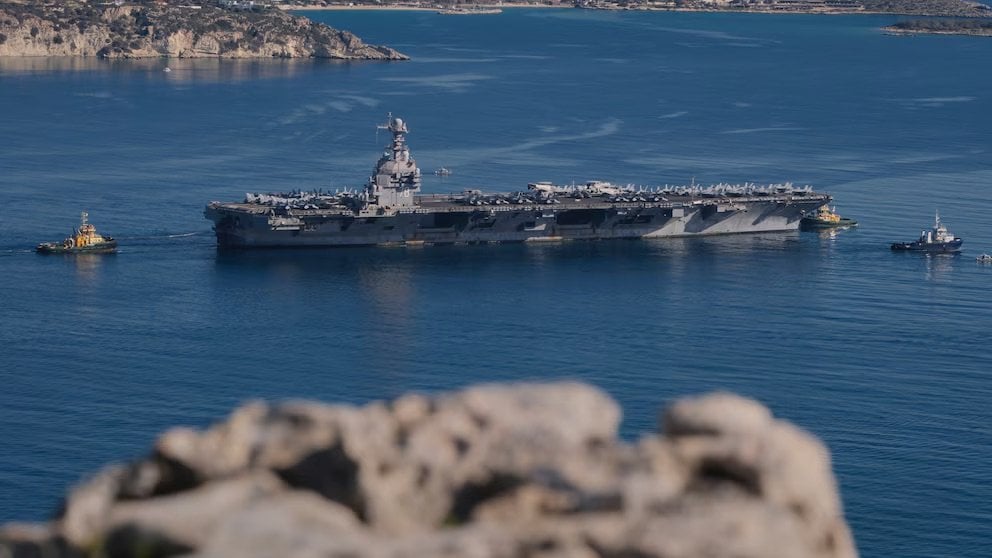

The United States has withdrawn its final aircraft carrier presence in the western Pacific, as President Donald Trump’s focus on operations related to Iran stretches the Navy’s carrier fleet and leaves allies in Asia watching more closely for signals from China.
The USS George Washington is departing the Pacific and is expected to replace the USS Abraham Lincoln in the Middle East. The shift comes as concerns grow about mental health and supply conditions aboard the long-deployed Lincoln. The Lincoln’s time at sea has also been extended beyond its original return date in May to support operations tied to Iran.
A gap in the Pacific may be short if the Navy deploys another carrier within the next couple of months. Even so, analysts say the change highlights how open-ended deployments connected to Iran are wearing down crews and reducing flexibility, while the Trump administration appears to be pulling attention away from the Asia-Pacific.
Pacific Priorities Questioned
Greg Poling of the Center for Strategic and International Studies said the administration’s messaging about the Pacific being the priority is not matching its actions. He argued that Washington is effectively doing the opposite of what it had previously said about reducing its exposure in the Middle East, while relying on extended carrier deployments for the Iran campaign.
Poling said American partners in the region are unsettled by what they see as the administration’s unpredictability. He added that China benefits from what he described as US distraction and the resulting frustration among allies and partners.
China views the US military presence in the region as a threat to its rise and as a barrier to its goal of taking Taiwan, which it claims as part of China. The United States has argued that the Pacific is too important economically to be left without a strong deterrent posture.
Although analysts do not expect Beijing to invade Taiwan in the near term solely because a carrier has left, the absence may still give China room to demonstrate capability, Bryan Clark, a former Navy submariner and defence analyst at the Hudson Institute, said. He argued the move can be used to signal to countries such as the Philippines, Japan and Indonesia that the US is not the dominant security provider in the western Pacific.
China Activity Spurs Regional Reassurance
Beijing’s recent moves include naval exercises with Indonesia this week and military activity that has drawn attention from Japan and the Philippines. This month, China conducted drills near Scarborough Shoal in the South China Sea, an area where both China and the Philippines claim sovereignty. In the previous month, a Chinese guided-missile destroyer carried out live-fire training off Okinotori, Japan’s southernmost island.
To reassure partners, Adm. Frank Bradley, head of US Special Operations Command, visited Manila on Thursday. He told Filipino counterparts that US special operations forces are prepared to increase joint exercises to strengthen the alliance, and he is expected to travel to Japan.
Evan Sankey of the Cato Institute said aircraft carriers provide a form of assurance beyond their operational role. He said their absence contributes to a broader perception that the US is distracted by events in the Middle East.
Carrier Strain and Maintenance Pressure
Trump has relied heavily on aircraft carriers during his second term. In mid-May, the USS Gerald R. Ford returned home after an 11-month deployment, the longest since the Vietnam War. The carrier supported operations including strikes connected to Iran and the capture of Venezuela’s then-president, Nicolás Maduro.
The Ford’s return followed a fire in a laundry space that forced it to turn back to the Mediterranean for repairs, leaving hundreds of sailors without sleeping arrangements. Meanwhile, the Lincoln has spent a record uninterrupted time at sea of more than 240 days, prompting calls from Democratic lawmakers for investigations and greater visibility into conditions onboard.
Robert Farley of the University of Kentucky said the sustained tempo of carrier operations pushes crews beyond normal limits, with rest and rotation crucial to maintaining readiness and health. He said the strain reflects the practical constraints of running ships and crews at peak performance over long periods.
Clark said the squeeze on carrier availability stems from inadequate preparation and planning for how long the Iran conflict would last. He noted the Navy has 11 carriers and usually deploys two or three at a time, but could temporarily send four, depending on movements such as the USS Theodore Roosevelt leaving San Diego for the Middle East. That would allow the Washington to return to the Pacific.
He also warned that the larger warships will require maintenance, potentially creating a bottleneck at the Navy’s two carrier shipyards. That could lead to a backlog of work and a reduced carrier presence in coming years, with a “maintenance debt” that would need to be addressed later.
Michael Swaine of the Quincy Institute questioned whether carriers will remain central as warfare changes. He said carriers can be targeted more easily by drones and missiles, while smaller vessels and submarines may be able to strike effectively without relying on carrier-based fighter jets.
Top Navy officials have also indicated a desire to reduce dependence on carriers. In February, Adm. Daryl Caudle, the chief of naval operations, said he wants commanders to use smaller newer ships and other capabilities more often rather than defaulting to large aircraft carriers.
Join the discussion? 

16 August 2026
Recommended Comments
Create an account or sign in to comment