



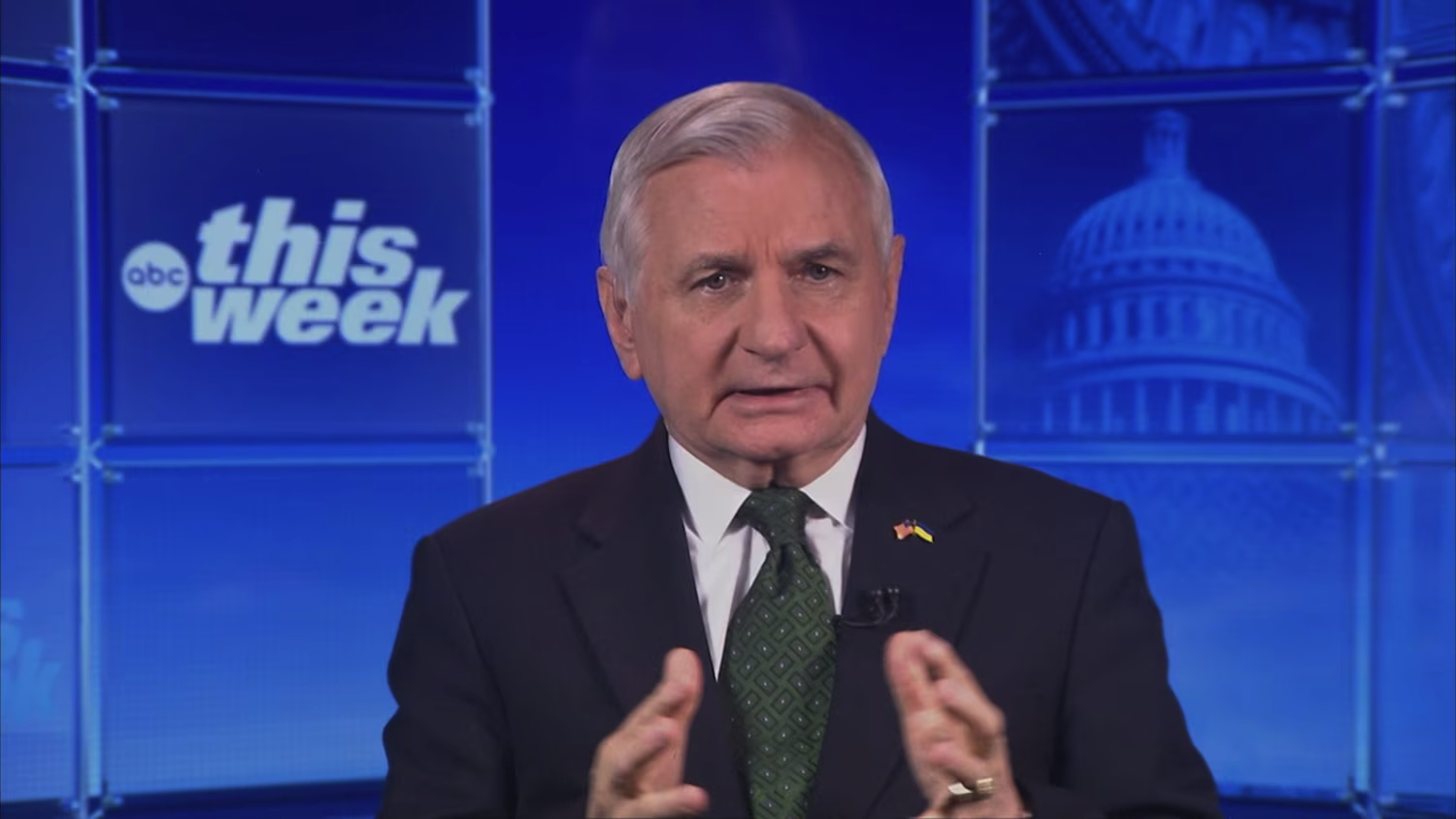

Senior Democrat says the president lacks a clear strategy and may be sidestepping war powers law. Jack Reed, the top Democrat on the Senate Armed Services Committee, criticised Donald Trump over the handling of the conflict with Iran, saying he does not believe the president has a coherent plan to achieve his stated objectives.
Get today's headlines by email 
Speaking on ABC’s “This Week”, Reed said the United States appeared to be in a weaker position since the war began. “We’re in, in many respects, a much worse position,” Reed told co-anchor Martha Raddatz. He argued that the government in Tehran had become more hostile and that key issues, including Iran’s nuclear material, remained unresolved.
Concerns over direction of the conflict
Reed said the military campaign had shown U.S. capability but had not achieved the strategic goals outlined by the president. He added that he had seen little evidence of a clear plan to reach those goals.
War enters its tenth week
The conflict between the United States and Iran has now lasted about 10 weeks. Although a ceasefire is currently in place, negotiations aimed at ending the fighting broke down on April 12, leaving the two sides at an impasse.
One of the most significant economic consequences has been the continued closure of the Strait of Hormuz, a critical shipping route for global oil supplies. The disruption has pushed energy prices higher worldwide.
The Trump administration has repeatedly said its central objective in the war is to prevent Iran from developing nuclear weapons. Iranian authorities have consistently denied seeking such weapons.
Warnings about possible further strikes
Reed was also asked about comments by fellow Democratic senator Richard Blumenthal, who suggested additional U.S. military strikes on Iran could be under consideration.
Blumenthal said briefings and other information he had received suggested a potential attack could be imminent, raising concerns about the possibility of American casualties.
Reed said U.S. forces were positioned in ways that would allow further strikes if ordered, but he stressed that he did not know what decision the president might take next.
“I don’t believe the president has a plan,” Reed said, describing the administration’s approach as reactive and driven by short-term decisions rather than long-term planning.
Dispute over war powers law
Reed has also clashed with Defense Secretary Pete Hegseth over the administration’s description of the conflict’s progress.
During a recent Senate Armed Services Committee hearing, Reed accused Hegseth of overstating the war’s military achievements. He said Iran’s leadership remained in power, the country still held stockpiles of enriched uranium, and its nuclear programme continued to operate.
The disagreement also extends to the legal authority for continuing military action. Under the War Powers Resolution, presidents must seek congressional approval if military operations continue beyond 60 days.
That deadline passed on Friday. Hegseth told lawmakers the countdown had effectively stopped after Trump declared a ceasefire.
In a letter sent to Congress the same day, Trump said hostilities that began on February 28 had ended.
Reed rejected that interpretation, arguing the statute does not allow the administration to pause the timeline without formally notifying Congress or requesting an extension.
“The language of the statute does not provide for timeouts,” he said, adding that the president had not submitted the required notification to lawmakers.
Political pressure grows
The dispute highlights growing political tension in Washington over the handling of the Iran conflict. Critics say the administration has not provided a clear strategy or legal justification for continuing military operations.
With peace talks stalled and the ceasefire fragile, questions remain over whether the conflict could escalate again and how the administration intends to bring it to a lasting conclusion.
Join the discussion? 
Already a member? 
 Adapted by ASEAN Now. Source 4 May 2026
Recommended Comments
Create an account or sign in to comment