



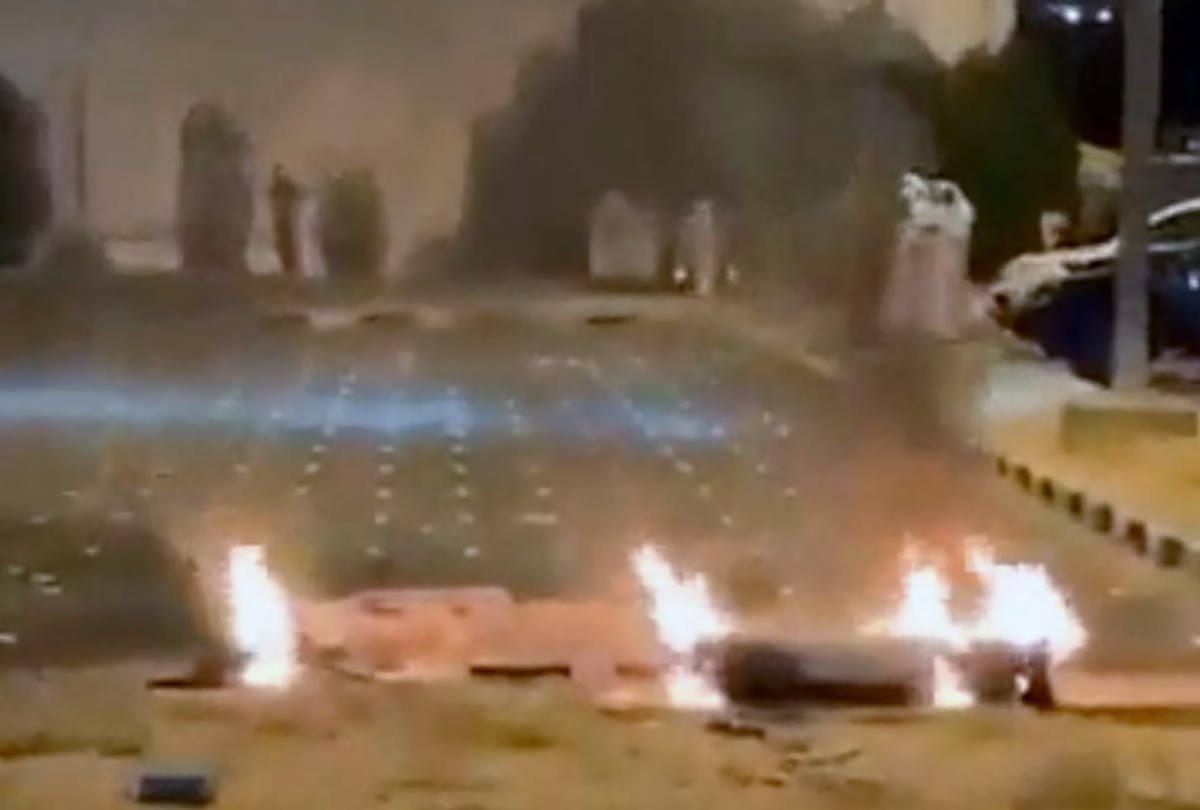

The United States and Iran exchanged new attacks overnight, as Kuwait said Iranian drones struck buildings, including its international airport, killing one person and injuring more than 60 others.
Get today's headlines by email 
The US military said it carried out what it described as self-defence strikes on Iran's Qeshm Island in the Strait of Hormuz and intercepted missiles and drones launched by Tehran towards Gulf countries and shipping in the region.
According to US Central Command (Centcom), the operation targeted an Iranian military ground control station after what it called attempted Iranian attacks across the Middle East. Centcom said Iran fired two missiles towards Kuwait and three towards Bahrain, but all either broke apart or were intercepted before reaching their targets.
Iran confirmed it had launched missiles and drones against US military assets in what it described as a regional country, saying the attacks were retaliation for recent American actions.
Kuwaiti officials said drones hit several sites, including Kuwait International Airport. The country's defence ministry spokesman, Brig Gen Saud Abdulaziz Al-Otaibi, condemned the incident as “criminal Iranian aggression”. Kuwait's foreign ministry later reported damage to infrastructure and diplomatic missions.
Strait of Hormuz Tensions
Centcom also said US forces shot down three Iranian attack drones that were heading towards civilian vessels navigating regional waters.
Earlier, the command announced that it had disabled an oil tanker travelling towards Iran as part of the US naval blockade of the Strait of Hormuz, which began on 13 April.
The military said a US aircraft fired a Hellfire missile into the engine room of the Botswana-flagged vessel after its crew ignored repeated warnings. The tanker was reportedly not carrying cargo at the time.
Iran's Islamic Revolutionary Guard Corps warned that any effort to disrupt security in the strategic waterway would come at a significant cost for US forces.
A separate statement from Iran's foreign ministry accused the leaders of Kuwait and Bahrain of bearing “direct and unmistakable responsibility” for what it called acts of aggression and also criticised the United States for its military strikes.
Ceasefire Talks Remain Stalled
The latest violence comes as efforts to negotiate a ceasefire between Washington and Tehran remain deadlocked.
US President Donald Trump has continued to express optimism about a potential agreement, saying this week that Iran wants a deal and that it would be beneficial for the United States.
Reports in US media suggested Trump recently sought changes to a proposed peace framework following discussions with senior advisers. The reported revisions involved the future of the Strait of Hormuz, the removal of highly enriched uranium from Iran, and a framework for renewed talks on Tehran's nuclear programme.
However, Iran's foreign ministry spokesman Esmail Baghaei rejected those reports, accusing Washington of repeatedly altering its positions and introducing contradictory demands.
Trump Signals Possible Meeting
In an interview broadcast on Wednesday, Trump said Iran had already agreed not to pursue a nuclear weapon and suggested discussions with Iranian leadership were progressing.
The president said Supreme Leader Ayatollah Mojtaba Khamenei was involved in the talks and indicated that a meeting could take place in the future.
Meanwhile, Secretary of State Marco Rubio told lawmakers that sanctions relief had not been offered in exchange for reopening the Strait of Hormuz. He said any easing of sanctions would depend on actions linked to Iran's nuclear programme.
Rubio also defended the administration's approach during a tense congressional hearing, insisting that the conflict had ended despite continuing military exchanges between the two sides.
Join the discussion? 
Already a member? 
 Adapted by ASEAN Now. Source 3 June 2026
Recommended Comments
Create an account or sign in to comment