



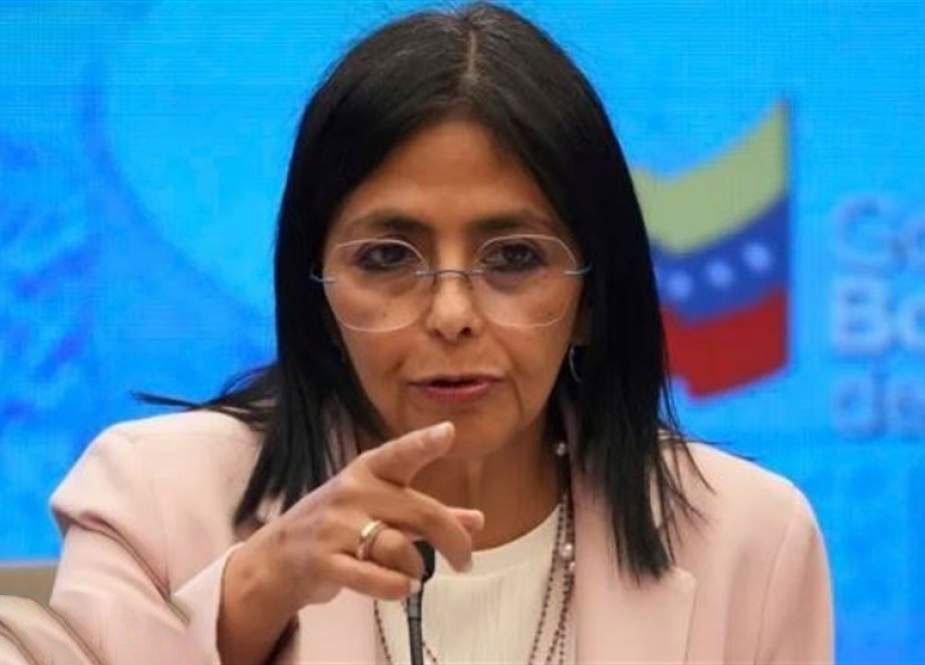

Venezuela’s acting president has rejected remarks by Donald Trump suggesting the country could become the 51st US state, while reaffirming Venezuela’s sovereignty during international court hearings over a long-running territorial dispute with Guyana.
Get today's headlines by email 
Speaking to journalists on Monday, acting President Delcy Rodríguez dismissed the idea after Trump said he was “seriously considering” the possibility. The comment was reported by Fox News following an interview earlier in the day.
Rodríguez said Venezuela would continue to defend its independence and national integrity.
“We will continue to defend our integrity, our sovereignty, our independence, our history,” she said, adding that Venezuela was “not a colony, but a free country.”
Response to Trump’s Comment
The White House did not immediately respond to requests for clarification about Trump’s remarks, and the context in which they were made remains unclear.
Trump has previously made similar statements about Canada becoming part of the United States.
Later on Monday, White House spokesperson Anna Kelly declined to comment directly on the president’s suggestion during a Fox News interview. She said Trump was “famous for never accepting the status quo” and praised Rodríguez for working cooperatively with Washington.
Rodríguez said officials from Venezuela and the United States had been communicating and were seeking “cooperation and understanding.”
Dispute Over Essequibo
Rodríguez made the comments while attending hearings at the International Court of Justice in The Hague, where Venezuela and Guyana are contesting ownership of the resource-rich Essequibo region.
The territory covers about 62,000 square miles and makes up roughly two-thirds of Guyana. It contains large deposits of gold, diamonds and timber and lies close to major offshore oil fields that are currently producing about 900,000 barrels of crude oil per day.
That output is approaching Venezuela’s daily production of around one million barrels and has helped transform Guyana into a major energy producer despite being one of South America’s smallest countries.
Addressing the court, Rodríguez argued that the dispute should be resolved through political negotiations rather than a judicial ruling.
She said a 1966 agreement signed in Geneva created mechanisms for Venezuela and Guyana to settle the matter through dialogue, accusing Guyana of undermining that framework by seeking a legal decision.
According to Rodríguez, Guyana shifted the dispute to the court after a major offshore oil discovery in 2015.
Historical Background
Venezuela claims Essequibo dates back to the Spanish colonial era, when the area was considered part of its territory.
However, an 1899 arbitration decision by representatives from Britain, Russia, and the United States drew the border along the Essequibo River largely in Guyana’s favor.
Guyana asked the International Court of Justice in 2018 to confirm the validity of that ruling, shortly after a major oil discovery was announced off its coast by ExxonMobil.
Tensions intensified in 2023 when Venezuela’s former president Nicolás Maduro threatened to annex the region following a referendum on turning Essequibo into a Venezuelan state.
Court Decision Expected Later
Maduro was later detained during a US military operation in Caracas in January and transferred to New York, where he faces drug trafficking charges. He has pleaded not guilty.
Guyana’s foreign minister Hugh Hilton Todd told judges the dispute had cast a shadow over the country’s sovereignty since its earliest days, noting that about 70% of Guyana’s territory is involved.
The International Court of Justice is expected to take several months to issue a final ruling in the case.
Venezuela has warned that participating in the hearings does not mean it accepts the court’s authority to decide the dispute.
Join the discussion? 
Already a member? 
 Adapted by ASEAN Now. Source 13 May 2026
Recommended Comments
Create an account or sign in to comment