



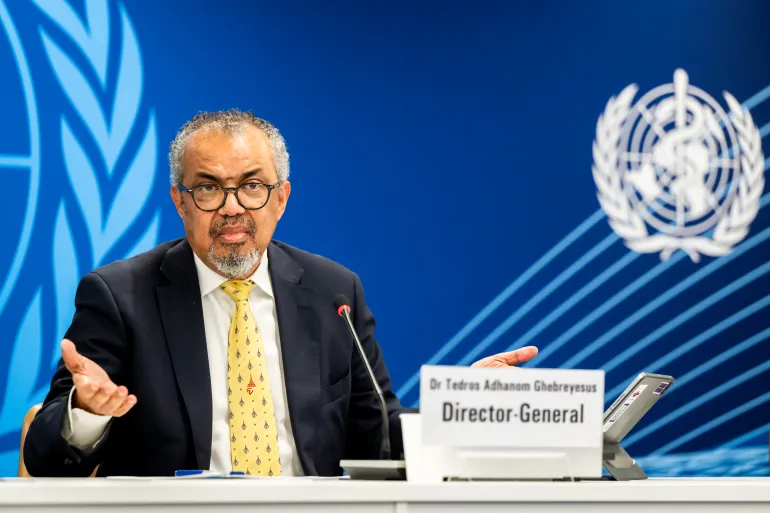

The head of the World Health Organization has warned of mounting concern over a rapidly growing Ebola outbreak affecting parts of the Democratic Republic of Congo (DRC) and neighbouring Uganda, as health officials struggle to respond in regions affected by conflict and displacement.
Get today's headlines by email 
World Health Organization (WHO) director-general Dr Tedros Adhanom Ghebreyesus said he was “deeply concerned about the scale and speed” of the outbreak, which is centred largely in the DRC’s northeastern Ituri province.
Authorities have confirmed 30 cases in Ituri so far, according to the WHO. The country’s health minister, Dr Samuel Roger Kamba, said that as of Tuesday the outbreak had been linked to 131 deaths, while more than 500 cases remain suspected.
The outbreak has been attributed to the Bundibugyo strain of Ebola, one of several viruses within the Orthoebolavirus group known to cause Ebola disease.
Two laboratory-confirmed infections have also been reported in Uganda’s capital, Kampala, according to the WHO.
Disease spread and medical challenges
Ebola typically has an average fatality rate of about 50%, the WHO says. The virus spreads through direct contact with the bodily fluids of infected people, or through contact with contaminated materials or individuals who have died from the disease.
Unlike the more common Zaire strain of Ebola, there are currently no approved vaccines or treatments specifically targeting the Bundibugyo virus.
Researchers are working to develop a potential monoclonal antibody therapy. Dr Satish Pillai of the US Centers for Disease Control and Prevention (CDC) said scientists are exploring the treatment option but did not provide a timeline for when it might become available.
Initial efforts to detect the outbreak were slowed because tests in Bunia, the provincial capital of Ituri, initially produced negative results for the Zaire strain. Bunia was also where the first suspected patient, a health worker whose symptoms began on 24 April, later died.
Genetic analysis has shown that the virus closely resembles strains responsible for previous outbreaks in 2007 and 2012. According to the CDC, existing diagnostic tools are capable of identifying this strain.
Conflict and displacement hinder response
Aid organisations say years of armed conflict, widespread displacement and limited healthcare infrastructure are complicating efforts to contain the disease.
Tedros told an emergency committee that insecurity in Ituri had intensified since late 2025, with fighting escalating over the past two months and causing civilian deaths.
More than 100,000 people have recently been displaced, he said, warning that large-scale population movements could increase the risk of further spread.
Humanitarian groups say children are particularly vulnerable in the affected areas. Philippe Guiton, national director for the charity World Vision in the DRC, said communities already struggling with conflict face shortages of humanitarian assistance.
World Vision’s east zone director, David Munkley, added that severe malnutrition in the region is weakening immune systems, while remote communities have extremely limited access to healthcare.
Travel restrictions and international response
As the outbreak has expanded, several governments have introduced precautionary measures.
The United States has invoked a public health law restricting entry from the affected region. The move followed confirmation that a US citizen in the DRC had tested positive for the virus and would be transferred to Berlin’s Charité University Hospital for treatment.
Ugandan authorities said the two confirmed cases in Kampala involved Congolese nationals who had recently crossed the border from the DRC. Officials stressed there has been no evidence of local transmission within Uganda.
The Africa Centres for Disease Control and Prevention criticised broad travel restrictions, warning they can disrupt lives and economies.
The US State Department later advised Americans not to travel to the DRC, South Sudan and Uganda, and urged reconsideration of travel to Rwanda because of the outbreak.
Early warning signs and concerns over detection
Health officials believe the virus may have circulated for weeks before being confirmed.
The WHO said it first received an alert on 5 May about an unknown illness causing unusually high mortality in Ituri province. A rapid response investigation later confirmed the presence of the Bundibugyo virus on 15 May.
Jeremy Konyndyk, a former senior official at the US Agency for International Development, said multiple “generations of transmission” likely went undetected before the outbreak was identified.
The WHO declared the epidemic a public health emergency of international concern on Sunday, citing rising case numbers and high positivity rates that suggest the outbreak may be larger than current figures indicate.
Officials also confirmed the virus has spread beyond Ituri into neighbouring North Kivu province, although the full scale of infections remains uncertain.
Join the discussion? 
Already a member? 
 Adapted by ASEAN Now. Source 20 May 2026
-
 1
1
Recommended Comments
Create an account or sign in to comment