



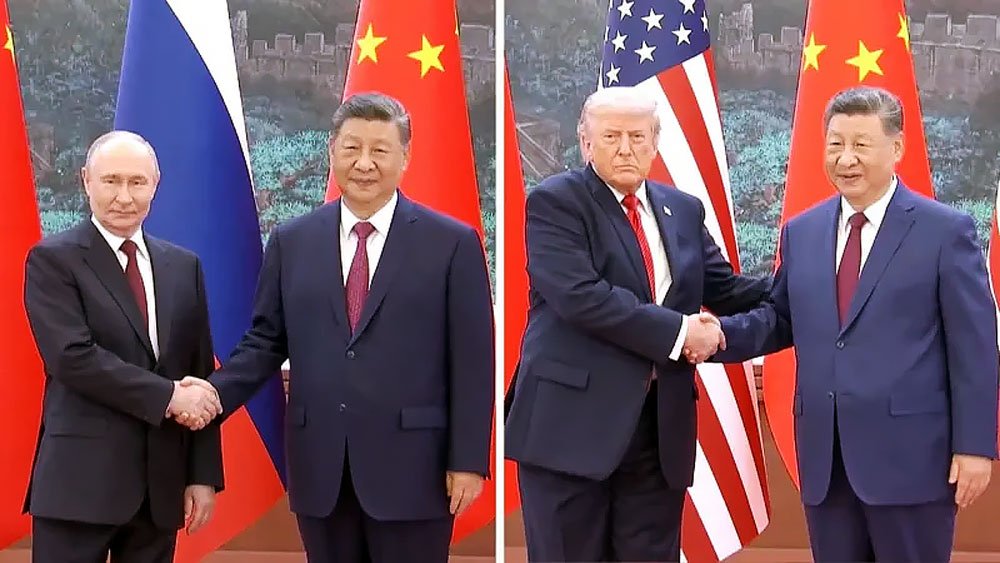

China’s leader Xi Jinping has hosted Russian President Vladimir Putin in Beijing just days after receiving US President Donald Trump, staging two high-profile meetings that underline China’s ambition to position itself at the centre of global diplomacy.
Get today's headlines by email 
Putin’s arrival outside the Great Hall of the People followed a carefully choreographed welcome: cheering schoolchildren, a military honour guard, cannon fire and a marching band. The ceremony closely resembled the reception given to Trump during his own visit the previous week.
Two major presidential visits in such quick succession highlight the image Beijing appears keen to project — a global power able to engage with rival leaders while remaining aligned with none.
For Chinese officials, the visits demonstrate the country’s growing economic weight and diplomatic reach.
“The new era of world affairs is less centered around the West,” said Samir Puri of King’s College London, noting that China often uses its influence gradually rather than directly intervening in conflicts.
Russia leans on Beijing
Despite the similar ceremonial treatment, the political context surrounding Putin’s visit differed significantly from Trump’s.
Putin has travelled to China more than 20 times and is widely seen as having a close personal relationship with Xi. Yet Russia’s war in Ukraine and sweeping Western sanctions have pushed Moscow into greater dependence on Beijing.
China is now Russia’s largest trading partner and its biggest customer for oil and gas, strengthening what analysts describe as an already uneven relationship.
Talks between the two leaders concluded with more than 20 agreements covering trade and technology. However, there was no approval for a long-delayed Russian gas pipeline project that Moscow has sought for years. A lengthy joint statement issued afterwards also produced few major breakthroughs.
“Both China and Russia need each other, but Russia clearly needs China more than before on the global stage,” said Zheng Runyu of the Centre for Russian Studies at East China Normal University in Shanghai.
China’s shifting diplomatic approach
Xi also appeared to negotiate from a position of strength in meetings with Trump.
China’s expanding trade links worldwide, alongside its dominance in rare earth minerals and advanced manufacturing, have given Beijing greater leverage in its dealings with Washington.
Both Trump and Putin also face ongoing military conflicts that have proved costly and prolonged. The war in the Middle East has become a global crisis affecting Trump politically at home, while Russia’s invasion of Ukraine has entered its fifth year and left Moscow increasingly isolated internationally.
Against that backdrop, analysts say Beijing has been able to set the tone for its engagements with both leaders.
The situation marks a notable shift from just a few years ago. During the COVID-19 pandemic, China closed its borders and faced rising tensions with Western governments. Relations deteriorated further amid confrontational “wolf warrior” diplomacy and criticism over human rights concerns in Xinjiang and Beijing’s tightening control over Hong Kong.
Western countries imposed sanctions and export controls, while China responded with countermeasures.
Diplomatic ambitions and limits
Five years later, China has sought to reposition itself as an indispensable centre for diplomacy and trade.
Beijing has moderated its diplomatic tone and worked to repair ties with countries such as Australia, Canada and the United Kingdom. Leaders from several Western nations have visited Beijing to strengthen economic cooperation with the world’s second-largest economy.
Xi has long promised what he calls the “great rejuvenation of the Chinese nation”, and the recent sequence of state visits provides a powerful domestic image of China as a country courted by global leaders.
Yet the meetings have also highlighted limits to Beijing’s influence.
During discussions with Putin, Xi urged an end to the conflict involving Iran, describing a halt to the war as “of utmost urgency”. However, he made no mention of Russia’s invasion of Ukraine.
China has attempted to maintain a neutral position on the war in Ukraine, though the United States and European governments have repeatedly urged Beijing to cut the economic support they say is helping sustain Russia’s war effort.
Analysts say China faces a difficult balancing act. While calling for peace in some conflicts, its reluctance to criticise Moscow risks undermining its claim to act as a neutral global broker.
At the same time, instability in Iran and disruptions to shipping through the Strait of Hormuz directly affect Chinese economic interests, particularly energy supplies.
Xi’s diplomatic push therefore comes with challenges, especially in Europe, where governments remain wary of China’s intentions and its close ties with Moscow.
Join the discussion? 
Already a member? 
 Adapted by ASEAN Now. Source 21 May 2026
Recommended Comments
Create an account or sign in to comment