



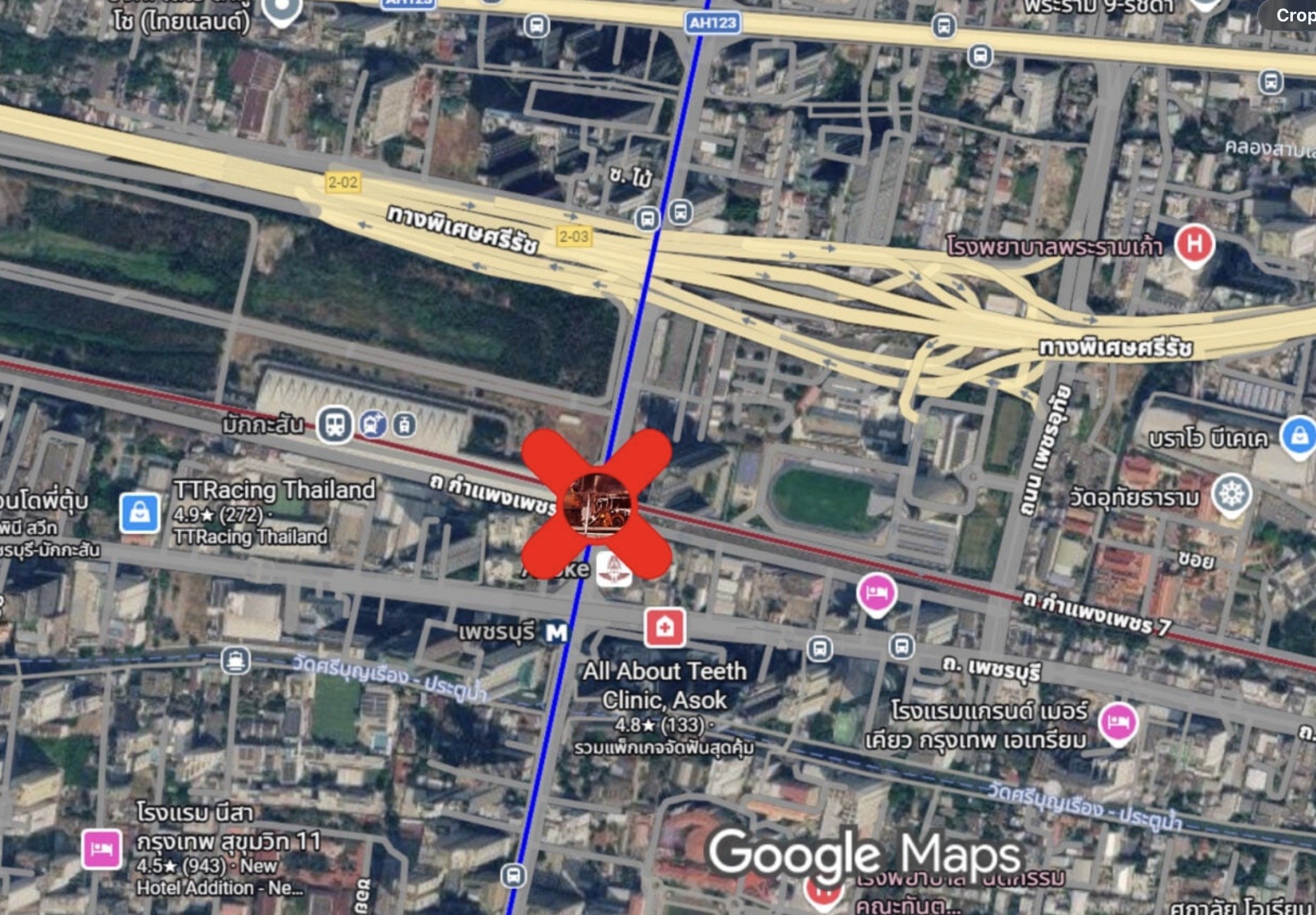

A fatal crash between a train and a public bus at the Asok-Din Daeng rail crossing in Bangkok has renewed scrutiny of one of the capital’s most dangerous transport bottlenecks. The collision, involving an eastern rail line train and a bus stranded on the tracks, has sparked debate over whether the disaster reflects deeper failures in urban planning rather than individual driver error.
Get today's headlines by email 
The crossing sits on Asok Montri Road, where traffic from Rama 9 junction and Asok-Phetchaburi junction converges before passing over a level railway crossing. According to data from the Bangkok Metropolitan Administration’s Traffic and Transportation Department, more than 100,000 vehicles pass through Rama 9 junction daily, while over 60,000 use the Asok-Phetchaburi junction.
The eastern railway line was built long before Bangkok expanded into a dense commercial district. However, critics argue that allowing heavy road traffic and rail operations to continue sharing the same ground-level crossing has created a long-standing safety hazard in the centre of the city.
Traffic congestion in the area frequently leaves vehicles trapped on the tracks as queues build up from nearby junctions. Vehicles approaching the crossing are often unable to move forward or reverse once warning signals activate and barriers lower, effectively turning stranded cars and buses into stationary obstacles directly in the train’s path.
The danger is heightened by the nearby Asok railway halt, where large numbers of passengers gather during rush hour close to the crossing. Concerns have been raised that any derailment or severe collision in the area could potentially lead to mass casualties.
Urban transport analysts say the problem stems from the physical design of the area rather than isolated mistakes by drivers or crossing staff. The combination of narrow road capacity, merging traffic from Kamphaeng Phet 7 Road and extremely high vehicle volumes has created what experts describe as a chronic choke point.
Comparisons have been drawn with major international cities, where dangerous inner-city level crossings have largely been eliminated through grade separation projects. Proposed solutions for the Asok crossing include elevating the railway line, constructing underground tunnels for road traffic, or creating bypass routes to reduce congestion through the central business district.
Daily News reported that authorities are now facing renewed calls to permanently separate rail and road traffic at the site. Critics argue that as long as trains and vehicles continue sharing the same level crossing in an area operating beyond traffic capacity, similar incidents remain likely in future.
Related stories
Bus-hit-by-train-near-Rama-9-bursts-into-flames
PM-visits-Makkasan-rail-crash-site
Join the discussion? 
Already a member? 
 Adapted by ASEAN Now Dailynews 17 May 2026
Recommended Comments
Create an account or sign in to comment