



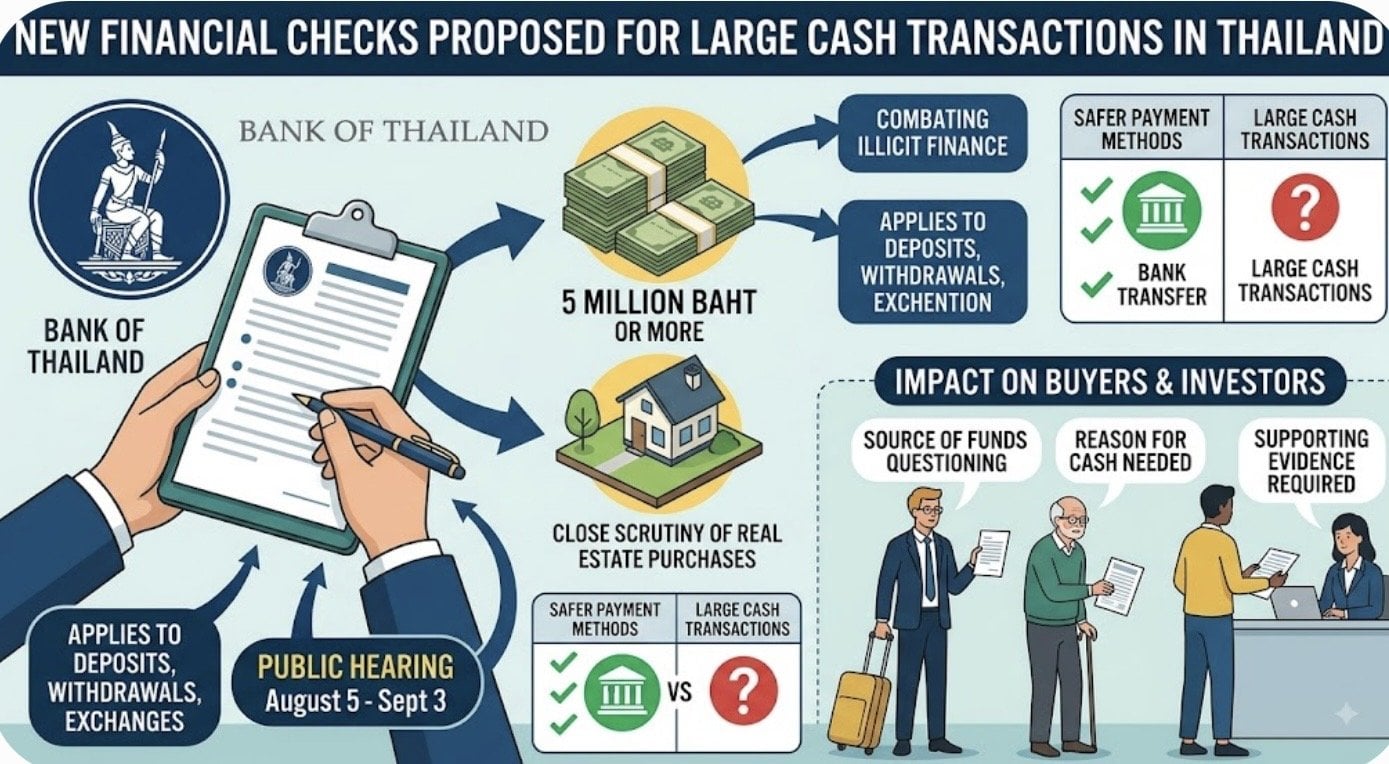

Thailand's central bank is proposing closer scrutiny of cash transactions worth at least 5 million baht, including purchases of land and high-value property.
The Bank of Thailand (BoT) has opened a public hearing on rules intended to stop banks and other financial institutions being used for money laundering or other illicit activity. The consultation runs from August 5 to September 3.
For foreign buyers, retirees and investors using Thai bank accounts, the proposal could mean being asked for a clearer explanation and supporting evidence when moving or withdrawing large sums in cash for a property purchase.
Cash property payments could prompt questions
The proposed rules would apply to cash withdrawals and deposits, banknote exchanges, and cash received for the issuance of cheques and drafts where a transaction is worth 5 million baht or more.
They would also cover the purchase, sale and exchange of foreign banknotes at or above that threshold.
Financial institutions would have to consider whether a customer's transaction behaviour is appropriate, including the reason and need for conducting a cash-related transaction. Under the consultation document, a large cash withdrawal to buy land or expensive property could be considered questionable where safer and more convenient payment methods are generally available.
Anyone planning a major purchase should therefore expect their bank to ask about the source and intended use of funds, particularly if money is being converted from foreign currency or withdrawn in banknotes rather than transferred through the banking system.
BoT reports progress against mobile banking malware
In a separate development, BoT assistant governor Daranee Saeju said Thailand had recorded no unauthorised mobile banking transaction caused by so-called "money malware" over the past 18 months.
Speaking at the 2026 Cybersecurity Annual Conference, "Responsible Innovation: Quantifying Cyber Risk for Business Trust", she said the result reflected cooperation between regulators, financial institutions and other parties, including the Thailand Banking Sector Computer Emergency Response Team, or TB-CERT.
TB-CERT is a specialised cybersecurity unit under the Thai Bankers' Association. Ms Daranee said cybersecurity was not simply an IT concern, but central to maintaining trust in the financial system.
She acknowledged, however, that financial crime was changing and required the BoT and banks to look beyond conventional cybersecurity measures. The central bank is using artificial intelligence to improve customer authentication, spot suspicious behaviour, detect threats sooner, respond faster, limit losses and identify networks of mule accounts.
"Let us not only secure our financial system -- let us strengthen the trust that sustains it," Ms Daranee said.
Join the discussion? 

12 August 2026
Recommended Comments
Create an account or sign in to comment