





The general election on 8 February 2026 could be ruled invalid if complaints over the Election Commission’s (EC) handling are upheld, according to political academics and a former election commissioner. Concerns focus on errors during advance voting and potential breaches of constitutional requirements for secrecy and fairness, raising the risk of legal challenges after polling day.
The warnings follow widespread problems during advance voting on 1 February 2026, when numerous procedural mistakes were reported nationwide. These included incorrect or missing constituency codes on ballot envelopes, missing candidate information, unsealed envelopes and cases where registered voters could not find their names. The EC has also been criticised for delays in seeking the disqualification of 28 candidates from four parties who allegedly lacked required voting qualifications.
Assoc Prof Suriya Sai Katasila, Dean of the College of Leadership and Social Innovation at Rangsit University, said the EC’s shortcomings have seriously damaged public trust. He warned that if courts later find the election was not conducted honestly or officials acted without neutrality, the entire poll could be declared void. He cited the 2006 election, which the Constitutional Court annulled over procedural violations, as a precedent.
Suriya Sai argued that the EC should urgently investigate and hold accountable officials responsible for errors, rather than publicly defending them. He also cautioned that some political parties, particularly the People’s Party, have used the EC’s mistakes to mobilise public sympathy and frame the commission as a political adversary. He said this strategy could influence voter sentiment and later be used to challenge unfavourable results.
Former election commissioner Somchai Srisutthiyakorn echoed these concerns in a Facebook post, identifying two specific risks that could lead to annulment. The first is a complaint that voting was not secret because queues for a constitutional referendum were located inside polling stations, potentially causing congestion near voting booths. The second is the placement of ballot boxes in areas not clearly visible to the public, which could allow fraud and be deemed unconstitutional.
Somchai proposed practical remedies, including issuing all three ballots in a single queue to reduce congestion and placing all ballot boxes in the centre of polling stations facing outward for transparency. He concluded his warning by saying it was his “1,000th reminder”.
According to VOTE62, 1,005 complaints were filed from 2,410,425 advance voters, with Bangkok reporting the highest number at 441 cases. The most common issue involved incorrect or missing four-digit constituency codes, reported 637 times. Other problems included missing signatures on envelopes, absent voter names and incorrect ballot distribution.
Manager online reported that the EC faces mounting pressure to ensure a smooth election day and prevent further errors. Any serious irregularities on 8 February could trigger legal challenges that may ultimately jeopardise the validity of the election.
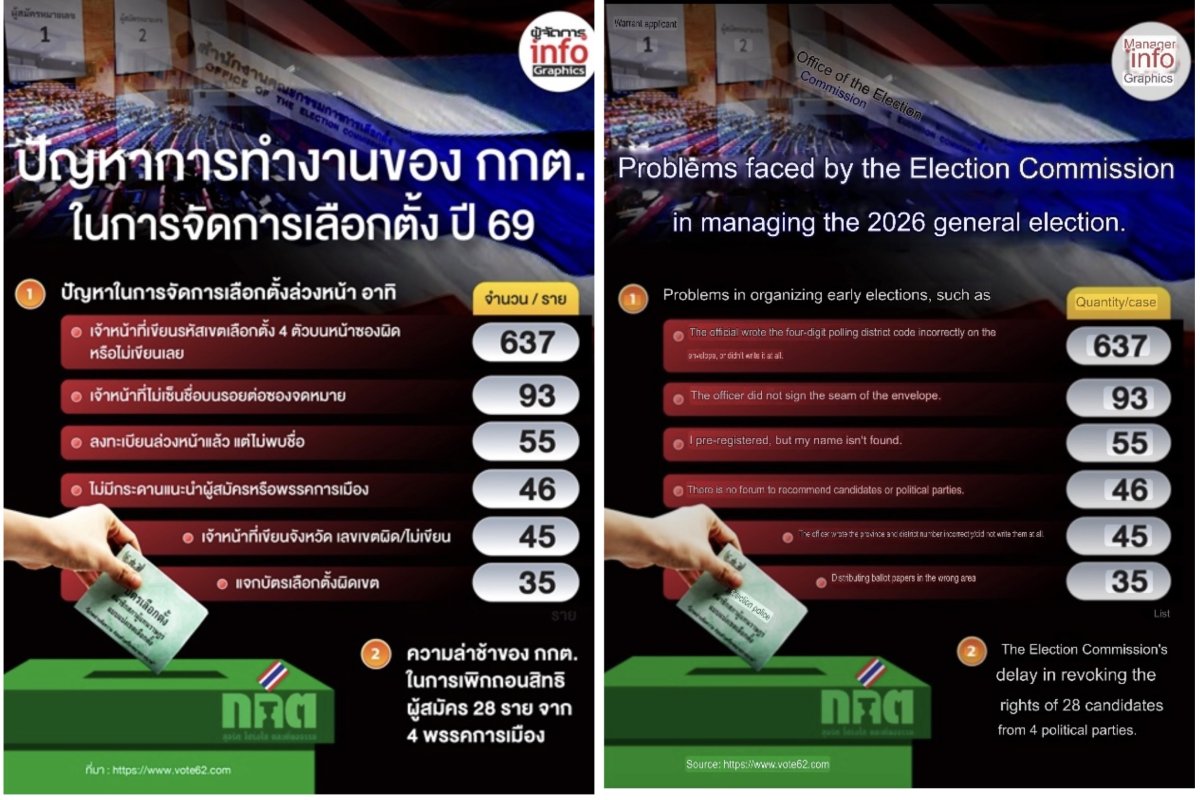
Pictures courtesy of MGR

Key Takeaways
• Academics and a former EC member warn procedural failures could lead to the election being voided.
• More than 1,000 complaints were reported from advance voting on 1 February 2026.
• Legal challenges after polling day could determine whether the election result stands.

Adapted by ASEAN Now from MGRonline 2026-02-07


Recommended Comments
Create an account or sign in to comment