




Hezbollah has rejected a renewed ceasefire agreement announced by Israel and Lebanon, describing the US-backed proposal as unacceptable and equivalent to surrender.
Get today's headlines by email 
In a strongly worded statement, Hezbollah leader Naim Qassem said negotiations had been “futile” and “humiliating” for Lebanon. He argued that the arrangement, which would require the group to halt attacks and withdraw fighters from southern Lebanon, served Israeli objectives and had been rejected by many Lebanese.
The agreement was announced on Wednesday following a fourth round of US-mediated talks in Washington. In a joint statement, the United States, Israel and Lebanon said the deal depended on a complete cessation of Hezbollah fire.
Security Zones Planned in Southern Lebanon
Under the proposed arrangement, Hezbollah operatives would be removed from territory between the Israeli border and the Litani River, roughly 30km north of the frontier. The area is currently occupied by Israeli ground forces.
The agreement also calls for the creation of pilot security zones where the Lebanese Armed Forces would exercise exclusive control, excluding all non-state armed groups. However, no maps or detailed plans were released explaining how the zones would operate.
The deal followed a partial ceasefire announced earlier in the week, under which Israel was expected to halt strikes on Beirut while Hezbollah refrained from attacking Israeli territory. Representatives from both countries are due to meet again on 22 June for further discussions aimed at reaching a broader settlement.
Opposition on the Ground
Reaction in Beirut’s southern suburbs, a Hezbollah stronghold, reflected the group’s opposition.
Local shopkeepers interviewed by the BBC questioned the viability of a ceasefire that did not appear to stop ongoing military operations. Some described the arrangement as a surrender rather than a genuine peace agreement and expressed little confidence that it would bring lasting stability.
Analysts suggest Lebanon’s government may have hoped Hezbollah would eventually accept the talks process, while the United States viewed the negotiations as part of wider efforts linked to regional diplomacy involving Iran. However, Hezbollah appears determined to present itself as the principal force resisting Israel.
Fighting Continues Despite Diplomacy
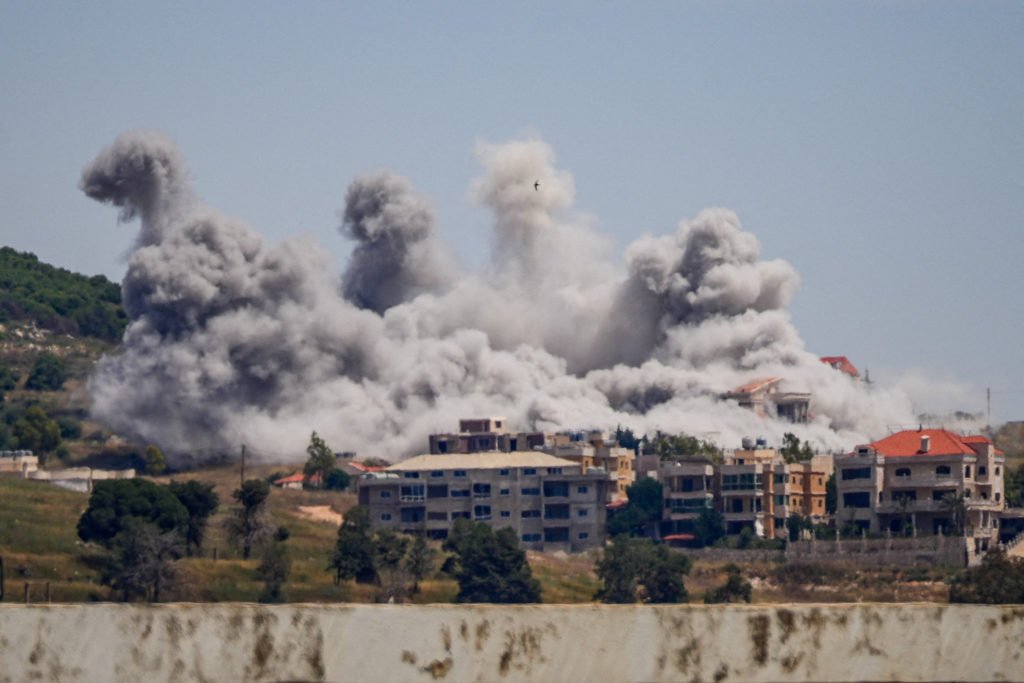
Hostilities continued across Lebanon on Thursday.
Lebanese media reported multiple Israeli strikes in southern regions and the Bekaa Valley. Lebanon’s health ministry said at least eight people were killed and 15 wounded in attacks targeting several towns, including Sohmor, Masaken and Arab Al-Jalil.
Meanwhile, the United Nations Interim Force in Lebanon, United Nations Interim Force in Lebanon, reported that one peacekeeper died from injuries sustained when mortar shells struck a position near Marjayoun. The Israeli military blamed Hezbollah for the attack, while the group had not commented on the allegation.
Serbia later identified the peacekeeper as Senior Sergeant Milovan Jovanovic.
Israel also announced the death of Capt Eitan Shmuel Lemberg during operations in southern Lebanon. The military said several aerial threats had been detected in the area, though no additional injuries were reported.
Hezbollah stated that it had targeted Israeli troops and military vehicles near Qantara and Beaufort Castle with rockets and attack drones.
War Shows No Sign of Ending
The conflict intensified after Hezbollah launched rockets into Israel on 2 March following an Israeli strike that killed Iran’s supreme leader. Israel responded with a large-scale air campaign and a ground offensive in southern Lebanon.
A previous US-brokered ceasefire reached on 16 April failed to halt the fighting. Last week, Israeli Prime Minister Benjamin Netanyahu ordered intensified military operations against Hezbollah following continued rocket and drone attacks.
According to Lebanon’s health ministry, at least 3,526 people have been killed in the country since the war began. The United Nations says more than one million people have been displaced.
Israel says 26 soldiers and four civilians have been killed during the conflict.
Join the discussion? 
Already a member? 
 Adapted by ASEAN Now. Source 5 June 2026
Recommended Comments
Create an account or sign in to comment