



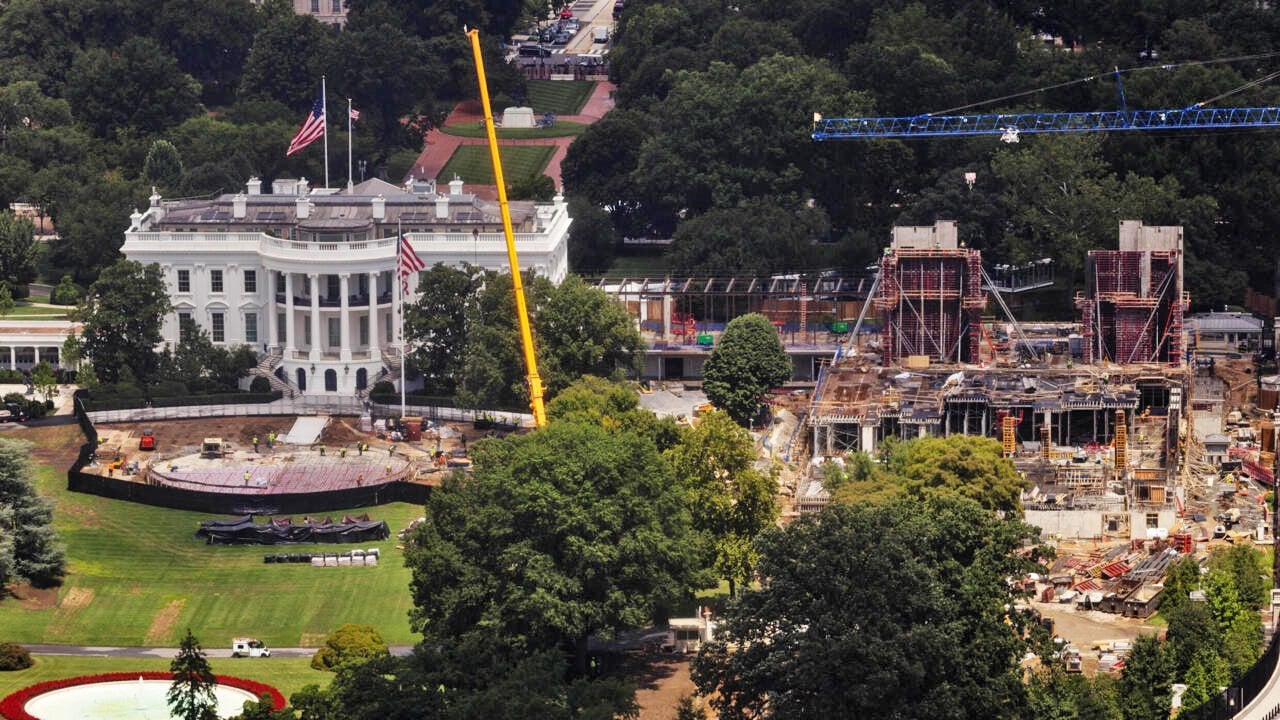

The US administration has been ordered to stop construction on a $400m (£297m) ballroom at the White House, after a federal appeals court upheld a legal injunction that said the work cannot proceed without authorisation from Congress.
The ruling, delivered on Friday by a three-judge panel in a 2-1 decision, marks another setback for President Donald Trump’s bid to reshape parts of the presidential residence. The court also gave the administration a 14-day window to ask the Supreme Court to review the decision.
Injunction Bars Above-Ground Work
The case was brought by the National Trust for Historic Preservation after the administration removed the East Wing last year to start the project. The appeals court maintained a preliminary injunction won by the group, which blocked above-ground construction while allowing other work to continue.
In its majority opinion, the panel said the question of whether a large ballroom should be built is one for Congress, not for the executive branch to determine through “self-help”.
The judges added that Congress had not granted the president broad, unrestricted power to redesign and reconstruct the White House to suit a specific administration. The court said the presidential residence and its executive accommodation are intended for use by successive presidents and for the public.
The opinion stated that each president is a “temporary tenant” of the White House rather than its owner. It also concluded that the executive does not have constitutionally assigned authority over the property in the way the administration planned.
Construction Authority and Timing
The administration sought to overturn earlier rulings after a federal judge twice prevented above-ground activity on the ballroom, while permitting underground work to continue.
On Friday, the appeals court confirmed that blocking order, while pausing its own implementation for 14 days so the government could pursue a Supreme Court appeal. The BBC said it contacted the White House and the Department of Justice for comment.
Trump, who has repeatedly promoted the ballroom project since unveiling plans, reacted strongly on social media, calling the court decision “horrendous” and claiming it was politically motivated. He said the dissenting judge described the order as a “blatant abuse of discretion”.
Trump Cites Security and Plans Appeal
Trump also argued that the military and the Secret Service regarded the ruling as a national security threat, and said the decision should be overturned by the Supreme Court in full.
He repeated that the ballroom would be delivered on an accelerated timetable and within budget. Trump said it would be funded by a coalition of private donors as a gift to the American people, while also arguing that the project is needed for “grand parties” and state visits.
At the same time, Republicans have sought to draw on part of a $1bn (£740m) pot of taxpayer money for Secret Service security upgrades. A budget watchdog had dismissed that plan in May.
Government lawyers have said the project includes a security complex below ground and additional measures intended to protect the White House from threats such as drones, ballistic missiles, biohazards and other hazards. Trump said the construction would involve bomb shelters, hospital and medical facilities and “top secret” military infrastructure.
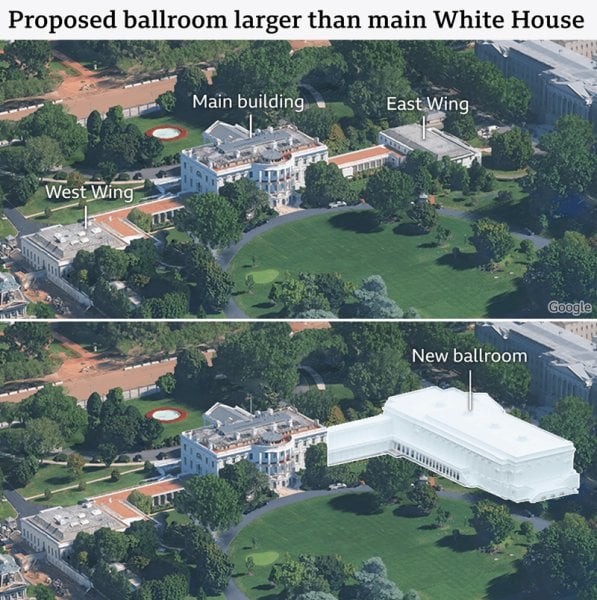
Graphic courtesy of BBC
The preservation group argued that the move to “disturb” the White House was not justified and that having a ballroom was not a national security emergency. It said there was no basis to proceed with work that would alter the historic property.
The appeals court majority said its decision did not assess whether the proposed ballroom is desirable, or whether it could be built eventually. Instead, it said the administration may not proceed during the ongoing litigation unless it secures authorisation from Congress.
After the ruling, Brent Leggs, president and chief executive of the National Trust for Historic Preservation, said no above-ground construction could take place “unless and until” Congress acts, calling the White House an irreplaceable monument.
Join the discussion? 

8 August 2026
-
 1
1
-
 3
3
-
 2
2
-
 3
3
Recommended Comments
Create an account or sign in to comment