



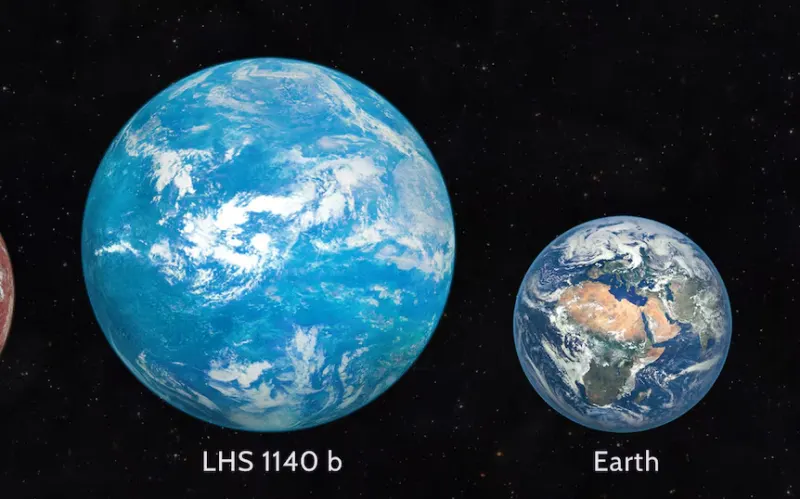

A team of astronomers has reported strong evidence that the rocky exoplanet LHS 1140b, located a few dozen light-years from Earth, has an atmosphere rich in helium. The finding, published in Science, adds to evidence that some worlds beyond the Solar System may have conditions consistent with habitability.
Researchers said the planet meets three broad criteria associated with life as understood on Earth: it appears rocky, it orbits within its star’s habitable zone where liquid water could exist at the surface, and it now shows signs of an atmosphere.
Collin Cherubim, a planetary scientist who recently completed his doctorate at Harvard University, said there is no evidence of life on the planet. However, he said the observations indicate that key components relevant to habitability are present.
A rocky planet in the habitable zone
LHS 1140b was first identified in 2017. It orbits a star at a distance that places it in the habitable zone, described as neither too hot nor too cold for liquid water to exist on the planet’s surface.
The exoplanet is cooler than Earth, but larger in both size and mass. Although it is often labelled Earth-like, astronomers say there are important differences between the planet and our own world, including how it moves and rotates relative to its star.
Helium signals point to a real atmosphere
The new data indicate that LHS 1140b likely has a helium-rich atmosphere. The research team said the detection provides the first clear evidence for a potentially habitable planet with an atmosphere.
An atmosphere is considered important for habitability because it can help a planet retain water, regulate climate conditions and protect the surface from harmful radiation. Scientists have confirmed atmospheres around giant gas planets, but have previously had less certainty about whether rocky planets can hold on to gases over time.
Helium escape appears to change over time
Cherubim previously built a theoretical model of how a rocky planet’s atmosphere might behave. His calculations suggested that lighter elements, including helium, may escape more easily under certain conditions. He argued that LHS 1140b is a candidate for active helium loss to space.
LHS 1140b orbits a red dwarf, the most common type of star in the galaxy. Red dwarfs are smaller and cooler than many other stars, which can make rocky planets around them easier to detect. At the same time, such stars can be energetic, emitting flares that may strip atmospheres from nearby planets.
Cherubim said the star hosting LHS 1140b appears less active than typical red dwarfs. In 2024, he and colleagues observed the planet transiting in front of its star using a telescope at Las Campanas Observatory in Chile. Their measurements showed helium at high altitudes, suggesting helium was escaping from an atmosphere that is otherwise difficult to detect.
In 2025, the team observed the system again during another eclipse, but this time reported no sign of helium escaping.
Shreyas Vissapragada, a planetary scientist at the Carnegie Observatories in Pasadena, California, and an author of the new study, said the change in results was surprising but not entirely unexpected. He noted that differing amounts of helium have been seen in the atmospheres of gas giants and that the new work represents the first time the effect has been observed on a rocky exoplanet.
Vissapragada said the observations amount to tracking changes in a planet’s atmosphere over time.
Earth-like, with key differences
Astronomers describe LHS 1140b as Earth-like, but it diverges from Earth in several ways. The planet completes an orbit in less than 25 days, compared with Earth’s 365 days. It also always shows the same face to its star, meaning it does not experience a regular day-night cycle in the way Earth does.
The planet’s atmosphere is expected to be helium-rich, while Earth’s atmosphere is dominated by nitrogen.
In 2020, Sara Seager of the Massachusetts Institute of Technology led research suggesting that yeast and E. coli could survive in an atmosphere of pure helium. While that does not establish that life exists on LHS 1140b, it illustrates that such an environment has been considered plausible in laboratory-based scenarios.
Vissapragada said finding an atmosphere on LHS 1140b is a step towards characterising exoplanets that may be truly Earth-like.
Join the discussion? 

17 July 2026
-
 1
1
Recommended Comments
Create an account or sign in to comment