



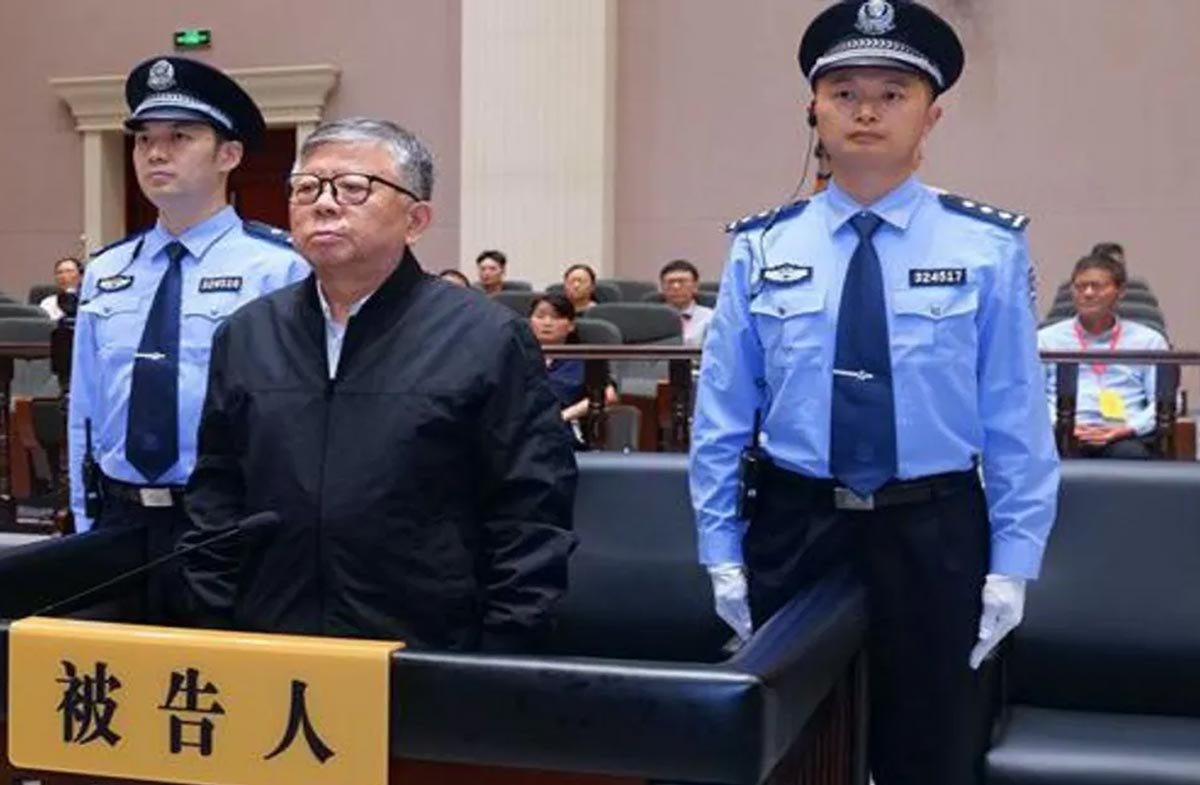

A court in eastern China has sentenced a former senior official to death after finding him guilty of accepting more than 2.2 billion yuan ($325 million; £243 million) in bribes over a 30-year period.
Get today's headlines by email 
Yang Youlin, 69, held a series of government positions in the city of Nanjing between 1993 and 2023. Alongside bribery, he was convicted of embezzlement, abuse of power and money laundering, with the value of his illegal gains ranking among the country's largest corruption cases in recent years.
Senior official convicted after decades of corruption
According to Chinese state media, Yang used his official positions to help individuals obtain engineering contracts, land transfers and financing in exchange for money and other valuables.
Part of Xi's anti-corruption campaign
Yang came under investigation during President Xi Jinping's long-running anti-corruption campaign, which has targeted officials across government, the military and the financial sector.
The Intermediate People's Court in Changzhou said Yang's crimes were "extremely serious" and had caused "exceptionally heavy losses to the interests of the state and the people". The court announced the death sentence on Monday.
Since taking office, Xi has overseen repeated anti-corruption drives that have resulted in the punishment of thousands of officials. While supporters say the campaign is aimed at tackling entrenched corruption, critics argue it has also been used to remove political opponents.
Death penalty remains uncommon
Although China retains the death penalty for certain economic crimes, executions for corruption remain relatively rare. Capital punishment is generally reserved for cases involving exceptionally large sums, often exceeding one billion yuan.
Among the most notable cases was former financial executive Lai Xiaomin, who was executed in 2021 after being convicted of taking 1.8 billion yuan in bribes over a decade.
More recently, former Inner Mongolia official Li Jianping was executed in 2024 after being found guilty of embezzlement and accepting bribes worth more than 3 billion yuan.
In many other corruption cases, courts have instead imposed lengthy prison terms or suspended death sentences, which are typically commuted to life imprisonment after a specified period.
Cooperation failed to reduce sentence
Chinese courts may reduce sentences when defendants cooperate with investigators or provide information leading to the prosecution of other offenders.
State media said Yang had assisted authorities and pleaded guilty. He also expressed remorse during his final statement before sentencing.
However, the Changzhou court ruled that the seriousness of his offences outweighed any mitigating factors. It said his cooperation was insufficient to justify a lighter sentence because of the exceptional scale and impact of his crimes.
Join the discussion? 
Already a member? 
 Adapted by ASEAN Now. Source 7 July 2026
Recommended Comments
Create an account or sign in to comment