



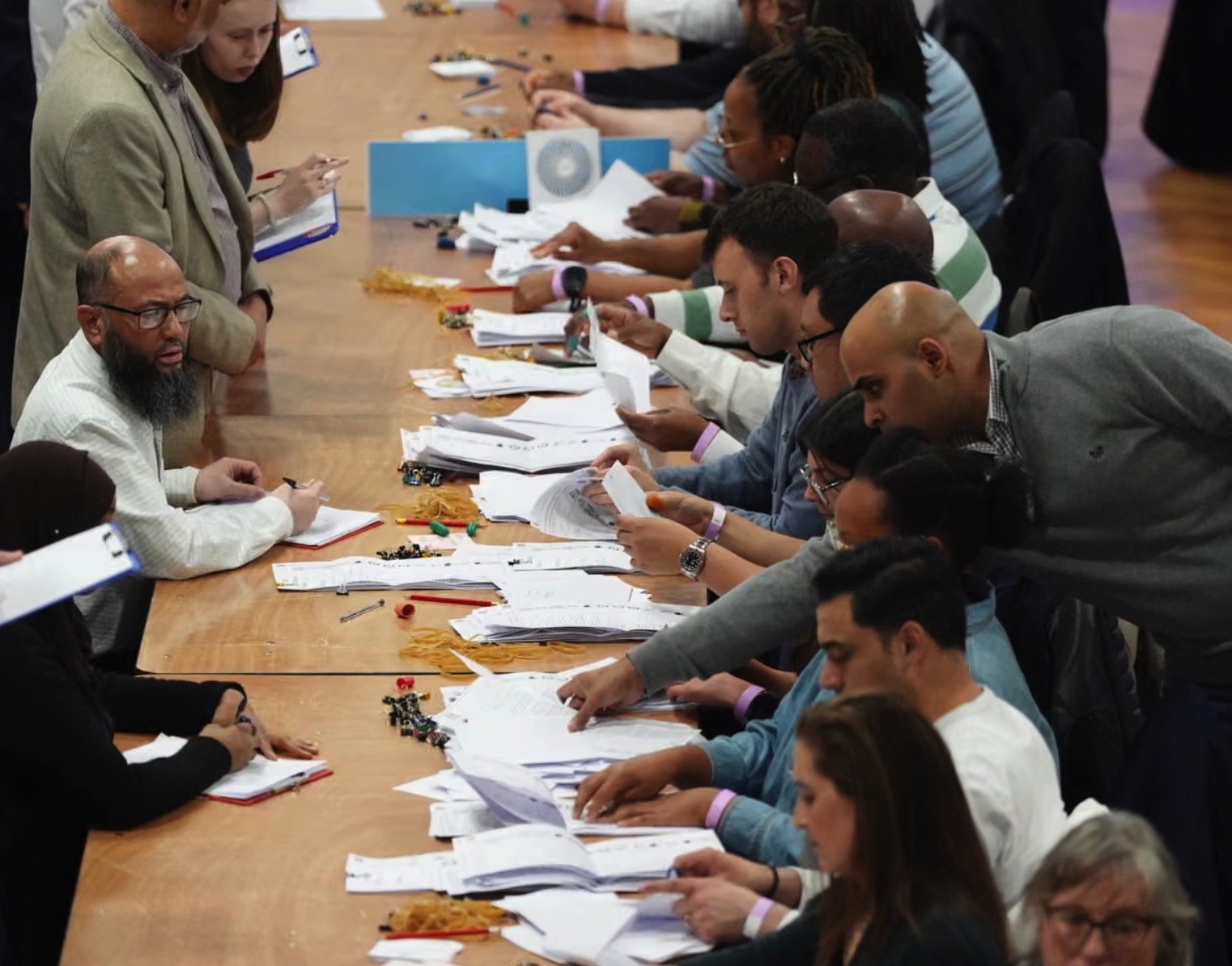

Counting is under way across the United Kingdom after voters cast ballots in elections in England, Scotland and Wales, with the first results expected in the early hours of Friday.
Get today's headlines by email 
Initial declarations from English councils are anticipated between midnight and 2am BST. Results from the Scottish and Welsh parliamentary contests are expected later in the day, beginning around midday.
Only a limited number of results will emerge overnight, but early declarations could shape the narrative of the elections and offer clues about broader political shifts.
Early Tests in English Councils
One of the earliest indicators of the night’s political direction may come from Hartlepool, where attention is focused on whether Reform UK can convert strong polling numbers into tangible gains at council level.
Election observers say the town could provide an early measure of the party’s ability to translate support into seats. A strong showing for Reform UK would raise concerns among Labour strategists that the party could become a sustained anti-establishment challenger in areas that once formed part of Labour’s traditional support base.
Oxford is also being watched closely. Analysts say the city may highlight growing fragmentation among voters opposed to the Conservatives, with Labour, the Green Party and the Liberal Democrats competing for similar constituencies of support.
Meanwhile, the result in Dudley is seen as a key test in the politically competitive Midlands. The area has experienced shifting voting patterns in recent years, and Labour faces pressure from Reform UK amid voter concerns about immigration, living standards and trust in Westminster politics.
Major Changes to Welsh Parliament
The elections also coincide with a major reform of the Welsh parliament, the Senedd. The chamber is expanding from 60 to 96 members under a new electoral system designed to produce more proportional outcomes.
Opinion polls suggest the change could reshape the political landscape in Wales. Labour, which has governed the Senedd since devolution began in 1999, is widely expected to lose its majority.
Plaid Cymru leader Rhun ap Iorwerth is predicted by some forecasts to emerge as the next first minister. Such an outcome would bring renewed attention to the party’s commitment to advancing the case for Welsh independence.
Coalition Scenarios and Close Margins
Even if Reform UK performs strongly in Wales, coalition mathematics make it unlikely the party would be able to form a government. Analysts say Plaid Cymru could instead attempt to govern as a minority administration if the numbers allow, avoiding formal coalition agreements with Labour or the Green Party.
Polls suggest Labour may face substantial losses in the Senedd election. Some projections place the party as low as fourth place, behind the Greens.
There is also speculation that Eluned Morgan, Labour’s current first minister in Wales, could lose her own seat.
The new electoral system introduces additional uncertainty. The revised list method means very small shifts in vote share could determine the final seat allocation in each constituency.
According to the polling group More in Common, margins as small as 0.06% of the vote could decide the final seat — the sixth — in a constituency list, making precise predictions difficult before counting is complete.
Results Expected Through Friday
With counting continuing across multiple elections, officials expect results to emerge gradually through Friday.
While only a small number of English council results will appear overnight, the outcomes from Scotland and Wales later in the day are expected to provide a clearer picture of the political balance across the three nations.
Join the discussion? 
Already a member? 
 Adapted by ASEAN Now. Source 8 May 2026
Recommended Comments
Create an account or sign in to comment