



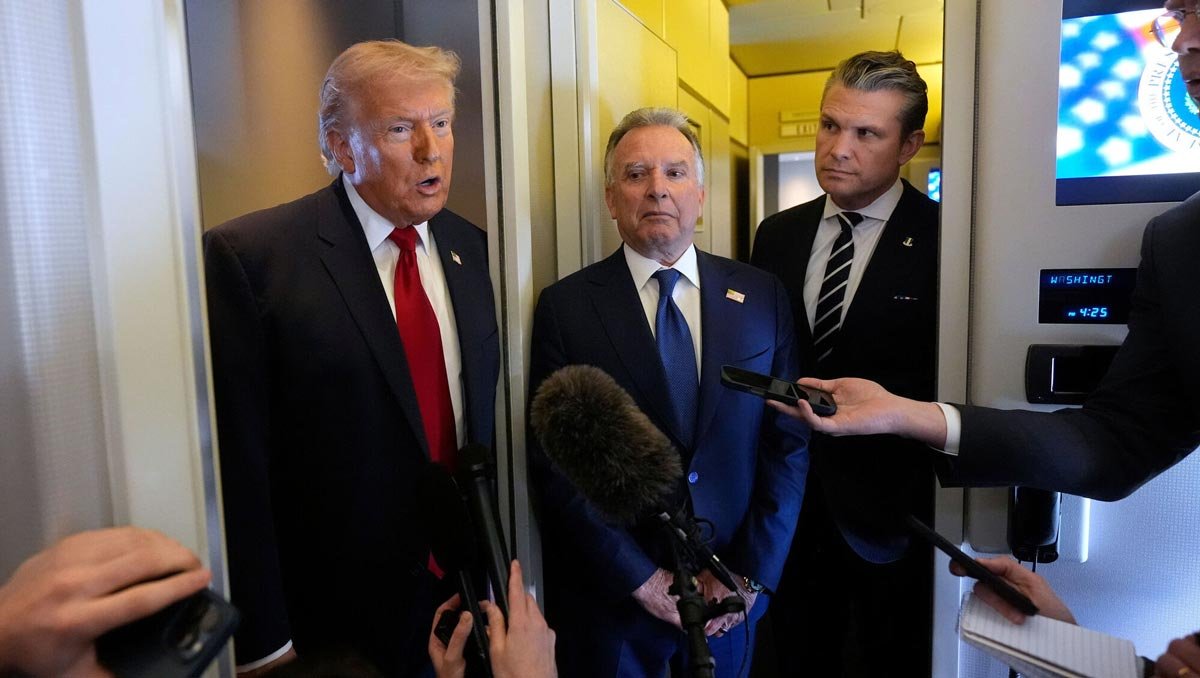

European confidence in the United States as a security partner has fallen to its lowest recorded level, with only about one in 10 people across 15 countries now viewing the US as an ally, according to a new survey released ahead of key G7 and NATO meetings.
Get today's headlines by email 
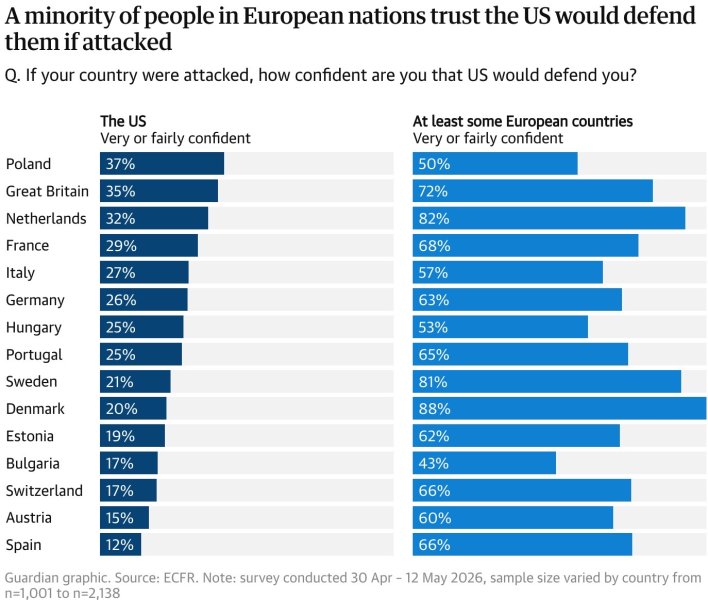
The poll, conducted in May by the European Council on Foreign Relations (ECFR), found widespread doubts about Washington's commitment to Europe's defence. Majorities in every country surveyed said they were not confident the US would come to their country's aid if it came under attack.
Confidence in US Falls Across Europe
The survey found that just 11% of respondents across the 15 countries regarded the US as an ally. That figure has steadily declined from 16% six months ago and 22% in November 2024.
Most Europeans now describe the US as a "necessary partner" rather than a close ally. Meanwhile, 13% of respondents considered the US a rival and 12% viewed it as an adversary.
According to the report's authors, the findings point to growing scepticism about American reliability under President Donald Trump. Concerns cited include US military actions in the Middle East, threats involving Greenland, suggestions of troop withdrawals from Europe and uncertainty surrounding NATO's future.
Support Grows for Stronger European Defence
The poll suggests Europeans are increasingly prepared to strengthen their own security capabilities rather than rely heavily on Washington.
Support for higher national defence spending has risen by an average of four percentage points since last year. Italy was the only country where a clear majority opposed increased military spending.
Nearly half of respondents, 47%, backed joint European Union borrowing to fund greater defence investment, while 35% opposed the idea. Support was strongest in Portugal, Denmark, the Netherlands and Spain.
Large majorities in most countries also favoured reducing dependence on American military equipment. Support for purchasing more European-made defence hardware was particularly strong in Denmark, the Netherlands, Sweden, Portugal and France.
Europeans Still Value NATO
Despite concerns about US reliability, there was little appetite for replacing NATO with a defence structure run solely by the EU. Only 29% of respondents supported creating an EU-only military alliance.
Most participants instead expected transatlantic relations to improve after Trump leaves office. More than 60% of respondents in France, Spain, Denmark, the Netherlands and Sweden said they believed ties between Europe and the US would likely improve in the future.
The survey also found that Europeans generally had greater confidence in support from neighbouring countries than from the US. In nearly all countries surveyed, respondents believed at least some European states would assist them in the event of a security crisis.
Divisions Over Russia and Ukraine
The poll highlighted continuing divisions over Europe’s approach to Russia and Ukraine.
Despite concerns about energy prices, 44% of respondents said restarting imports of Russian oil and gas would be a bad idea.
Opinion was also split over Ukraine's bid to join the European Union. Respondents in several countries, including Hungary, Bulgaria, Austria, Germany and Estonia, were more likely to oppose Ukrainian membership under current circumstances than support it.
The findings come as European leaders face increasing pressure to strengthen defence capabilities while reassessing the continent's long-term security relationship with Washington.
Join the discussion? 
Already a member? 
 Adapted by ASEAN Now. Source 10 June 2026
-
 1
1
Recommended Comments
Create an account or sign in to comment