



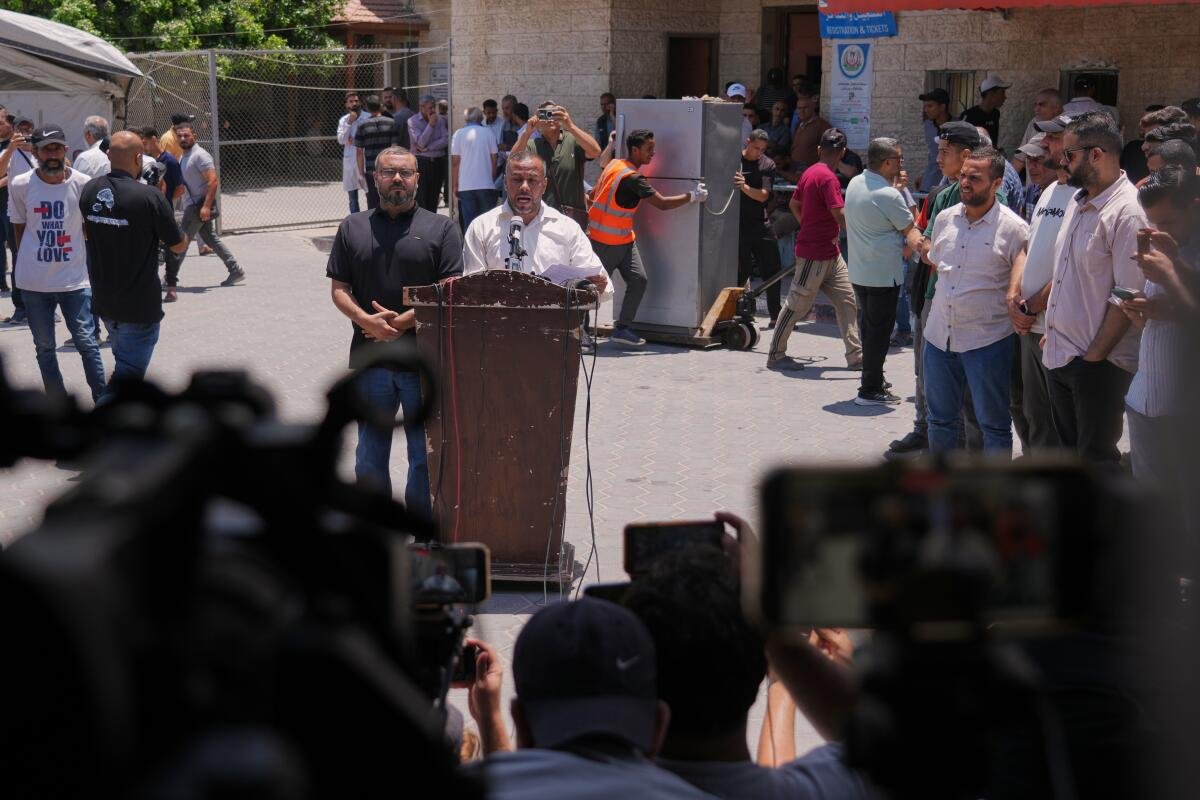

Hamas has announced that it is prepared to hand over governing authority in Gaza after nearly two decades in power, inviting a US-backed interim administration to assume responsibility for running the Palestinian territory.
Get today's headlines by email 
The move, announced on Monday, could mark a significant political shift, although it remains unclear whether it will strengthen the fragile ceasefire in Gaza or improve conditions in the territory, where a humanitarian crisis continues.
Hamas Signals Political Transition
While Hamas said it was ready to transfer security responsibilities as part of a broader transition, it did not commit to disarming, a key demand made by Israel and the United States.
The group has instead maintained that it will not surrender its weapons while Israel retains military control over large parts of Gaza and continues military operations inside the territory.
Interim Authority Faces Obstacles
The proposed successor, the National Committee for the Administration of Gaza (NCAG), was established in January under a US-brokered ceasefire arrangement. However, Israel has prevented the committee from entering Gaza since its creation, raising doubts about when any transfer of power could take place.
Mohammed al-Farra, who heads Hamas's administration in Gaza, announced his resignation from his government roles, saying preparations had been completed for the handover. He indicated that Hamas would immediately step aside from directing Gaza's political administration, while civil servants would continue performing their duties until the NCAG could assume control.
Hamas spokesperson Hazem Qassem said the organisation had decided to relinquish governance to remove what it described as Israeli justifications for continuing military operations in Gaza.
Ali Shaath, the NCAG's chair, said the committee was ready to take on its responsibilities once the necessary conditions and resources were available.
Disarmament Remains Sticking Point
The Board of Peace, established by US President Donald Trump as part of a ceasefire framework and responsible for overseeing the NCAG, responded cautiously, saying it had "taken note" of Hamas's announcement.
The board said it would judge the proposal by actions rather than statements and reiterated that all weapons should ultimately come under the control of the interim administration, reflecting its principle of "one authority, one law and one weapon."
In a report to the UN Security Council in May, Trump's envoy for Gaza, Nickolay Mladenov, blamed Hamas for the stalled peace process. Hamas, however, argues that it cannot disarm while Israel controls more than 60% of Gaza, continues military strikes and supports Palestinian armed groups inside the territory.
Analysts See Symbolic Move
Analysts described Hamas's announcement as largely symbolic but potentially aimed at reviving a stalled political process that has delayed reconstruction and humanitarian assistance for Gaza's estimated 2.1 million residents.
They also suggested the move was intended to challenge Israeli-backed plans to concentrate aid, reconstruction and governance within a limited area of Gaza under Israeli military control. The proposal has received support from the Trump administration under names including "humanitarian city", "alternative safe communities" and "New Rafah", although critics have strongly opposed the concept.
Max Rodenbeck of the International Crisis Group said Hamas appeared willing to surrender political authority while stopping short of disarmament, arguing that the group was attempting to break the diplomatic deadlock and shift pressure onto international mediators.
Muhammad Shehada of the European Council on Foreign Relations said Hamas was trying to prevent the NCAG from becoming associated only with the proposed New Rafah project, warning that such an arrangement could undermine its legitimacy.
Diplomats expect limited progress on Gaza's political future in the coming months, with Israeli Prime Minister Benjamin Netanyahu focused on maintaining his governing coalition ahead of elections expected by late October.
Join the discussion? 
 Adapted by ASEAN Now. Source 7 July 2026
Recommended Comments
Create an account or sign in to comment