



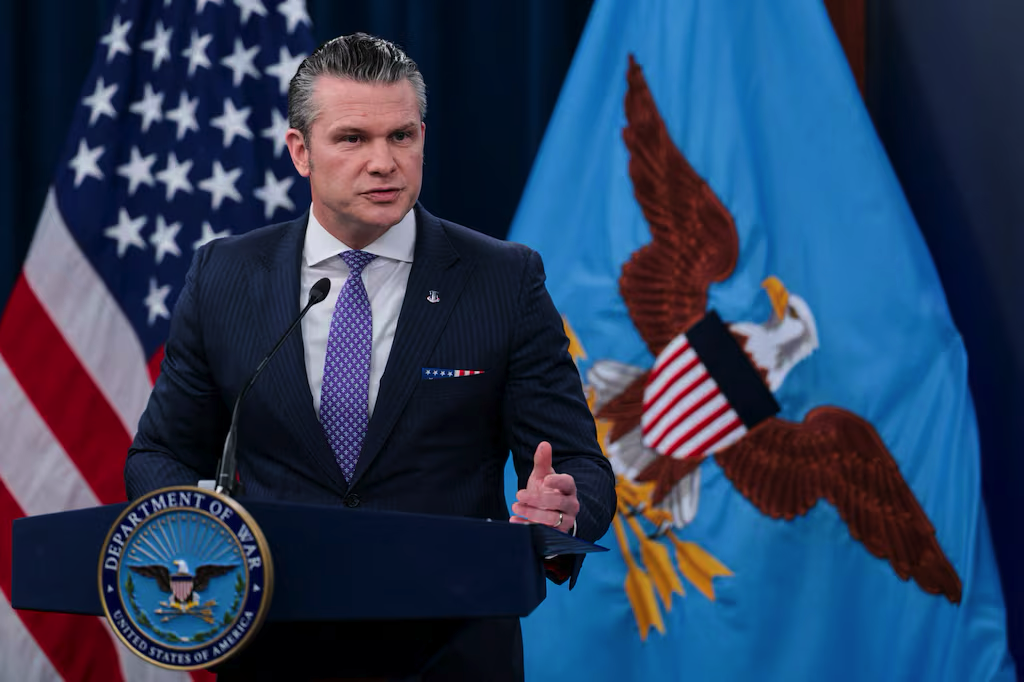

U.S. Defense Secretary Pete Hegseth’s increasing use of Christian language and imagery in connection with the American military has prompted debate among experts, veterans and political figures about the role of religion in the armed forces.
Get today's headlines by email 
During a briefing last week on the conflict with Iran, Hegseth urged Americans to pray to Jesus for the success of U.S. troops in the Middle East. Days later, he read a sermon that called for “wicked souls” to face “eternal damnation” in the fight against Iran.
The remarks reflect a broader pattern in which Hegseth has openly linked Christian faith with U.S. military operations. Pentagon officials say his approach reflects the country’s historical religious traditions, while critics argue it risks alienating service members of different faiths.
Growing emphasis on faith
Hegseth, a former Fox News host who served in Iraq and Afghanistan, has increasingly incorporated religious language into public statements about the military.
At a press briefing in March, one day after attending a dignified transfer ceremony at Dover Air Force Base, he quoted Psalm 144 from the Bible: “Blessed be the Lord, my rock, who trains my hands for war and my fingers for battle.”
He has also introduced a monthly prayer service at the Pentagon and invited several Christian pastors to speak at the events. Among them was Doug Wilson, a pastor known for advocating Christian nationalist ideas and arguing that women should not have the right to vote.
The invitation drew criticism from some veterans and political figures.
Fred Wellman, an Army veteran running for Congress in Missouri, wrote on the social media platform X that Hegseth was using his official role to promote his personal faith through government facilities and communications channels. Nancy Lacore, a retired Navy rear admiral seeking election to Congress in South Carolina, said the invitation risked sending a message that not all service members belong.
Defense Department officials have rejected those criticisms. Pentagon press secretary Kingsley Wilson said Hegseth was “a proud Christian” and had welcomed Wilson to the Pentagon in that capacity.
“The Christian faith is woven deeply into the fabric of our nation,” she said, adding that the defence secretary embraces that heritage.
Changes to chaplain corps
Hegseth has also introduced changes to the U.S. military’s Chaplain Corps. Under one new policy, chaplains will no longer display their rank insignia and instead wear symbols indicating their religious affiliation.
In a video announcement, Hegseth said the move was intended to highlight the spiritual wellbeing of service members, which he described as equally important as their physical and mental health. He criticised previous administrations for introducing what he called “political correctness and secular humanism” into the corps.
The Pentagon chief has long criticised diversity, equity and inclusion initiatives within the military, arguing they discourage young patriotic recruits. Data from the Defence Department indicates that roughly 70% of the U.S. military’s 1.3 million active-duty personnel identify as Christian.
Since taking office, Hegseth has also implemented a ban on transgender troops, removed diversity initiatives and launched reviews of women serving in combat roles and the department’s longstanding partnership with Scouting America.
Debate over religion and the military
Supporters say Hegseth’s religious expressions reflect long-standing traditions in the armed forces, where official events often begin with prayers delivered by chaplains.
Steven Bucci, a former Army Special Forces officer and visiting fellow at the Heritage Foundation, said he believes the controversy has been overstated.
He said Hegseth’s references to Jesus when urging Americans to pray for troops reflect his personal faith rather than an attempt to impose religion on service members.
Others remain concerned that the growing prominence of religious rhetoric could undermine the military’s tradition of representing a broad cross-section of American society.
Matthew Taylor, a visiting scholar at Georgetown University’s Berkley Center for Religion, Peace and World Affairs, said the military has historically sought to avoid ideological uniformity.
“The ideological consolidation of the military is something that we have historically not wanted,” Taylor said, adding that diversity within the armed forces has long been viewed as a strength.
Join the discussion? 
Already a member? 
 Adapted by ASEAN Now. Source 4 April 2026
Recommended Comments
Create an account or sign in to comment