



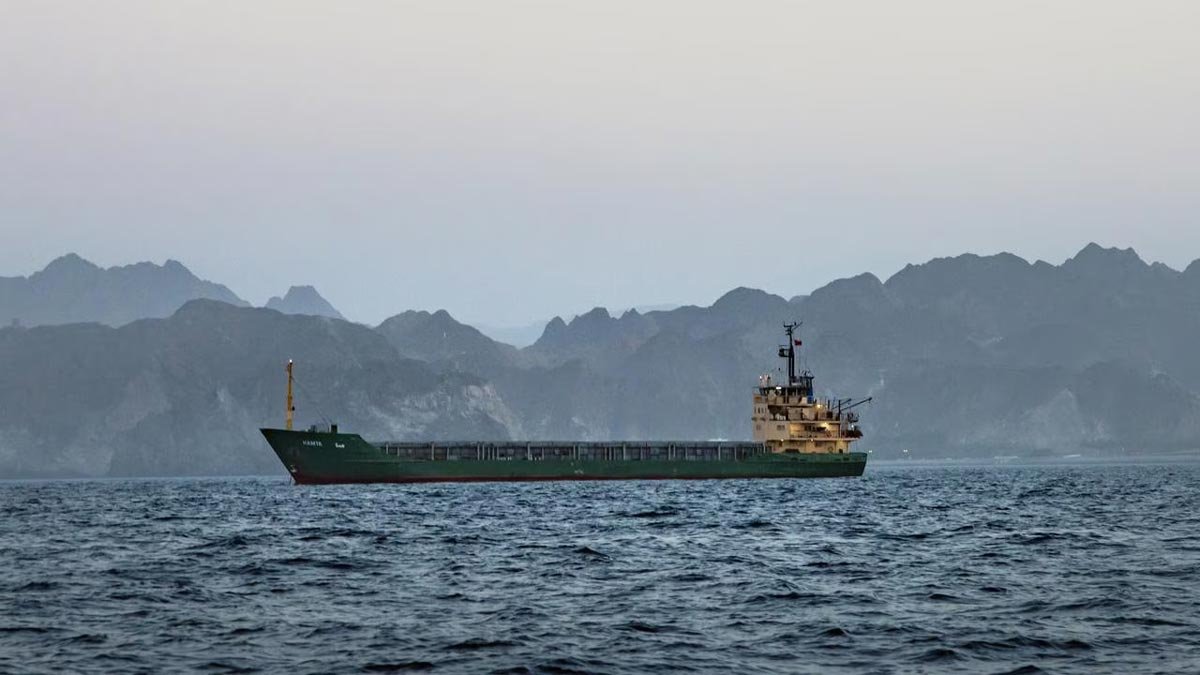

A vessel was struck in the Strait of Hormuz on Thursday, forcing the United Nations to suspend an operation to evacuate hundreds of ships and thousands of stranded seafarers, underscoring continued security risks despite last week's agreement between the United States and Iran.
Get today's headlines by email 
Vessel Attack Raises Fresh Security Fears
A US official told CNN the vessel was hit by an Iranian drone, although no further details were provided. Iran has not claimed responsibility for the attack.
The incident came only hours after Iran's Islamic Revolutionary Guard Corps warned that ships would be granted safe passage only if they used routes approved by Tehran, challenging US assertions that the strategic waterway had reopened to normal traffic.
UN Pauses Evacuation Mission
According to the United Kingdom Maritime Trade Operations, the cargo vessel was struck on its starboard side by an unidentified projectile, damaging its bridge. No casualties or environmental damage were reported, but vessels transiting the area were urged to proceed with caution and report suspicious activity.
The attack prompted the UN's International Maritime Organization (IMO) to suspend its recently launched evacuation mission, which was intended to assist more than 11,000 seafarers and hundreds of ships stranded in the Persian Gulf since fighting erupted in late February.
IMO Secretary-General Arsenio Dominguez said the safety of seafarers remained the organization's highest priority and that evacuation efforts would remain on hold until the security situation became clearer.
He added that the vessel targeted in Thursday's attack was not participating in the IMO evacuation program but said the incident highlighted the need to ensure future operations could proceed without putting crews at risk.
Dispute Over Strait Control Continues
Shipping traffic through the Strait of Hormuz had reached its highest level since the conflict began, with MarineTraffic data recording 70 crossings on Wednesday. Most vessels were using routes close to the Omani coastline.
Iran continues to view control of the strait as an important bargaining tool. Following the attack, the newly established Persian Gulf Seaways Management Organization warned that vessels using routes not authorized by Iran could no longer be guaranteed safe passage, saying any consequences would be the responsibility of ship owners, operators and captains.
The US-Iran memorandum signed last week committed both sides to reopening the waterway without tolls for 60 days and led Washington to lift its blockade of Iranian ports. The agreement also gave Iran a formal role, alongside Oman, in overseeing commercial traffic through the strait.
Tehran had imposed transit charges during the conflict, a practice the Trump administration has rejected as incompatible with any long-term agreement.
Speaking at a Gulf Cooperation Council meeting in Bahrain, Secretary of State Marco Rubio said no country had the right to charge for passage through international waterways. Following talks with Iran's parliamentary speaker, Oman's foreign minister said both sides had reaffirmed their commitment to international law and toll-free navigation, although Tehran continues to dispute that the strait constitutes international waters and has suggested future service fees could be introduced.
Talks Continue Despite Tensions
The attack pushed Brent crude oil prices up about 2% to $74 per barrel after prices had fallen following last week's agreement.
The memorandum aims to end hostilities, reopen the Strait of Hormuz and provide economic relief to Iran in exchange for its commitment not to develop nuclear weapons. However, major issues—including Iran's nuclear programme and its stockpile of enriched uranium—remain subject to negotiations scheduled over the next 60 days.
Expert-level talks covering nuclear issues and sanctions are due to begin on June 30. The diplomatic process has already faced challenges, including continued fighting between Israel and Hezbollah. Although the agreement called for an end to hostilities across the region, Iran maintains that developments in Lebanon remain linked to its negotiations with Washington.
The Trump administration has also voiced growing frustration over Israel's military campaign in Lebanon, while Rubio omitted Israel from his current Middle East tour, a move some analysts viewed as a diplomatic signal toward Prime Minister Benjamin Netanyahu.
Join the discussion? 
Already a member? 
 Adapted by ASEAN Now. Source 26 June 2026
Recommended Comments
Create an account or sign in to comment