



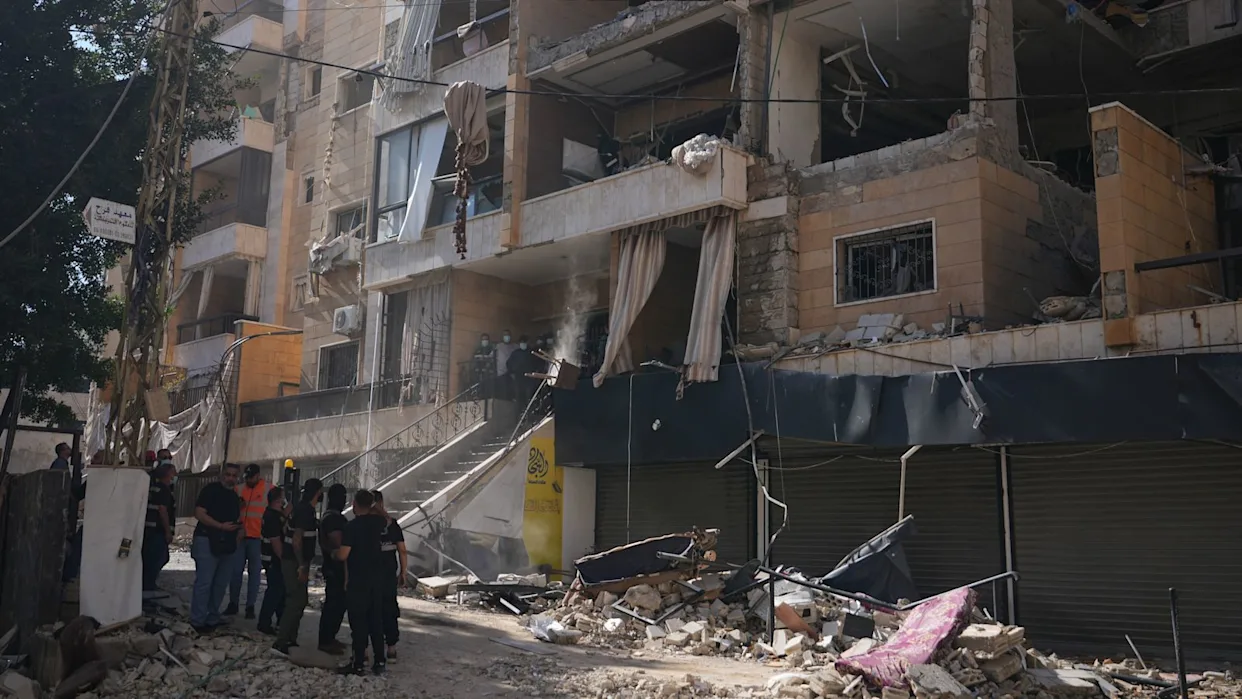

Israel carried out air strikes on southern Beirut on Sunday, marking the first attack on the Lebanese capital since a US-brokered truce was announced last week.
Get today's headlines by email 
According to Lebanon's health ministry, two people were killed and at least 20 others injured when two apartment buildings in the Dahieh district, a Hezbollah stronghold, were hit. The wounded included four women and four children.
Israeli Prime Minister Benjamin Netanyahu said the strikes targeted what he described as "terrorist headquarters" in response to Hezbollah rocket fire into Israeli territory. Hezbollah later confirmed it had launched attacks against Israeli military positions.
Strike Hits Residential Area
One of the strikes heavily damaged a residential building, exposing lower-floor apartments and scattering debris across nearby streets. Videos shared on social media showed residents and emergency workers rushing to assist those injured in the attack.
Before the strikes, an Israeli military spokesperson issued a warning in Arabic on X, saying Hezbollah infrastructure was being targeted and suggesting additional operations could follow, ending the message with the words: "To be continued."
The Israeli military said it intercepted two projectiles fired from Lebanon into Israel.
Hezbollah Claims Responsibility
In a statement issued later on Sunday, Hezbollah said it had fired rockets at Israeli artillery positions at Yiftah Barracks and at troops near al-Marj Pond.
The group said the attacks were retaliation for what it described as Israeli violations of the ceasefire and continuing strikes on villages in southern Lebanon.
Iran also reacted strongly. Ebrahim Rezaie, spokesperson for the Iranian parliament's foreign policy and national security committee, warned that Israel would face a "decisive and painful response" for the Beirut attack.
Concerns Over Ceasefire Stability
The strike comes despite diplomatic efforts by the United States to contain the conflict. In the days before the 3 June truce, Israel had threatened a wider offensive against Dahieh, prompting many residents to flee and triggering intensive US diplomatic intervention.
US President Donald Trump later announced that there would be "no troops going to Beirut" following discussions with Netanyahu. Washington also informed Qatar, which had been involved in mediation efforts, that it had urged Israel to stand down.
However, speaking to NBC's Meet the Press on Sunday, Trump said Lebanon was not a required part of any broader peace agreement involving Iran, effectively separating the Lebanese conflict from negotiations with Tehran.
Conflict Continues Despite Truce
The latest violence follows months of fighting between Israel and Hezbollah. Lebanon became directly involved in the conflict on 2 March when Hezbollah launched rockets into Israel after an Israeli strike that killed Iran's supreme leader.
Israel responded with a large-scale air campaign across Lebanon and later launched a ground offensive in the country's south.
Although a ceasefire has officially been in place since 17 April, both sides have repeatedly accused each other of violating it.
Sunday's attack was the third Israeli strike on Beirut since the ceasefire began and the first targeting the capital since last week's truce announcement. The previous two strikes reportedly targeted Hezbollah commanders.
Political tensions also remain high within Lebanon. Parliament Speaker Nabih Berri, an ally of Hezbollah and leader of the Amal movement, recently rejected the US-brokered agreement, arguing it failed to address Israeli withdrawal from occupied areas in southern Lebanon.
Meanwhile, Hezbollah leader Naim Qassem said this week that disarming the group would serve "the enemy's objectives", underscoring the continuing divisions over any long-term settlement.
Join the discussion? 
Already a member? 
 Adapted by ASEAN Now. Source 8 June 2026
Recommended Comments
Create an account or sign in to comment