



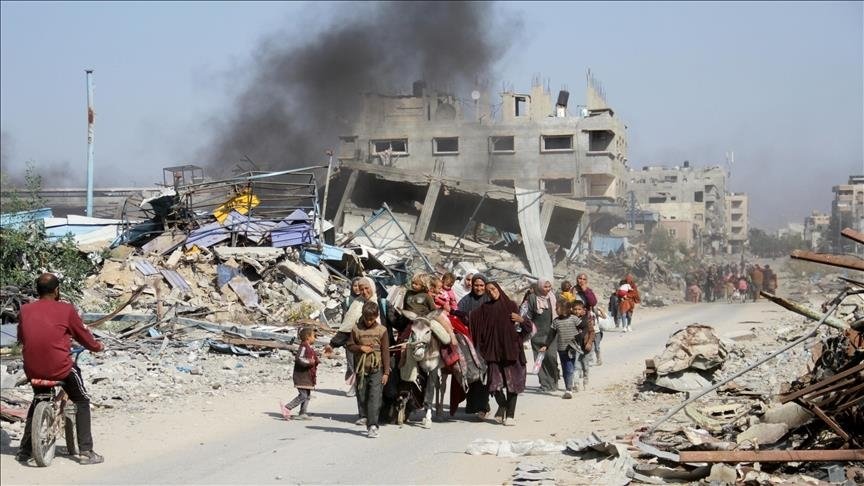

Israel has issued its largest evacuation order in southern Lebanon since a ceasefire came into effect last month, warning residents across a wide area to leave ahead of what it described as intensified military action against Hezbollah.
Get today's headlines by email 
The Israeli military said areas south of the Zahrani River were now considered “combat zones” and urged civilians to move north. The order affects around 300 towns and villages, covering roughly 14% of Lebanese territory.
The Israel Defense Forces said it would act “with extreme force”, accusing Hezbollah of repeatedly violating the ceasefire agreement.
Rising fears of escalation
The evacuation warning followed a series of Israeli air strikes on Wednesday, including attacks on the southern Lebanese city of Tyre. Hezbollah later said its fighters had clashed with Israeli troops.
Israeli Prime Minister Benjamin Netanyahu announced an expansion of Israel’s ground operations after Hezbollah launched drone attacks targeting Israeli troops in southern Lebanon and civilians in northern Israel.
The Israeli military has issued nine evacuation warnings over the past 24 hours, increasing concerns that fighting along the Israel-Lebanon border could intensify further and trigger another wave of displacement.
Residents in Tyre described scenes of panic after evacuation notices were followed quickly by air strikes. People gathered near the city’s port carrying belongings as explosions hit nearby areas.
A local resident named Rida, whose home and cafe had previously been destroyed in an earlier strike, said many people were fleeing the city in fear.
Displacement pressures grow
Humanitarian workers and Lebanese officials warned that cities already hosting displaced families were struggling to cope with the growing number of arrivals.
Officials said the coastal city of Sidon could no longer absorb large numbers of displaced residents, urging people instead to seek shelter in the Beqaa Valley and Mount Lebanon regions.
Lebanese media also reported Israeli strikes across southern Lebanon and the eastern Bekaa Valley on Wednesday. Four people were reported killed in the towns of Choukine and Nabatieh.
The latest attacks came after a heavy wave of Israeli bombardments over the previous 24 hours, during which more than 150 strikes reportedly hit around 50 towns and villages across southern Lebanon and the Bekaa Valley.
Lebanon’s health ministry said at least 31 people were killed on Tuesday alone, including 15 in Burj al-Shamali near Tyre.
Hezbollah said its fighters had engaged Israeli troops “at point-blank range” in Zawtar al-Sharqiyeh, north of the Litani River and outside an Israeli-declared buffer zone.
Ceasefire tensions deepen
Speaking during a cabinet meeting on Tuesday evening, Netanyahu said Israeli forces were “deepening” operations beyond areas already occupied near the border.
“We are fortifying the security zone to protect the communities of the north,” he said.
Israeli officials argue that Hezbollah’s attacks breach the temporary ceasefire agreement reached between Israel and Lebanon, which has already been extended twice since taking effect in April.
Lebanese officials, however, say Israel’s continued strikes also violate the agreement.
The worsening violence threatens broader diplomatic efforts involving the United States, Israel and Iran to end the regional conflict. Iran has said any future deal must also address the situation in Lebanon, while Israel maintains it will continue military operations against Hezbollah.
The conflict expanded on 2 March after Hezbollah launched rockets into Israel following an Israeli strike that killed Iran’s supreme leader. Israel responded with a major air campaign and ground invasion in Lebanon.
According to Lebanon’s health ministry, at least 3,213 people have been killed in Lebanon since the war began, although the figures do not distinguish between civilians and combatants.
Israel says 23 soldiers and four civilians have been killed on both sides of the border during the conflict.
Join the discussion? 
Already a member? 
 Adapted by ASEAN Now. Source 28 May 2026
Recommended Comments
Create an account or sign in to comment