



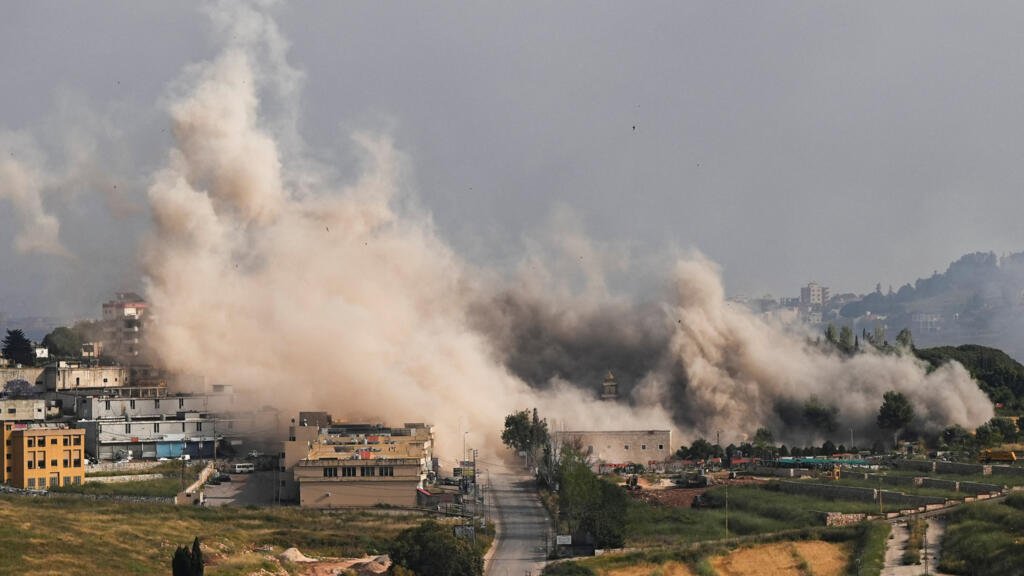

Israel carried out air strikes in southern Lebanon on Saturday after warning residents to evacuate around 20 locations, according to Lebanese state media.
Get today's headlines by email 
The Lebanese National News Agency reported that at least one person was killed in a strike on the town of Marrakeh in the Tyre district. The attacks came after Israeli Prime Minister Benjamin Netanyahu warned that Israel would target Hezbollah if the group continued attacks on northern Israel.
Peace Deal Moves Closer
The strikes coincided with growing optimism over negotiations aimed at ending hostilities between Iran and the United States.
Pakistani Prime Minister Shehbaz Sharif, whose government is helping mediate the talks, said on X that the parties were closer than ever to reaching a peace agreement. He said finalisation of the deal could come within 24 hours and later added that preparations were under way for an electronic signing of the accord.
Iranian Foreign Minister Seyed Abbas Araghchi also said an agreement was near. According to Araghchi, the proposed deal would not only end fighting between Iran and the US but could also help bring an end to the conflict involving Hezbollah in Lebanon.
He said the agreement would reopen the Strait of Hormuz and include the lifting of a US blockade on Iran. Discussions on Iran's nuclear programme, however, would take place during a later phase of negotiations.
Details of the Proposed Agreement
US officials have confirmed elements of the framework, while stressing that economic benefits for Iran would depend on Tehran meeting its commitments.
Under the proposal, the Strait of Hormuz would reopen and restrictions on Iranian shipping would be eased. A subsequent 60-day negotiation period would focus on Iran's stockpile of enriched uranium, which US officials say would ultimately be destroyed and removed from the country, although the exact process remains under discussion.
Washington also rejected reports suggesting Iran would receive immediate access to frozen assets. Instead, sanctions relief and broader economic reintegration would occur gradually as Iran fulfilled verified obligations.
The agreement would also require Iran to end support for regional proxy groups, including Hezbollah and other allied organisations across the Middle East.
US officials said the arrangement was based on verifiable actions rather than trust, with economic incentives linked to confirmed compliance.
Cautious Optimism Remains
The current conflict began on 28 February when US and Israeli forces launched strikes across Iran. Tehran responded with attacks against Israel and US-aligned Gulf states and effectively closed the Strait of Hormuz, a vital route for global oil and liquefied natural gas shipments.
Although Iran and the US agreed to a ceasefire in April, both sides have continued exchanging intermittent strikes, including two rounds of retaliatory attacks this week.
US President Donald Trump said on Thursday that he had cancelled planned attacks on Iran because negotiators had reached what he described as a major settlement.
Despite the positive signals from Washington, Tehran, Islamabad and mediator Qatar, officials acknowledge that the agreement has not yet been formally approved. Araghchi said Iran's Supreme National Security Council still contains both supporters and opponents of the latest terms.
"If approved, the agreement will be signed remotely," he said, adding that he remained hopeful a final accord could be announced within days.
Join the discussion? 
Already a member? 
 Adapted by ASEAN Now. Source 13 June 2026
Recommended Comments
Create an account or sign in to comment