



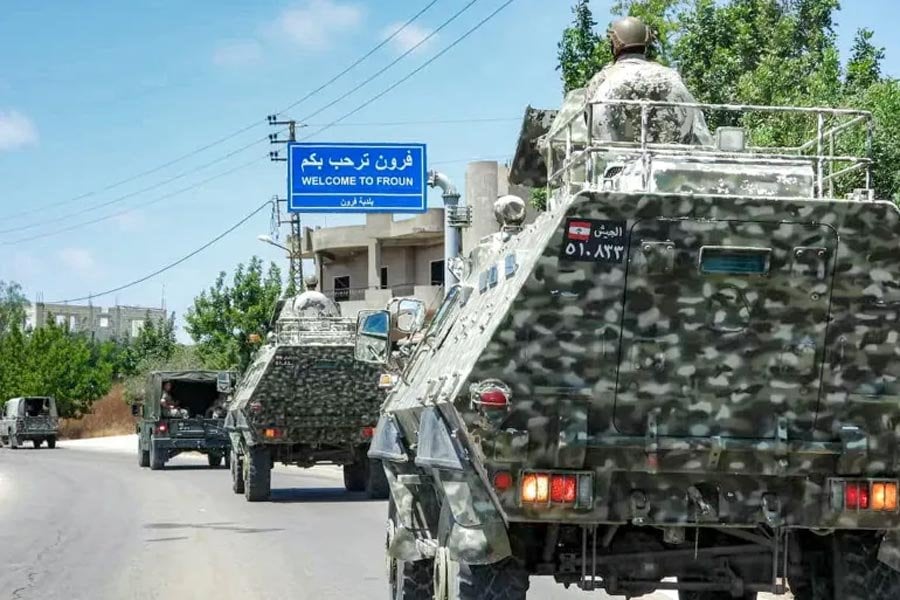

Lebanon's army has begun deploying troops to a designated "pilot zone" in the country's south following a partial Israeli withdrawal under a US-brokered agreement reached last month.
Pilot zone deployment begins
Engineering units entered the village of Zawtar al-Gharbiyeh in Nabatieh district on Tuesday, the Lebanese army said. The deployment is part of a plan that envisions Israeli forces withdrawing from limited areas occupied during the conflict with Hezbollah while the Lebanese Armed Forces expand their presence and work toward disarming the Iran-backed group.
The operation started ahead of a meeting in Washington between US President Donald Trump and Lebanese President Joseph Aoun.
Troops come under fire
Later on Tuesday, Lebanon's army said Israeli forces opened fire near its troops, warning that the incident could hinder implementation of the pilot zone plan.
Israel's military said its soldiers fired warning shots after Lebanese troops and an engineering vehicle crossed about 150 metres into the Israeli-declared security zone and breached barriers near neighbouring Zawtar al-Sharqiyeh. It said the Lebanese forces withdrew and no injuries were reported.
The Lebanese army urged residents not to return to Zawtar al-Gharbiyeh until the security situation stabilised and to follow instructions from deployed troops.
The US State Department announced on Monday that pilot zone operations had begun in Zawtar al-Gharbiyeh, Froun and Srifa under the Trilateral Framework agreed by Lebanon, Israel and the United States at the end of June. The agreement followed talks between Israeli and Lebanese representatives in Rome last week.
An Israeli military official said the Israel Defense Forces would adjust their deployment in one pilot area to allow the Lebanese army to carry out its mission while maintaining security and retaining the right to respond to threats.
Israel also reiterated it would keep troops inside its 10km-deep security zone along the border for as long as it considered necessary to protect northern Israeli communities.
Trump backs Lebanon
During his White House meeting with Trump, Aoun said he had requested political backing and support for the Lebanese Armed Forces as they seek to extend state control into areas where Hezbollah has long operated.
Trump said the United States would continue supporting Lebanon, describing the country as having suffered for decades. He also said Washington had "concrete plans" to help Lebanon build the capacity to disarm Hezbollah, although he gave no further details. Trump added he would speak directly with Hezbollah representatives if Aoun requested it.
Tensions remain high
Hezbollah has rejected the agreement linking Israel's withdrawal from southern Lebanon to the group's disarmament, saying the conditions crossed "all red lines". Israel has insisted it will not fully withdraw until Hezbollah is disarmed.
Elsewhere on Tuesday, Lebanon's state-run National News Agency reported explosions near Beit Yahoun, Kounine and Majdal Zoun, attributing them to Israeli military activity. Israel says it has been destroying Hezbollah infrastructure, while human rights groups have accused it of deliberately destroying civilian infrastructure, allegations that could amount to war crimes.
The conflict escalated on 2 March after Hezbollah launched rockets into Israel following a strike that killed Iran's supreme leader. Israel responded with a large-scale air campaign and a ground offensive in southern Lebanon.
According to Lebanon's health ministry, more than 4,300 people have been killed in Lebanon during the conflict, including nearly 800 children, women and medics. Israeli authorities say 37 soldiers and four civilians have been killed on both sides of the border.
Join the discussion? 

22 July 2026
-
 1
1
Recommended Comments
Create an account or sign in to comment