



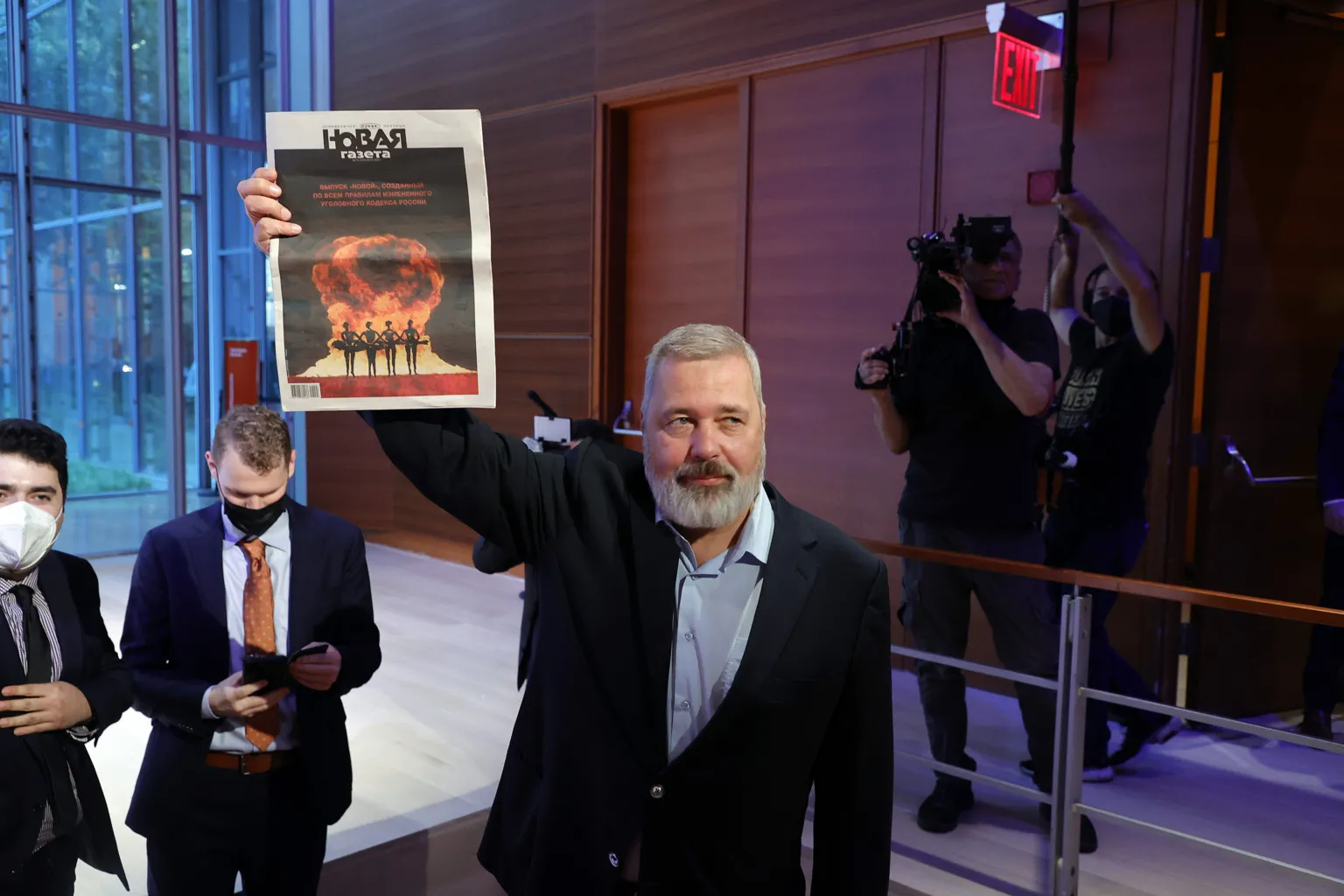

At the offices of the independent newspaper Novaya Gazeta in Moscow, former staff describe an atmosphere of emptiness after the paper was driven from print and subjected to restrictions online.
Dmitry Muratov, who co-founded the outlet more than three decades ago and shared the Nobel Peace Prize in 2021, said the newspaper no longer exists in its original form. Speaking at the publication’s offices, he told the BBC that “there is no newspaper anymore”.
Nobel recognition, then shutdown
Muratov shared the Nobel Peace Prize for efforts “to safeguard freedom of expression”. The Nobel Committee cited the deaths of six Novaya Gazeta journalists, including Anna Politkovskaya, whose reporting included articles about the war in Chechnya.
He said the award did not prevent the authorities from moving against the paper. Muratov said a Kremlin decree led to the nationalisation of Novaya Gazeta’s printing presses and that the newspaper’s registration was revoked.
Online, the paper remains but access is heavily limited. Muratov said authorities have blocked access to its website, which can only be reached from abroad or by using VPNs, virtual private networks used to bypass restrictions.
Crackdown since Russia’s invasion
Muratov said the fate of Novaya Gazeta reflected a wider clampdown on free speech that has intensified since Russia’s full-scale invasion of Ukraine in 2022.
He said most opinion leaders have been branded “foreign agents”, “extremists” or “terrorists”, adding that “several hundred” people have been affected. He also said figures vary, but that at a conservative estimate at least 1,500 people have been jailed since the start of Russia’s “special military operation” for speaking out against state policy.
He compared the scale to the Soviet Union’s era of political repression, saying it was about three times higher than during the worst years of the KGB.
Questioning claims of victory
President Vladimir Putin has continued to predict victory in Ukraine. Muratov challenged that framing, saying the war can no longer be described as success “no matter how it ends”.
He said the conflict has caused mass destruction and deaths in Ukraine and Russia, describing it as impossible to treat as a victory given the human toll.
Muratov also said that in his view Ukraine could be “destroyed” but not “conquered”, warning that continued escalation could include the use of a nuclear weapon.
He dismissed speculation about what Putin may or may not intend. Muratov said attempts by “political experts” to claim knowledge of the Kremlin leader’s thinking are akin to unreliable guesswork, and he added that he does not know what is in Putin’s mind.
Prisoners and barriers to dissent
Muratov said nuclear weapon use has been discussed repeatedly by public voices, including on state television. He claimed that since the beginning of the year the idea has been raised more than 500 times and said that at the St Petersburg International Economic Forum one speaker praised the use of nuclear weapons as favourable.
He said Putin’s argument in announcing the invasion—promoting Russia’s security—had not translated into improved safety. Muratov cited what he described as ongoing impacts including attacks by Ukrainian drones on warehouses of Wildberries, a petrol crisis, disruption to mobile internet and continued imprisonment of political detainees.
Muratov said he believes Putin retains control of Russia despite polling showing lower approval ratings. He said he does not accept claims that the elite is split, and that fear of Putin is reinforced by the Federal Security Service, the FSB.
He also described the legal limits faced by people branded “foreign agents”, saying the label can bar individuals from teaching and from participating in elections, and restricts access to assets after selling property. Muratov said the purpose is also to stigmatise critics and create an “enemy within” narrative.
In a series of photographs, he highlighted cases of people jailed for opposing the state or the war. He cited journalists Antonina Favorskaya, Konstantin Gabov, Sergey Karelin and Artyom Kriger, saying they were convicted on extremism charges after accusations of links to Alexei Navalny’s anti-corruption organisation. He also mentioned Alexei Gorinov, a city councillor jailed for knowingly spreading false information about the Russian military after speaking out against the war.
Muratov said pianist Pavel Kushnir was arrested after posting anti-war videos and died in pre-trial detention during a hunger strike at the age of 39.
He added that in April police searched Novaya Gazeta’s office while the newspaper’s lawyer tried to enter, and that the search lasted 13 hours. Muratov said the lawyer was not allowed inside, and that the paper’s managing editor, Oleg Roldugin, is now under house arrest.
Hope in support
Asked whether being a Nobel Peace laureate offers protection, Muratov said it was not a question for him and that it should be put to the authorities instead.
Despite the pressure, Muratov said colleagues still receive support in Moscow, describing gratitude from people who he said speak quietly.
Join the discussion? 

13 August 2026
-
 1
1
Recommended Comments
Create an account or sign in to comment