



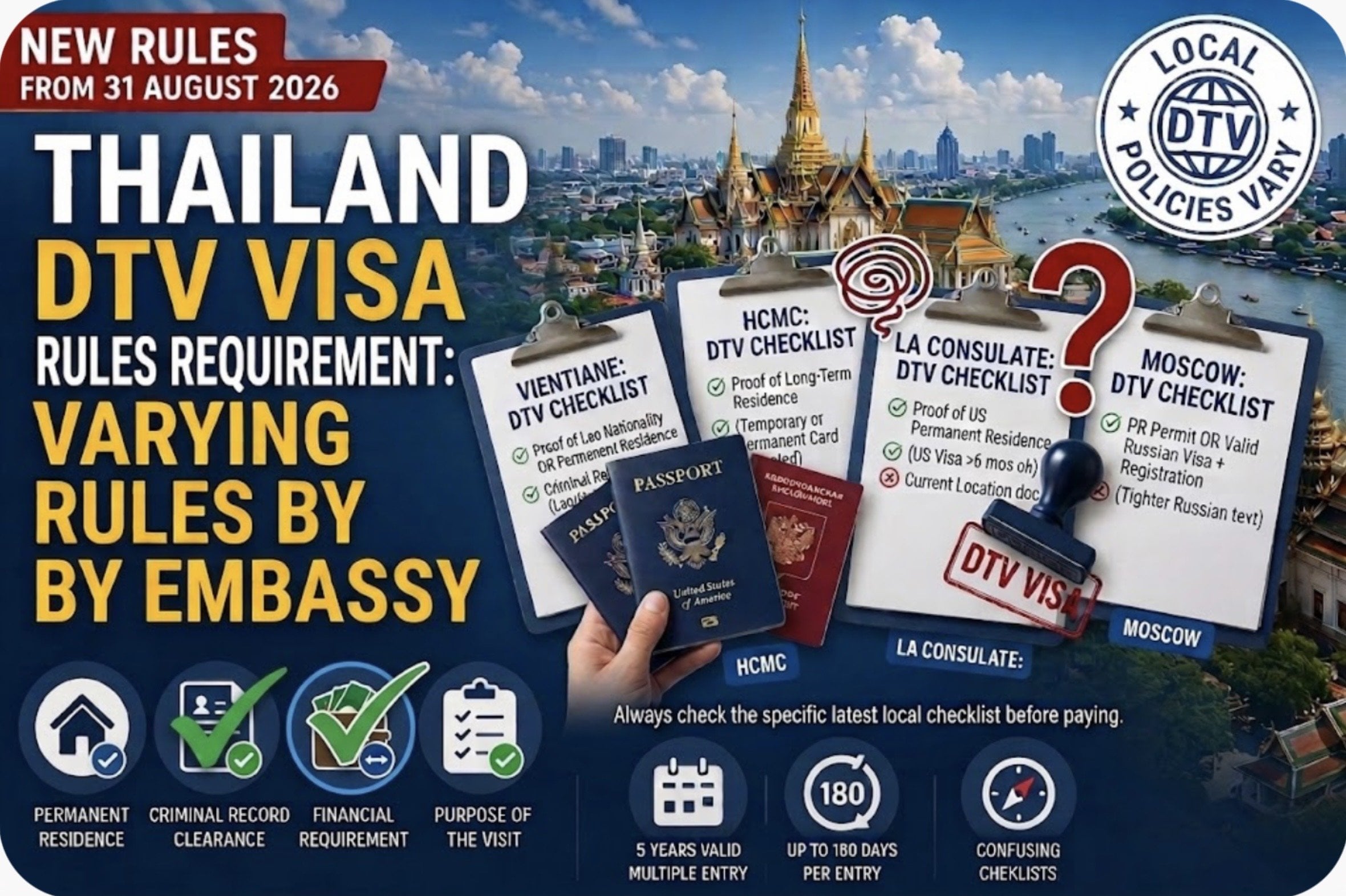

Thailand's revised Destination Thailand Visa rules, effective from 31 August, have created uncertainty for applicants applying outside their home country as Thai embassies and consulates publish differing residence requirements.
The Department of Consular Affairs replaced the previous requirement for proof of an applicant's current location with proof of permanent residence. Applicants must now also submit a criminal record clearance certificate.
Applications lodged through the Thai e-Visa system before 31 August will continue to be assessed under the previous document rules.
For foreigners hoping to use the five-year, multiple-entry DTV for remote work, digital-nomad life or eligible activities in Thailand, the practical issue is that a visa or residence document accepted by one Thai mission may not be enough at another. Applicants should check the latest checklist from the embassy or consulate where they intend to apply before paying a visa fee.
Different standards in neighbouring countries
The Royal Thai Embassy in Vientiane says DTV applicants must be either Lao nationals or permanent residents of Laos. Its guidance, first published in 2023 and updated on 28 August 2026, includes the rules introduced on 31 August.
Applicants using Vientiane must also provide a criminal record clearance certificate issued by Laos or their country of nationality.
By contrast, the Royal Thai Consulate-General in Ho Chi Minh City asks applicants for proof of long-term residence in Vietnam. It specifically accepts either a Temporary Residence Card or a Permanent Residence Card, potentially allowing some foreigners with temporary but long-term Vietnamese status to apply there.
US and Moscow guidance raises questions
The Royal Thai Consulate-General in Los Angeles takes a broader approach. Its information says proof of permanent residence can include a valid driving licence, a valid US visa or a permanent resident card.
The Los Angeles DTV page, updated on 1 September, says non-US citizens may submit either a permanent resident alien card or a valid US visa with at least six months remaining. However, the same page still lists a document showing the applicant's current location elsewhere in its checklist.
In Moscow, the embassy's English-language DTV page, updated on 12 September, requires proof of permanent residence in the country of application. Yet separate requirements for non-Russian citizens allow either a permanent residence permit or a valid Russian visa accompanied by a registration paper.
A Russian-language embassy announcement issued on 12 September uses tighter wording, saying Moscow applications are available to citizens of Russia, Belarus, Armenia, Uzbekistan or Moldova, or nationals of other countries with permanent-resident status in one of those five countries.
That differs from an English-language notice published on 2 September, which explained the nationwide changes without setting out country-specific eligibility conditions.
Department has not defined qualifying documents
The Department of Consular Affairs' 28 August announcement does not define which residence permits, temporary visas or other documents qualify as proof of permanent residence.
The result is a range of published standards, from Vientiane's nationality or permanent-residence rule to Ho Chi Minh City's acceptance of temporary residence cards and Los Angeles' acceptance of a valid US visa.
The DTV remains available to qualifying remote workers and digital nomads, people visiting Thailand for eligible activities, and eligible family members of DTV holders. Thai missions may also request additional documents in individual cases.
Join the discussion? 

16 September 2026
Recommended Comments
Create an account or sign in to comment