



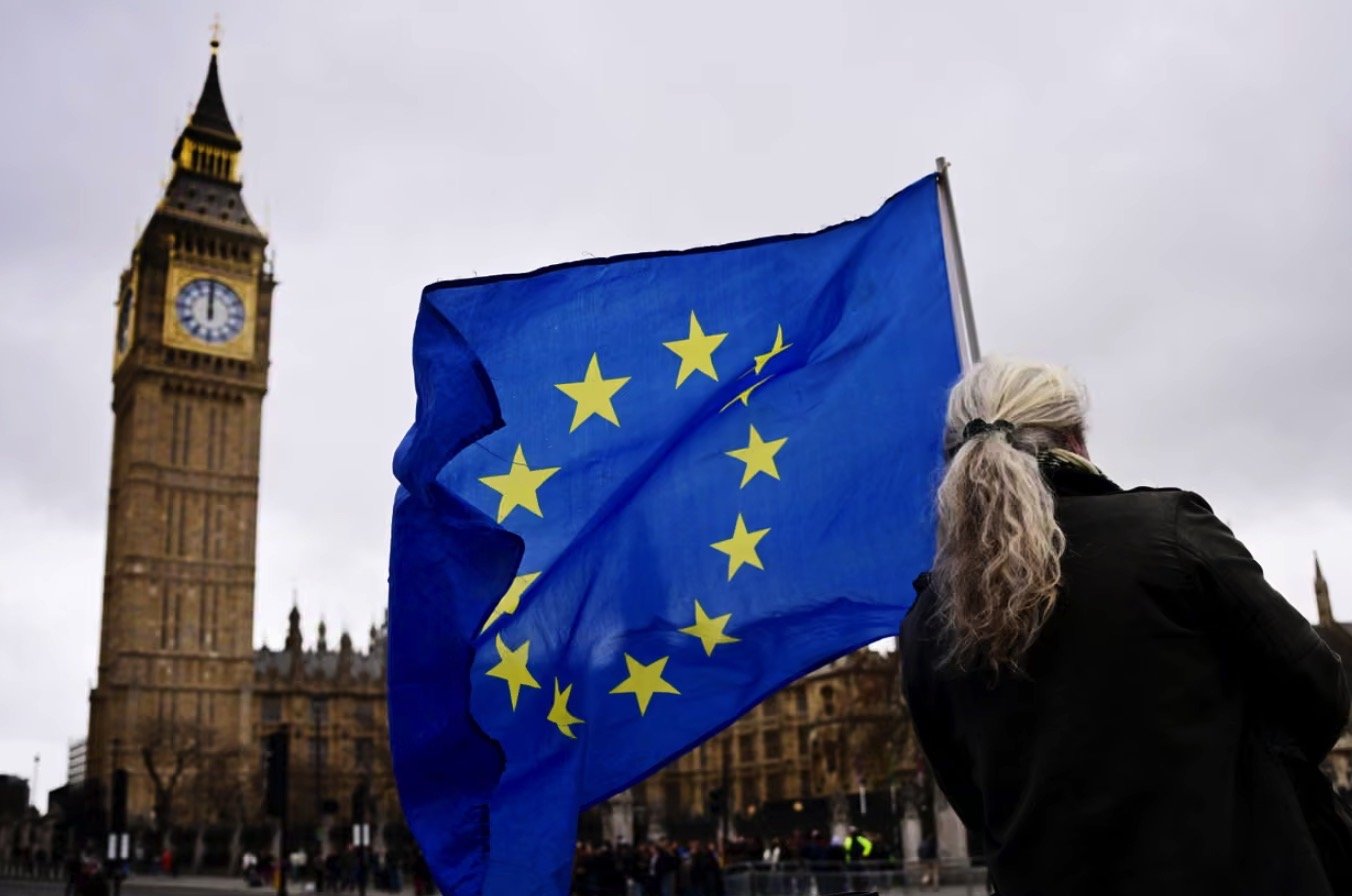

Support for the United Kingdom rejoining the European Union has risen to a majority of voters, according to new polling released nearly ten years after the country voted to leave the bloc.
Get today's headlines by email 
The research suggests that while many voters still back the government’s current approach to managing relations with the EU, enthusiasm for that strategy is limited. Analysts warn that the governing Labour Party could face political risks if it maintains a cautious stance on the issue.
Majority Back EU Membership
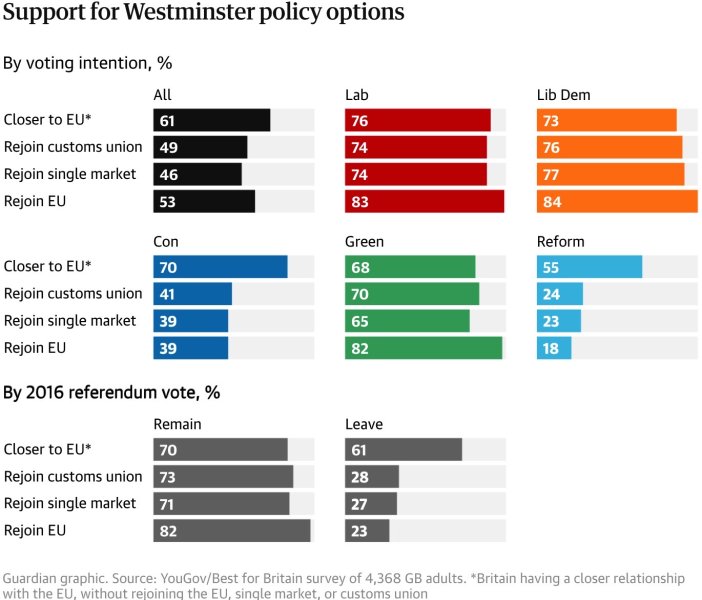
The survey found that 53% of voters support the UK rejoining the EU, with particularly strong backing among supporters of centre-left parties.
Among Labour voters, support for returning to the EU reached 83%, while 84% of Liberal Democrat voters and 82% of Green Party voters expressed the same view.
Backing for the policy was lower among right-leaning voters. The research indicated that 39% of Conservative supporters and 18% of Reform voters favoured rejoining the bloc.
The findings come from research conducted by Best for Britain, a civil society group that campaigns for closer ties between the UK and Europe.
Despite the growing support for EU membership, the government’s current approach to relations with Brussels still received approval from 61% of voters overall. However, only 19% said they supported the policy strongly.
Questions Over Labour’s Strategy
Researchers and political analysts say Labour’s cautious messaging on Brexit could create electoral pressures.
Tom Brufatto, director of policy and research at Best for Britain, said policies that fall between full integration and clear separation could struggle to satisfy voters.
The research examined six possible approaches to the UK’s relationship with the EU. These included continuing Labour’s current strategy, maintaining the Brexit deal negotiated by former prime minister Boris Johnson, diverging further from EU rules, joining the customs union and single market, or fully rejoining the EU.
Brufatto said returning to the customs union and single market would present major political challenges because it would reopen debates over sovereignty and regulatory control.
Such arrangements would require the UK to adopt large areas of EU regulation, he said, potentially making it difficult for any party to sustain public support during lengthy negotiations.
Concerns About ‘Rule-Taking’
Under Labour’s existing policy, the UK would align with certain EU standards without rejoining the single market, a position critics say leaves Britain adopting regulations it has little influence over.
The government has already pursued agreements aimed at easing trade barriers, including a sanitary and phytosanitary (SPS) deal designed to simplify procedures for agricultural exports.
However, negotiations over that agreement highlight the regulatory complexity involved. Since leaving the EU in 2020, the UK has diverged from 76 EU rules connected to the SPS framework.
At a Westminster event presenting the research, polling expert John Curtice questioned Labour’s low-profile approach to Brexit. He suggested that the party risked losing more support among pro-European voters than it might lose to pro-Brexit parties.
Curtice said Labour had lost roughly one in ten voters to Reform but around one in four to the Liberal Democrats and Greens.
Long-Term Debate Over Brexit
Former Labour leader Neil Kinnock said he believed the UK would eventually seek to return to the EU, although he did not suggest when that might happen.
He argued that Brexit had caused significant harm to the country and predicted that public opinion could shift further over time.
Anand Menon, director of the research organisation UK in a Changing Europe, said Labour’s position reflects a tension between acknowledging the economic costs of Brexit and proposing only limited policy changes.
He noted that estimates cited by the government suggest Brexit has reduced the size of the UK economy by around 8% of GDP, while the planned reset in relations with the EU is expected to generate growth of about 1%.
Menon added that the strategy of aligning with EU rules sector by sector could require continuous monitoring to prevent regulatory divergence, creating an ongoing administrative burden for policymakers.
Join the discussion? 
Already a member? 
 Adapted by ASEAN Now. Source 18 April 2026
-
 1
1
Recommended Comments
Create an account or sign in to comment