



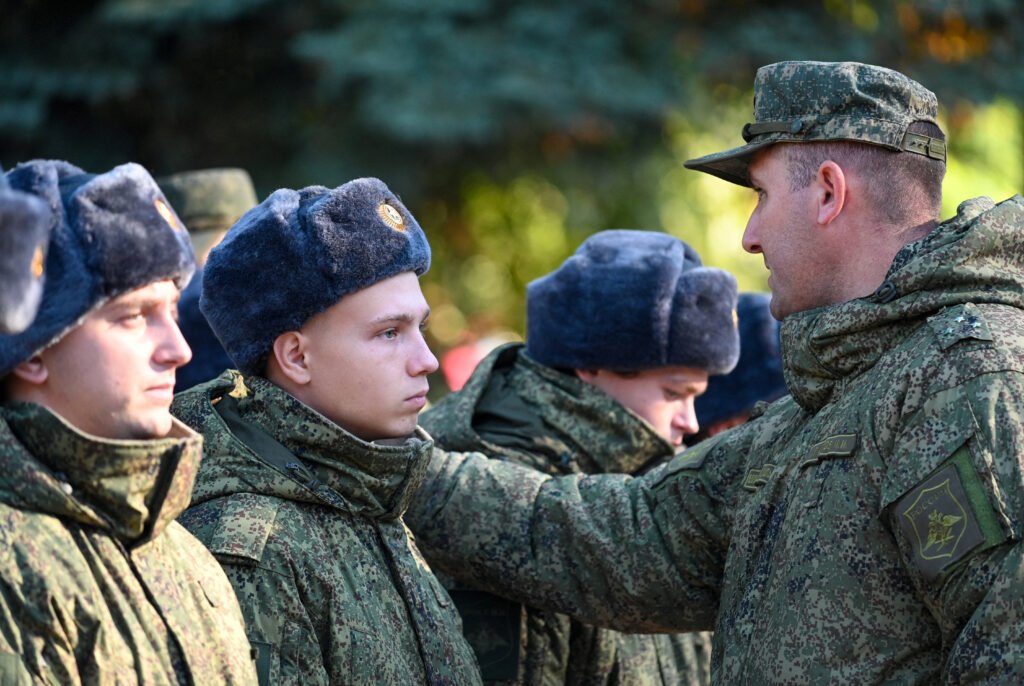

Russia is increasingly recruiting university, technical college and vocational school students to help replenish military ranks as the war in Ukraine continues into its fifth year. The campaign, launched earlier this year, encourages young people to sign one-year military contracts to serve in the country's expanding drone forces, which are promoted as a technologically advanced and comparatively safer branch of the armed forces.
Get today's headlines by email 
Student recruitment expands as war enters fifth year
The initiative has focused particularly on students facing academic difficulties or considering taking a break from their studies. Recruiters have highlighted generous financial incentives, technical training and the opportunity to return to education after completing service.
However, the deaths of several young recruits have raised questions about the reality of those promises.
Families describe unexpected frontline deployments
Among the first known student recruits killed was 23-year-old Valery Averin, who had been studying at the Buryat Republican Technical School of Construction. Raised in an orphanage before entering foster care at the age of 11, Averin told his foster mother, Oksana Afanayeva, that he had completed training as a drone operator and reassured her that he would be safe.
He initially claimed he was leaving to work for Russian online retailer Wildberries before revealing he had signed a military contract. In early April, he said he was being sent to an area without phone coverage. Days later, on 8 April, he was killed in a mortar strike near Russian-occupied Luhansk in eastern Ukraine.
Afanayeva said he had received three months of drone training but was instead sent into a frontal assault despite having no previous military service.
Eighteen-year-old Vladislav Gorbunov, a railway construction student from the Bryansk region, died on 6 April after initially serving in an infantry assault unit before being transferred to a drone operators' unit.
Another recruit, Rakhim Abdullin, enrolled at Kumertau Mining College to train as a welder before leaving his studies. Shortly after turning 18, he signed a contract hoping to become a drone operator because he believed the role would be safer. His mother, Elena, said he soon discovered drone operators were positioned close to frontline assault troops. He was killed by 13 March.
Heavy losses and growing recruitment
The three students are among 230,407 Russian military deaths verified by the BBC through analysis of cemeteries, official registers, war memorials and obituaries. Military analysts estimate publicly confirmed deaths represent only 45% to 55% of the total, suggesting the actual number of Russian military fatalities could range between 417,000 and 509,500.
The UK's intelligence agency GCHQ estimated in May that Russian military deaths were approaching 500,000.
Ukraine has also suffered heavy losses. President Volodymyr Zelensky most recently acknowledged 55,000 military deaths in February 2026, while noting many personnel remain missing. Other independent estimates suggest the total could be significantly higher.
Drone forces promoted despite battlefield risks
Russia's Defence Ministry has made drone warfare a recruitment priority as unmanned systems have become central to combat operations. Defence Minister Andrei Belousov said in late 2025 that the new unmanned systems troops would mainly recruit people under 35 because younger volunteers were considered more adaptable to emerging technologies.
By late February, BBC Russian found recruitment campaigns at at least 95 universities and colleges, while student publication Groza later identified almost 270 institutions promoting the contracts.
Students are promised substantial financial rewards, specialist training and educational benefits, with some in Moscow offered potential first-year earnings of at least five million roubles. Some universities have also advertised postgraduate advantages, subsidised study places and improved accommodation.
Lawyers and rights advocates, however, warn that one-year contracts may not be honoured because military agreements have effectively remained open-ended since Russia's partial mobilisation decree in September 2022.
Drone operators have also become prime battlefield targets. Analysis by BBC Russian, Mediazona and volunteers has confirmed at least 920 Russian drone operators have been killed since the full-scale invasion began in February 2022, with the true number likely to be considerably higher.
The investigation also found reports of pressure on students to enlist, including recruitment efforts targeting those facing expulsion or academic leave. Some institutions have reportedly been assigned enlistment quotas, although at least one university denied those claims.
Join the discussion? 
 Adapted by ASEAN Now. Source 4 July 2026
Recommended Comments
Create an account or sign in to comment