



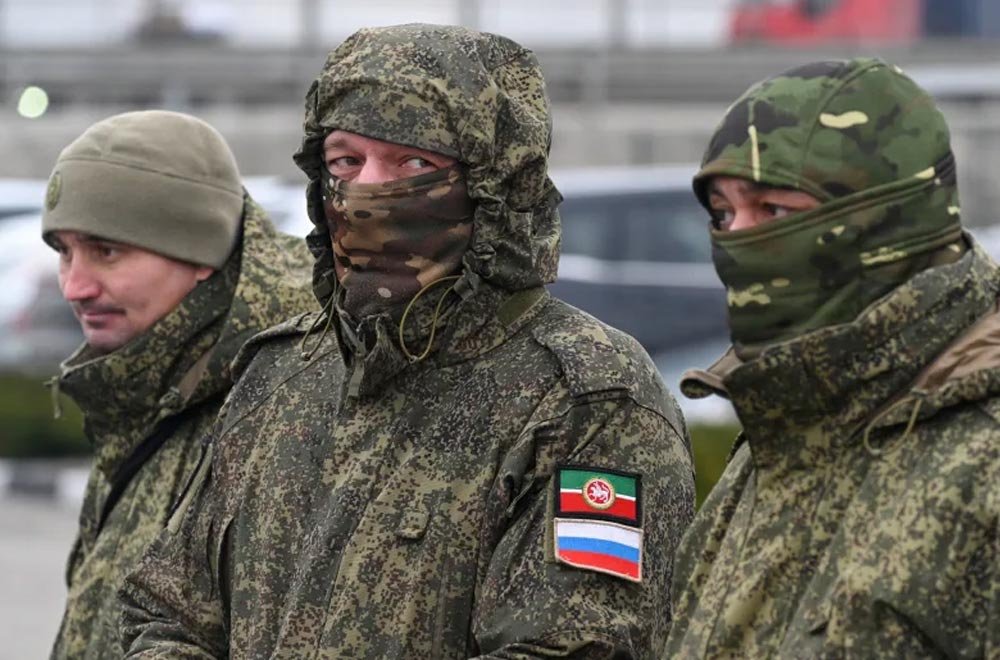

Russia's long-standing advantage in manpower over Ukraine is showing signs of weakening, despite increasingly generous financial incentives aimed at attracting recruits for the war.
Get today's headlines by email 
Military advertisements across Russia are offering signing bonuses worth millions of rubles, debt relief packages and promises of social status to encourage men to enlist. Some incentives are equivalent to several years of average earnings, while recent measures include writing off debts of up to $140,000 for those who join the armed forces.
Even so, recruitment appears to be slowing. According to Russian economy expert Janis Kluge, military enlistment fell by around 20% in the first quarter of 2026 compared with the previous year, suggesting that financial incentives may be losing their effectiveness.
Recruitment Challenges Grow
Since launching its full-scale invasion of Ukraine, the Kremlin has relied heavily on Russia's larger population and defence industry to sustain a prolonged war of attrition. Higher oil prices linked to tensions involving Iran have provided additional revenue for Moscow, but analysts argue that money alone cannot solve mounting manpower problems.
Nigel Gould-Davies, a senior fellow at the International Institute for Strategic Studies (IISS), said Russia is facing a situation in which troop losses may be exceeding the number of new recruits.
He noted that modern Russia has largely relied on financial incentives rather than compulsory service to fill its ranks, creating growing economic pressure. According to Gould-Davies, there are indications that the current recruitment model is becoming less effective.
Russia has already drawn heavily on alternative sources of manpower, including former prisoners, foreign recruits and several deployments of North Korean troops. The government has also sought to attract immigrants and expand recruitment efforts beyond traditional pools of volunteers.
Labour Shortages Hit the Economy
The war's impact extends beyond the battlefield. Analysts say Russia is experiencing a severe labour shortage as military recruitment and emigration have reduced the number of working-age men available to the civilian economy.
Defence factories are reportedly operating around the clock, leaving little room to expand production further. At the same time, competition for workers is pushing wages higher and contributing to inflationary pressures.
Some Western intelligence assessments estimate that nearly 500,000 Russian soldiers have been killed since the war began, while hundreds of thousands of people have left the country to avoid military service.
Analysts suggest the Kremlin may increasingly rely on foreign labour from countries such as India, North Korea and several African nations to offset shortages. More controversial options could include another large-scale mobilization campaign or tighter restrictions on men leaving the country, although such measures would likely be unpopular.
Economic Pressure Mounts
Maria Snegovaya of the Center for Strategic and International Studies argues that Russia may still be able to maintain recruitment by increasing pressure on poorer regions, students and foreign nationals. However, she says the economic burden of the war is becoming more visible.
Military personnel and recruitment spending account for a significant share of Russia's federal budget and economic output. Meanwhile, the country is facing sluggish growth, business closures and weak consumer confidence.
Although official inflation has moderated, households continue to face rising food and utility costs, while infrastructure disruptions linked to Ukrainian attacks have affected fuel supplies and transportation in some areas.
Ukraine Gains Through Innovation
At the same time, Ukraine is increasingly relying on technology to offset Russia's numerical advantages.
According to analysts, Ukrainian forces have made significant advances in drone warfare and unmanned systems. President Volodymyr Zelensky has said Ukrainian troops have successfully conducted operations using only drones and robotic systems, while thousands of unmanned ground missions were carried out during the first months of 2026.
Ukrainian military officials also claim Russia suffered net territorial losses for a second consecutive month in May, while drone operations inflicted casualties at a rate exceeding Russia's recruitment capacity.
Analysts say Russia's growing dependence on former prisoners and poorly trained recruits may further reduce battlefield effectiveness, even as Ukraine continues to develop new military technologies.
Join the discussion? 
Already a member? 
 Adapted by ASEAN Now. Source 14 June 2026
Recommended Comments
Create an account or sign in to comment