



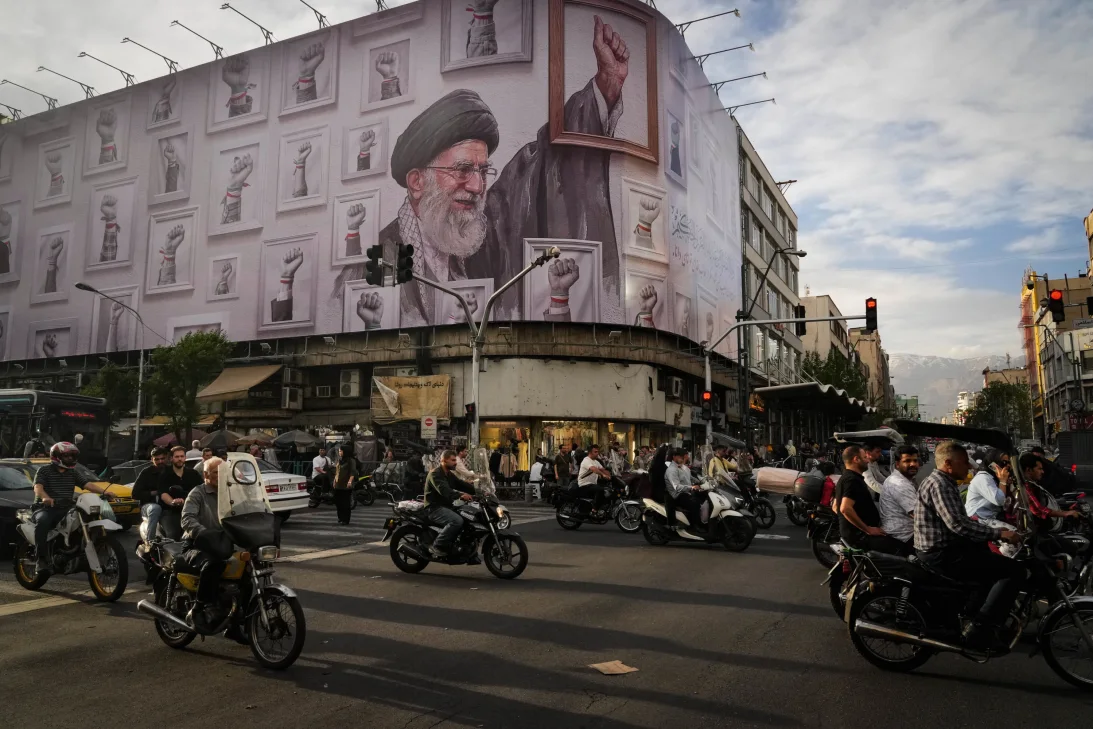

The war between the United States and Iran, initially expected to last little more than six weeks, has now entered its 10th week, leaving President Donald Trump struggling to find a path toward ending the conflict.
Get today's headlines by email 
Despite repeated claims from the White House that negotiations are making progress, the administration faces growing geopolitical and domestic constraints that complicate any clear exit strategy.
Iran’s continued resistance and its control over the strategic Strait of Hormuz have prevented Washington from securing a decisive outcome. At the same time, rising political pressure at home is narrowing the president’s room to manoeuvre.
Opinion polls show Trump’s approval rating in the 30s, while US gasoline prices have climbed above $4.50 a gallon. Public opposition to the conflict has also grown, increasing the pressure on the administration to end the war quickly.
Diplomatic push for a deal
Officials are now pursuing a potential agreement aimed at halting the fighting. According to reports, US and Iranian representatives are discussing a one-page memorandum through Pakistani mediators that would formally end hostilities and establish a 30-day period to resolve remaining disputes.
Iran is expected to deliver its response to the proposal to the mediators on Thursday. Some officials involved in the talks say negotiations have come closer to ending the conflict than at any previous point.
However, analysts caution that such a brief document would struggle to resolve the longstanding tensions between Washington and Tehran. These include disputes over Iran’s nuclear programme, its ballistic missile capabilities and its support for armed proxy groups across the region.
Tehran is also seeking extensive sanctions relief to revive its economy and wants to benefit financially from the passage of oil and gas shipments through the Strait of Hormuz.
Trump has repeatedly suggested in recent weeks that an agreement was imminent, only for talks to stall as negotiations continued.
Short-lived military initiatives
The conflict has also been marked by rapidly changing military strategies.
On Tuesday, Secretary of State Marco Rubio indicated that “Operation Epic Fury” — the main US military campaign — had effectively ended. He then promoted another initiative announced hours earlier by Trump known as “Project Freedom”.
The plan aimed to reopen the Strait of Hormuz by escorting vessels through the waterway. But the effort was halted within hours after only a small number of ships were guided to safety.
Trump said the decision to pause the operation was intended to support ongoing peace negotiations. However, the swift launch and suspension of the initiative added to perceptions of uncertainty surrounding US strategy.
Several earlier measures had also failed to produce the decisive result the administration sought. These included a joint US-Israeli bombing campaign targeting Iranian leadership and military facilities, as well as naval blockades of Iranian ports and shipping.
Despite heavy losses among its leadership, Iran’s governing structure — including the powerful Islamic Revolutionary Guard Corps — has remained intact.
Challenges of securing a decisive outcome
Military analysts say the conflict illustrates the difficulties powerful nations can face when confronting smaller states using asymmetric tactics.
US officials argue that Iranian naval and air capabilities have been severely damaged and that military infrastructure has been significantly weakened. However, the administration has avoided deploying large numbers of ground troops — a decision seen as limiting the prospects for a clear battlefield victory.
Meanwhile, Iran’s use of the Strait of Hormuz as leverage has affected global energy markets and added economic pressure on the United States and its allies.
Experts say the gap between American military capabilities and the ability to achieve a lasting strategic result remains significant.
There has been no widespread uprising inside Iran, and Tehran has not agreed to abandon its nuclear ambitions or dismantle its regional networks of allied groups.
With the strait still closed and oil prices elevated, diplomats and analysts say the conflict remains unresolved despite ongoing negotiations.
Join the discussion? 
Already a member? 
 Adapted by ASEAN Now. Source 8 May 2026
Recommended Comments
Create an account or sign in to comment