



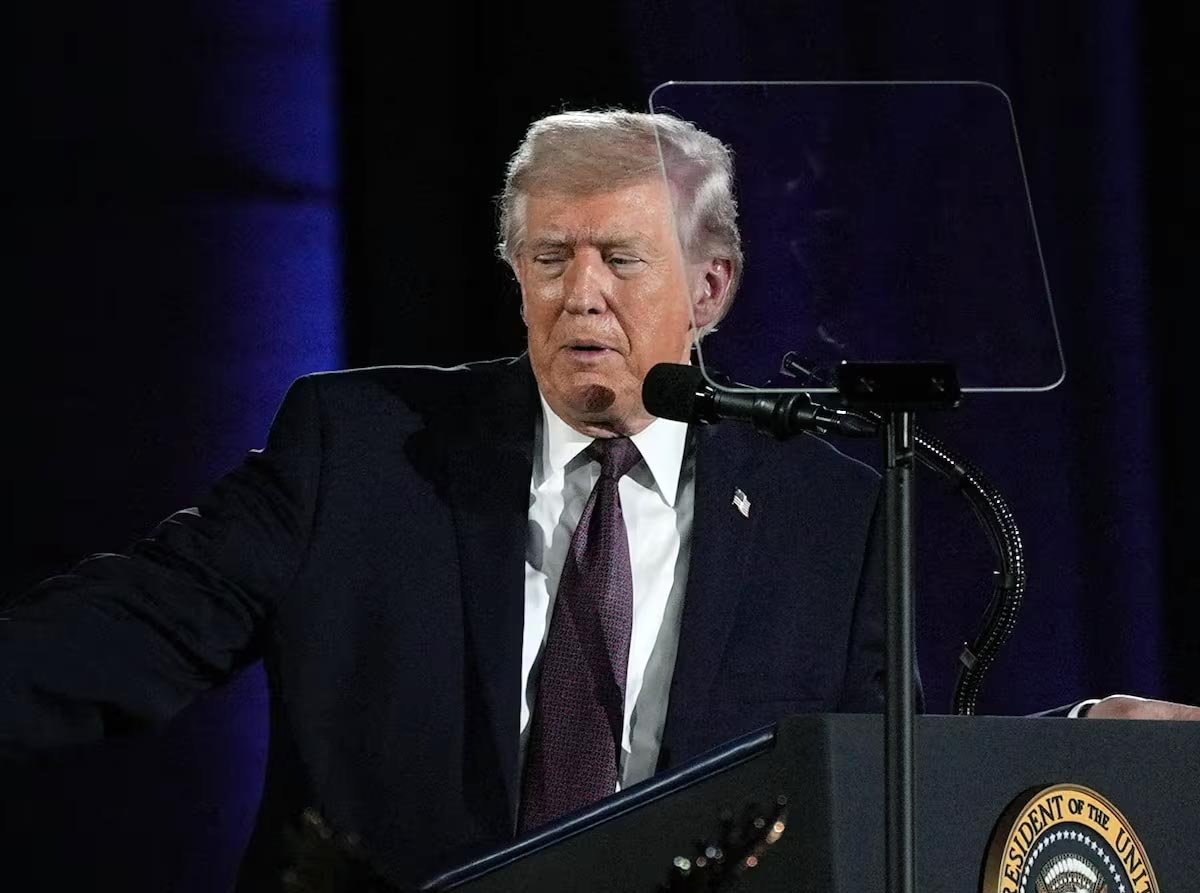

President Donald Trump is now arguing that Iran has effectively been stripped of its nuclear capability, a position that contrasts with the rationale his administration gave for launching the war earlier this year.
Get today's headlines by email 
When the conflict began in February, Trump said Iran posed an imminent nuclear threat. However, critics noted that he had spent months beforehand insisting that U.S. and Israeli strikes in June 2025 had already "obliterated" Iran's nuclear programme.
Trump shifts message on Iran's nuclear threat
Just weeks before the war started, he said those attacks had left Iran without even a "potential capability" to build nuclear weapons.
Now, as the conflict enters its fifth month, Trump is once again describing Iran's nuclear programme as effectively eliminated.
Trump declares war a success
Speaking at a NATO summit in Turkey on Wednesday, Trump rejected suggestions that the war had reached a strategic dead end.
"I was there for one reason: that Iran cannot have a nuclear weapon. I call it, we denuclearize Iran," he said. "And that's happened; they will never have a nuclear weapon."
Trump argued that Iran's nuclear materials are now buried so deeply beneath mountains that they are effectively inaccessible. He also said the United States can monitor the sites and ensure they remain unusable.
"There's no way they have a nuclear weapon," he said.
At another event, Trump was asked how the United States intended to secure Iran's nuclear materials. He suggested that their location effectively placed them under U.S. control.
"We've already got the nuclear material, because it's so far underground," Trump said. "Nobody's going to be able to get it except us."
"They can't get it," he added, calling the outcome "a tremendous success."
Questions over the war's objectives
Trump's latest comments have fuelled questions about the administration's original justification for the conflict.
Throughout the war, administration officials repeatedly described securing or eliminating Iran's nuclear materials as a key objective. Treasury Secretary Scott Bessent referred to obtaining the materials as a "red line" only weeks ago.
Trump has increasingly suggested that physically recovering those materials may no longer be necessary because Iran cannot access them and the sites can be monitored remotely.
His latest remarks also add to what critics describe as shifting explanations for the war. Over recent months, the administration has cited multiple objectives, including preventing Iran from acquiring nuclear weapons and, at times, promoting regime change. Trump has also claimed that the killing of senior Iranian leaders amounted to achieving regime change, despite Iran's government remaining in power.
Critics point to inconsistencies
The president's latest position has prompted further questions about why the war continued if Iran's nuclear capability had already been neutralised.
The largest attacks on Iran's nuclear facilities occurred in June 2025, when Trump first declared the programme had been "obliterated." Major combat operations in the current conflict ended with a ceasefire announced on April 7.
If Iran's nuclear materials were already inaccessible, critics ask why the administration continued pursuing a nuclear agreement and maintained that securing those materials remained essential.
Some analysts argue Trump's latest comments suggest he is preparing to reduce U.S. involvement while portraying the campaign as a success, despite key objectives remaining unmet and negotiations with Tehran showing little sign of progress.
The conflict has imposed significant costs, including the deaths of 13 U.S. service members, disruption to the global economy and heightened concern over Iran's demonstrated ability to affect shipping through the Strait of Hormuz. Critics argue those consequences may ultimately prove among the war's most enduring outcomes.
Join the discussion? 

10 July 2026
-
 3
3
Recommended Comments
Create an account or sign in to comment