



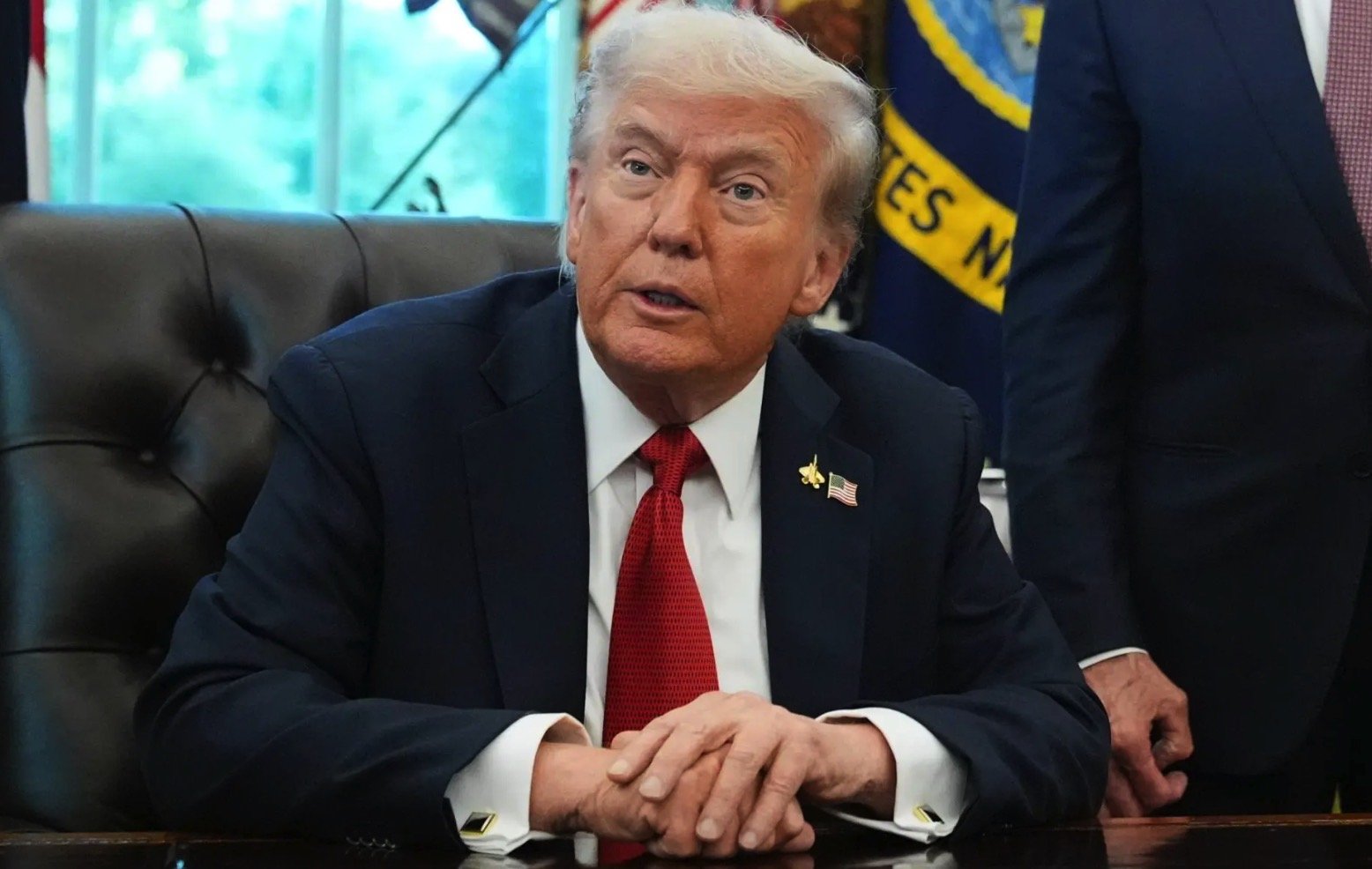

Donald Trump earned at least $2.2bn (£1.7bn) during his first year back in the White House, according to a newly released financial disclosure report, marking an unprecedented level of personal income while serving as US president.
Get today's headlines by email 
Historians say the figure represents a sharp departure from the longstanding practice of presidents distancing themselves from their private financial interests while in office.
The contrast with earlier presidents is striking. Harry Truman left office with little income beyond a monthly Army pension of $113 (£85) and argued that former presidents should not profit from the prestige of the office.
Trump's earnings dwarf those of past presidents
George W Bush placed his investments in a blind trust before becoming president and later said he did not know how the 2008 financial crisis had affected his personal wealth.
Barbara Perry, a presidential historian at the University of Virginia's Miller Center, said there was "no precedent" for Trump's level of personal earnings while in office.
Cryptocurrency drives record income
According to the disclosure, cryptocurrency generated the largest share of Trump's reported income in 2025.
He declared about $1.4bn from cryptocurrency-related ventures, including $635m in royalties from Celebration Coins, the company believed to be behind the $TRUMP meme coin launched shortly before his second term began.
Trump also reported more than $500m from World Liberty Financial, a cryptocurrency business founded by his sons, Donald Trump Jr and Eric Trump, together with the sons of Steve Witkoff, Trump's special envoy to the Middle East and Ukraine.
His reported income for 2025 was almost four times the $622m disclosed for 2024, before his return to office.
White House rejects conflict claims
The White House denied that Trump or his family had benefited improperly from the presidency.
Deputy press secretary Anna Kelly said neither the president nor his family had engaged in conflicts of interest and insisted all decisions made by the administration were in the interests of the American people. She accused critics of repeating longstanding political attacks.
Before both of his presidential terms, Trump transferred day-to-day control of the Trump Organization to his adult sons but, unlike several previous presidents, did not place his business assets in a traditional blind trust or sell his holdings.
The Trump Organization said before his second inauguration that Trump would play no role in its daily operations, while Eric Trump said the company would follow strict ethical standards.
Ethics concerns remain
Critics argue several actions taken by the administration have benefited businesses connected to Trump and senior officials.
Last July, Trump signed legislation supporting stablecoins, months after World Liberty Financial launched its digital currency business. Later, he pardoned Binance founder Changpeng Zhao as his administration promoted the cryptocurrency industry.
A New York Times report also said Trump secured a deal with Kazakhstan that gave an American company access to a major critical minerals project. Eric Trump and Donald Trump Jr later acquired a minority stake in a company involved in the venture, while Cantor Fitzgerald, led by Commerce Secretary Howard Lutnick's sons, also participated in the deal.
Speaking to reporters on Wednesday, Trump said his wealth reflected investment gains and maintained he was not involved in managing his family's business interests.
"I don't get involved in my personal [finances]," he said. "I've made a lot of money before I became president."
Richard Painter, who served as the chief White House ethics lawyer under George W Bush, said Trump's cryptocurrency earnings represented a clear conflict of interest.
"This is a very, very troubling situation for the American people to see their president making so much money," he said.
Join the discussion? 
 Adapted by ASEAN Now. Source 2 July 2026
-
 1
1
-
 1
1
Recommended Comments
Create an account or sign in to comment