



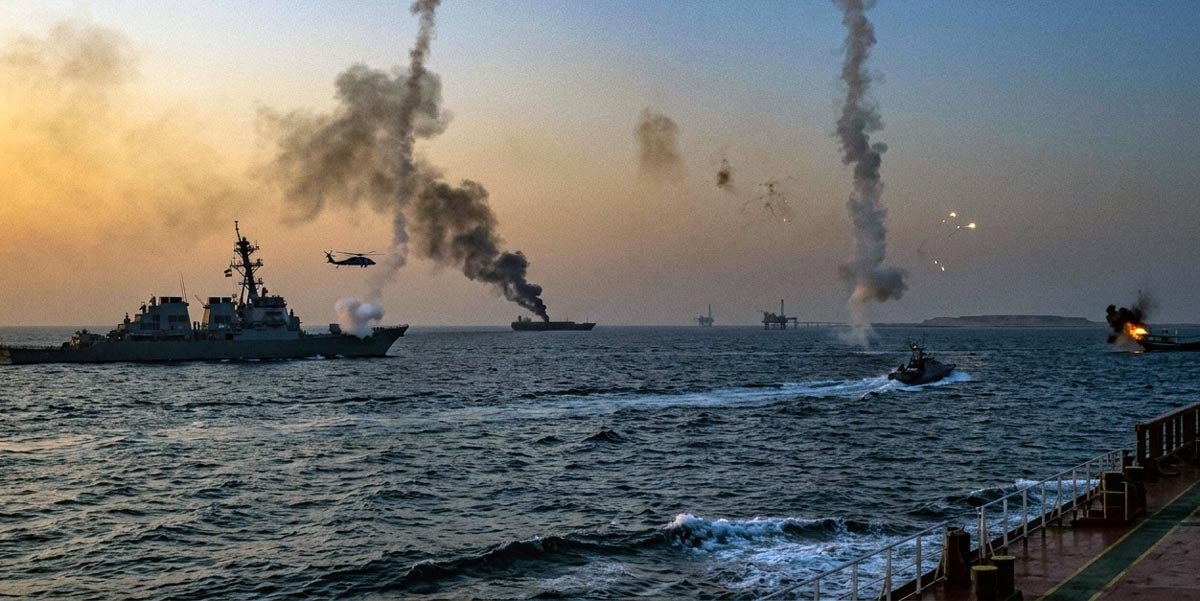

The fragile ceasefire between the United States and Iran has come under renewed strain after both sides exchanged military strikes in the Gulf, raising fresh concerns about the stability of the truce agreed in April.
Get today's headlines by email 
The US military said it targeted Iranian drones and radar installations after detecting what it described as an immediate threat to maritime traffic in the Strait of Hormuz. According to US Central Command (Centcom), four Iranian "one-way attack drones" were launched toward the strategic waterway before being intercepted and destroyed.
Washington said its subsequent strikes were aimed at radar sites linked to the drone activity.
Iran Condemns US Action
Iran denounced the attacks, accusing the United States of violating the ceasefire agreement. The Iranian foreign ministry described the strikes on radar facilities in Sirik and on Qeshm Island as a "flagrant" breach of the truce and an attack on the country's sovereignty and territorial integrity.
In a statement carried by news agencies, Tehran said the operation demonstrated Washington's disregard for international law and the United Nations Charter.
Missile Retaliation Across the Gulf
Iran responded by launching ballistic missiles at two US air bases in Kuwait and naval facilities in Bahrain, according to Iran's state-run Irib news agency.
Authorities in both Bahrain and Kuwait condemned the attacks, reporting that the incoming missiles and drones had been successfully intercepted.
Centcom said seven Iranian missiles were fired toward the two Gulf states. Initial assessments indicated that six were intercepted, while the remaining missile failed to reach its intended target.
The United Arab Emirates and Qatar also criticised the attacks on their Gulf neighbours.
Iran's Islamic Revolutionary Guard Corps (IRGC) said it had struck what it called "enemy bases" in retaliation for the American action.
Ceasefire Under Pressure
The latest exchange is one of several incidents that have tested the ceasefire since it took effect in April. Diplomatic efforts to secure a broader agreement have stalled, with reports in US media suggesting President Donald Trump has sought changes to the terms of a proposed settlement.
Earlier this week, Iran's foreign ministry spokesman accused Washington of repeatedly altering its position and introducing new or contradictory demands during negotiations.
Despite the ongoing hostilities, the US has granted visas to Iran's World Cup football team ahead of its opening match in Los Angeles on 15 June. The tournament is expected to mark the first time a host nation welcomes a team from a country with which it is at war.
Conflict's Wider Impact
The current conflict began on 28 February when the US and Israel launched extensive strikes against Iran. Tehran responded with attacks on Israel and US-aligned Gulf states, while also effectively shutting the Strait of Hormuz.
The waterway handles roughly one-fifth of global oil and liquefied natural gas shipments, including exports from Iraq, Kuwait, Qatar, Saudi Arabia and the United Arab Emirates. Disruption to shipping through the strait caused oil prices to surge worldwide.
Following the ceasefire agreement in early April, the US maintained a blockade of Iranian ports. Trump said the restrictions would remain in place until a formal agreement was reached, certified and signed.
Join the discussion? 
Already a member? 
 Adapted by ASEAN Now. Source 7 June 2026
Recommended Comments
Create an account or sign in to comment