



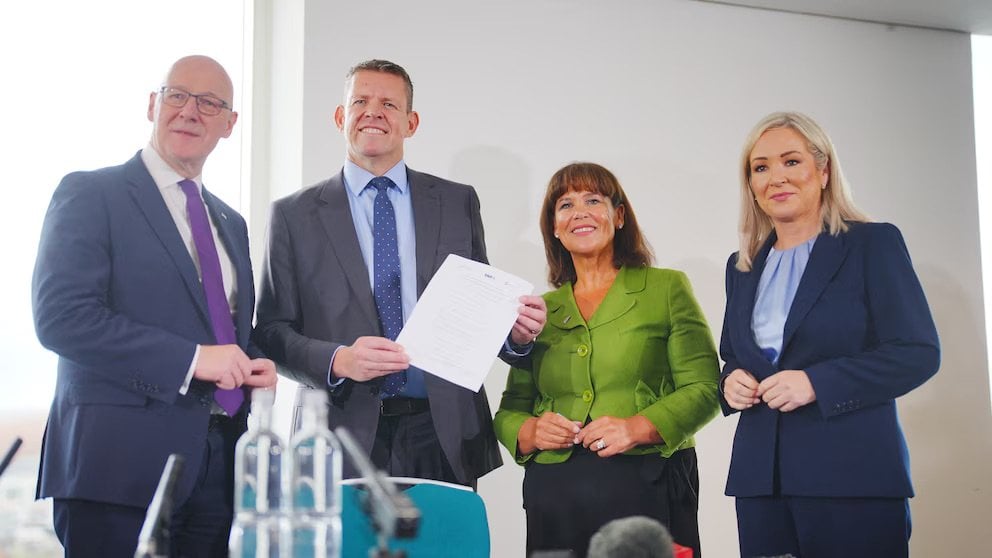

The leaders of Wales, Scotland and Northern Ireland signed a pact on Monday that they said could force constitutional change, raising the prospect of the United Kingdom breaking apart.
The first ministers of the three nations, which have varying degrees of devolved powers, told Prime Minister Andy Burnham and his government to make preparations for changes to the constitution. They also said their future lay with the European Union, according to a memorandum of understanding.
“For people watching across these islands — for people watching around the world — there could be no clearer sign that Westminster’s time is coming to an end,” the leaders said, referring to the UK Parliament.
The move comes about 48 hours after US President Donald Trump weighed into the debate during a trip to his golf course hosting the Irish Open, saying he would “love to see” a reunified Ireland.
This was the first time the leaders of all three nations were backing independence, or unification in Northern Ireland’s case. Northern Ireland was partitioned and remained in the UK when Ireland won independence from Britain more than a century ago.
UK Government Rejects Constitutional Threat
Burnham’s spokesman dismissed the pact, saying the prime minister believed strongly in the union and was focused instead on reducing the cost of living.
“The United Kingdom is at its best when people come together around our shared values and problem-solving, rather than division,” Tom Wells said.
A director at the University of Glasgow’s Centre for Public Policy, Nicola McEwen, said the summit was symbolically important but had no legal impact.
“I don’t see the threat to the union being bigger today than it was yesterday,” McEwen said.
McEwen noted that devolution, introduced through legislative acts in the late 1990s, gave each country other than England policy independence and self-governance through its own parliament. However, she said tensions have persisted with the UK-wide government in London, which retains responsibility for national issues and those affecting England.
Referendums, Brexit And Party Alignment
Scotland’s John Swinney and Northern Ireland’s Michelle O’Neill called for independence referendums in their respective countries. Rhun ap Iorwerth, the leader in Wales, did not set a timetable for a vote.
The three leaders appeared in their political roles rather than their official ones. O’Neill, a Sinn Fein politician, is in a power-sharing administration with the Democratic Unionist Party, which has a long-standing position opposing Irish unification.
Northern Ireland’s Deputy First Minister Emma Little-Pengelly, of the DUP, accused O’Neill of “weaponizing” the first minister’s position by signing the agreement.
“I am first minister in the north of Ireland,” O’Neill replied. “This is about historic change happening all around us.”
Scotland previously attempted to leave the UK in 2014, when voters rejected independence in a referendum by 55% to 45%. McEwen said support for Scottish independence has grown since Brexit, after the UK formally left the European Union in January 2020 following a referendum in June 2016.
Swinney said he believed voters would now choose independence if the UK government agreed to hold a referendum. Burnham told Parliament last week he would allow such a vote if there was a “clear consensus” in Scotland, but later wrote to Swinney saying a referendum was “off limits”.
Peace Accord And The Threshold For Unification
Under the 1998 Good Friday peace accord, which ended decades of sectarian violence known as “The Troubles”, a vote on Irish unification would be required if opinion polls in Northern Ireland indicated it would be likely to pass. The UK government has said that threshold has not been met, and Ireland would also need to approve any change through a separate referendum.
Burnham has made devolution a prominent theme since taking office less than two months ago, but his focus has largely been on regional governments across England, reflecting his previous role as mayor of Greater Manchester.
Swinney sought to build on Burnham’s approach, saying his frequent calls for devolution “leads you to the logic of recognizing the right of the people of Scotland, in my case, to decide their own future.”
Beyond any immediate challenge to the union, McEwen said the most significant effect of the three leaders joining forces could be regular cooperation that might help them exert more influence on the UK government.
“It does keep on the agenda that question about, well, if the United Kingdom is a union based on consent, what is the pathway where it looks like that consent may no longer be there?” she said. “Any U.K. government has been very reluctant to engage in that discussion.”
Join the discussion? 

15 September 2026
Recommended Comments
Create an account or sign in to comment