



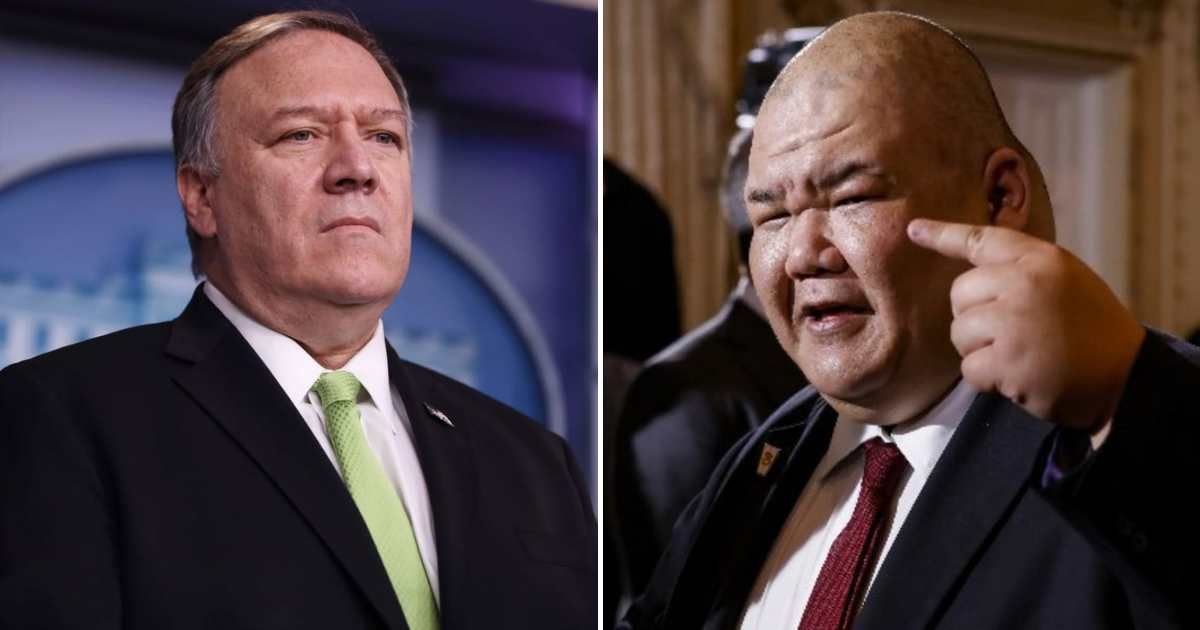

The White House has sharply criticised former Secretary of State Mike Pompeo after he attacked an emerging US proposal aimed at ending the conflict with Iran, with a senior communications official telling him to “shut his stupid mouth”.
Get today's headlines by email 
White House Communications Director Steven Cheung accused Pompeo of commenting without proper knowledge of ongoing negotiations, escalating a public dispute over the direction of US policy on Iran.
Cheung said Pompeo “has no idea what the f— he’s talking about” and urged him to stop commenting on the talks, arguing that he was not briefed on current developments and therefore could not accurately assess the situation.
Pompeo, who served as Secretary of State during the first Trump administration, had earlier criticised the reported outline of a deal in a post on X, saying it did not align with an “America First” approach.
Criticism of emerging Iran framework
In his remarks, Pompeo compared the reported negotiations to earlier diplomatic efforts linked to Obama-era officials, referencing figures involved in previous Iran nuclear talks, including Wendy Sherman, Robert Malley and Ben Rhodes.
He argued that the approach being discussed would strengthen Iran’s military-linked institutions and warned against financial concessions, urging a far tougher strategy toward Tehran. His comments formed part of a wider wave of criticism from Republican figures.
Several Republican lawmakers, including Senators Roger Wicker, Ted Cruz and Lindsey Graham, also raised concerns about the emerging framework, reflecting divisions within conservative ranks over how to handle Iran.
Limited details of proposed agreement
Details of the proposed deal remain limited, but reports suggest it may include reopening the Strait of Hormuz, a vital global shipping route through which around a fifth of the world’s oil supply passes. Any disruption or reopening of the passage has significant implications for global energy markets.
The reported framework also appears to include lifting a blockade on Iranian ports and establishing a temporary 60-day ceasefire intended to allow further negotiations on longer-term issues.
However, the proposal does not appear to include immediate restrictions on Iran’s nuclear programme, a point that has drawn criticism from conservatives and former officials who argue the omission is a major weakness.
US President Donald Trump said in a post on Truth Social that final details of the agreement were still being discussed and would be announced soon. He also indicated that reopening the Strait of Hormuz would be part of any deal.
Tensions over past policy and alliances
Pompeo served in Trump’s first administration but later became politically distanced from parts of the former president’s circle. Relations between the two have remained strained since Trump returned to office in 2025.
The exchange also reflects wider disagreements over US strategy toward Iran, particularly the legacy of the Obama-era nuclear agreement, which the Trump administration previously withdrew from and has repeatedly criticised.
Trump has also previously revoked security protection for Pompeo and other former officials with whom he fell out, despite ongoing threats reportedly linked to Iran.
Join the discussion? 
Already a member? 
 Adapted by ASEAN Now. Source 25 May 2026
Recommended Comments
Create an account or sign in to comment