
Bacon1
Global Moderator
-
Joined
-
Last visited
Everything posted by Bacon1
-
-
Didn't know about the hunting under water. Here's a link & an extract from it. https://animaldiversity.org/accounts/Prionailurus_planiceps/?utm_source=chatgpt.com 'Furthermore, captive adult animals were observed groping along the bottom of a pool with their forepaws spread wide, also like raccoons . A mouse in a bathtub excited captive cats more than a mouse on dry land, as the cats stood either in the water or next to the tub and attempted to fish out the mouse with their mouth or paws"
-
@roo860 I have hidden your post, which had previously been hidden by another moderator. This could be interpreted as a comment on moderation. However, I am giving you the benefit of the doubt and will not impose a sanction at this time. Please refrain from engaging in this behavior again. Thank you for your cooperation.
-
@JonnyF An incorrect name was used for another member. Please use the correct board name when referring to members directly. Replies removed
-
Inflammatory comment & reply removed. Please do not post extraneous or unnecessary comments. We are all attempting to improve the layout where necessary. Thank you
-
In a monumental win for wildlife conservation, the elusive flat-headed cat has been caught on camera in Thailand for the first time in nearly three decades. Previously feared to be "possibly extinct" within the country, this rare feline was recently spotted in the Princess Sirindhorn Wildlife Sanctuary, bringing new hope to researchers and nature lovers alike. The Return of a Wetland Specialist The flat-headed cat (Prionailurus planiceps) is one of the world's most mysterious small wild cats. It had not been officially documented in Thailand since 1995, leading many to believe it had vanished from the region entirely. However, a joint ecological survey by Thailand’s Department of National Parks (DNP) and the global conservation group Panthera changed everything. Using strategically placed camera traps, researchers recorded 29 detections between 2024 and 2025. Perhaps the most heartening discovery was the footage of a mother cat traveling with her kitten. Since these cats typically only have one offspring at a time, this sighting confirms that the population is not just surviving, but actively breeding in the wild. Why This Discovery Matters These cats are uniquely adapted to life in the water. Roughly the size of a domestic house cat, they possess webbed feet and a flattened skull structure—traits that make them expert hunters of fish and frogs in dense swampy environments. However, their specialized lifestyle is also their greatest vulnerability. Thailand’s peat swamp forests have faced extreme fragmentation due to agricultural expansion and land development. Experts note that while the rediscovery is a cause for celebration, it must serve as a "starting point" for stricter protection of these fragile wetland ecosystems. With only an estimated 2,500 adults left globally, every sighting is a vital clue in the race to save the species. Key Takeaways First Sighting Since 1995: The flat-headed cat was rediscovered in southern Thailand after being missing for 29 years. Proof of Breeding: Camera trap footage of a mother and kitten confirms a reproductive population exists in the Princess Sirindhorn Wildlife Sanctuary. Endangered Status: With fewer than 2,500 mature individuals remaining worldwide, protecting their wetland habitats is now a top conservation Adapted From https://www.sciencealert.com/flat-headed-wild-cat-not-seen-in-30-years-caught-on-camera-in-thailand


-
The golf course at Joint Base Andrews, long known as the “president’s golf course,” is set for a major transformation. President Donald Trump has enlisted golf legend Jack Nicklaus to redesign the Courses at Andrews, a historic military golf facility located about 15 miles from the White House in Maryland. For decades, the Courses at Andrews have offered presidents a rare escape from the pressures of office. Gerald Ford, Ronald Reagan, George H.W. Bush, Bill Clinton, George W. Bush, Joe Biden, and Barack Obama all played there during their presidencies. Obama, in particular, was a frequent visitor, logging roughly 110 rounds over eight years—more than any other president. Unlike many of his predecessors, Trump has typically favored golf courses owned by his family. During his second term, he reportedly spent about one out of every four days at Trump-branded properties. Despite that preference, Trump’s decision to invest in the Andrews course marks a notable shift, signaling interest in upgrading a symbolic piece of presidential and military tradition. Jack Nicklaus, widely regarded as one of the greatest golfers of all time, will serve as the project’s architect. Nicklaus has designed or redesigned hundreds of courses worldwide and is known for blending strategic play with respect for a course’s natural setting. His involvement is expected to bring both prestige and modern design standards to the aging facility. The revamp aims to improve course conditions, update layouts, and enhance the overall playing experience while remaining within the secure confines of Joint Base Andrews. Supporters say the project could restore the course’s status as a top-tier destination for presidents, military leaders, and authorized guests. As plans move forward, the redesign highlights the enduring connection between the presidency, golf, and Andrews Air Force Base—an intersection of politics, sport, and history just outside Washington, D.C. Key Takeaways: The Courses at Andrews, known as the “president’s golf course,” are set for a major redesign. Donald Trump has chosen golf icon Jack Nicklaus to lead the overhaul. The project aims to modernize a historic military golf course near Washington, D.C., long favored by U.S. presidents. Adapted From Trump, Nicklaus aim to revamp military golf course near DC | AP News https://share.google/pq0pMIXmxZWuB0hZg


-
A New Year’s celebration turned into a frightening ordeal for one driver in Nakhon Ratchasima. On January 2, 2026, a 30-year-old man driving a new Toyota Corolla Cross encountered a wild gaur that suddenly charged out of the forest near Khao Yai National Park. The collision left the vehicle severely damaged, highlighting the ongoing risks of driving near wildlife habitats. The incident occurred around midnight as the driver, identified as Mr. Nattapat, was navigating a shortcut behind Wat Mu Si. While traveling from Rural Road 3052 toward Thanarat Road, a gaur leaped into the path of his red-plate SUV from the left. With no time to react, the vehicle struck the massive animal head-on. Fortunately, the driver escaped with only minor injuries. However, the front of the SUV was nearly destroyed. The site of the crash was located approximately one kilometer outside the official boundaries of Khao Yai National Park. Pol. Lt. Col. Prayong Wangkulkang of the Mu Si Police Station noted that while animal collisions are common on main roads like Route 3052, this was the first such incident reported in this specific alleyway. Officials speculate that the gaur may have been spooked by New Year’s fireworks, causing it to flee toward the road. Mr. Chaiya Huayhongthong, Chief of Khao Yai National Park, emphasized that wildlife—including elephants and gaur—are increasingly venturing into agricultural and residential areas. While volunteer teams monitor these boundaries, the vastness of the terrain makes it impossible to predict where an animal might emerge. Key Takeaways Nighttime Danger: Drivers near Khao Yai should exercise extreme caution at night, as wildlife frequently crosses roads outside park boundaries. Holiday Impact: Loud noises like fireworks can startle wild animals, pushing them into unexpected areas or toward traffic. Insurance Protection: The victim was able to process a claim through his First-Class insurance, proving the value of comprehensive coverage when driving in high-risk zones. Adapted From https://www.matichon.co.th/region/news_5531249

-
The global automotive landscape has reached a historic turning point. Chinese automaker BYD has officially overtaken Tesla to become the world's top seller of battery-electric vehicles (BEVs) for the full year of 2025. This milestone marks the first time Elon Musk’s Tesla has lost its crown on an annual basis, signaling a major shift in the balance of power within the EV industry. BYD’s Record-Breaking Growth According to the latest data, BYD delivered approximately 2.26 million fully electric vehicles in 2025, representing a robust 28% increase from the previous year. While the company is well-known for its "New Energy Vehicles" (which include plug-in hybrids), these figures reflect only its pure electric sales, proving that BYD's appeal is no longer limited to budget-conscious hybrid buyers. The company’s success has been driven by a diverse lineup, including popular models like the Seagull, Dolphin, and the Atto 3. Despite facing stiff competition and cooling demand in its home market of China, BYD successfully pivoted toward international expansion. Its exports skyrocketed by over 150%, with the United Kingdom emerging as its largest market outside of China. A Challenging Year for Tesla In contrast, Tesla’s annual deliveries fell to 1.64 million vehicles, an 8.6% decline from 2024. This marks Tesla’s second consecutive year of shrinking sales. Several factors contributed to the slump: Political Backlash: Elon Musk’s high-profile involvement in the U.S. government and political rhetoric reportedly alienated segments of the company’s traditional customer base. Aging Lineup: Delays in refreshing top-selling models like the Model Y left the brand vulnerable to newer, flashier competitors. Market Pressures: The expiration of key EV tax credits in the U.S. and fierce price wars in Europe and China squeezed Tesla’s margins and demand. While Tesla remains the world’s most valuable automaker by market capitalization, BYD’s manufacturing scale and aggressive pricing have made it the new volume leader, reshaping the future of green transportation. Key Takeaways Historic Shift: BYD sold 2.26 million BEVs in 2025, officially surpassing Tesla’s 1.64 million to become the world leader in electric car sales. Global Expansion: BYD’s international exports grew by 151%, overcoming high tariffs to dominate markets in Europe, Southeast Asia, and Latin America. Tesla’s Decline: Tesla saw its sales drop for the second year in a row, struggling with increased competition and reputational challenges surrounding CEO Elon Musk. Adapted From https://www.bbc.com/news/articles/cj9rjwpvmpzo


-
A devastating sparklers roof fire at a Swiss ski resort bar on New Year’s Eve has left at least 40 people dead and more than 100 injured, many with severe burns, officials confirmed. The blaze erupted around 1:30 a.m. at Le Constellation, a popular bar in the Crans-Montana resort, where mostly young revelers were celebrating the start of 2026. Authorities believe the fire began when sparklers or pyrotechnic candles attached to champagne bottles were held too close to the low ceiling, igniting flammable sound-absorbing material. Within seconds, the basement venue was engulfed in flames, leaving partygoers disoriented and scrambling for narrow exits. Valais public prosecutor Béatrice Pilloud said mobile phone footage and witness statements show the blaze spread “very rapidly” after contact between the lit sparklers and the ceiling. Investigators are now probing whether the bar complied with fire safety regulations, including proper materials, emergency exits, crowd limits, and fire suppression systems. Regional health officials reported that many of the injured are in life-threatening condition, with serious third-degree burns. Hospitals in the Valais canton quickly reached capacity, prompting transfers of dozens of patients to specialized burns units across Switzerland and neighboring European countries. Victim identification is ongoing and expected to take days, as many were severely burned. Authorities are using dental records, DNA, and clothing descriptions to confirm identities. Swiss President Guy Parmelin declared five days of national mourning. The tragedy has sparked international condolences and highlighted concerns about indoor fire safety at entertainment venues. Key Takeaways A sparklers roof fire at Le Constellation bar in Crans-Montana killed ~40 and injured >100 during New Year celebrations. Investigators suspect sparklers on champagne bottles ignited flammable ceiling materials, causing rapid fire spread. Many victims are critically injured; identification and safety compliance probes continue. Adapted From https://www.theguardian.com/world/2026/jan/02/swiss-ski-resort-fire-injured-life-threatening-condition

-
Several inflammatory comments & replies removed.
-
Inflammatory post removed @Harrisfan
-
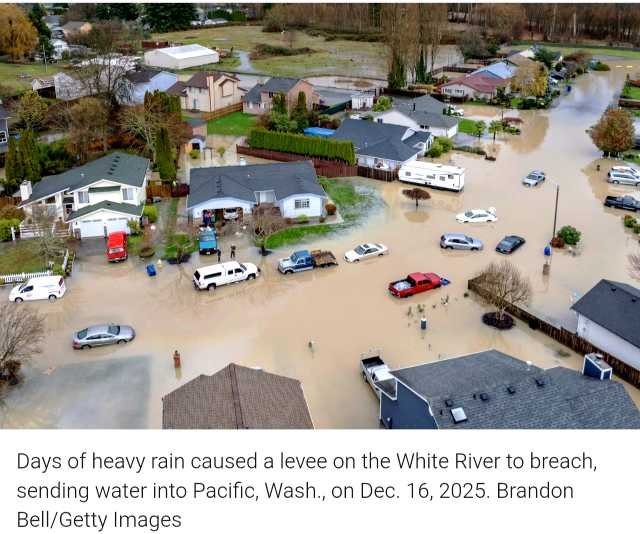
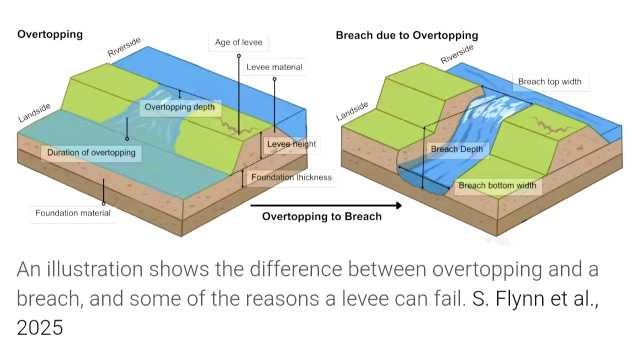
In December 2025, days of powerful atmospheric river storms along the U.S. West Coast caused multiple levees to overtop or breach, sending floodwaters into communities and forcing thousands to evacuate, particularly along the White and Green Rivers in Washington state. These events highlight a broader national issue: America’s flood-defense levees, many of which were built decades ago and now average about 61 years old, are aging and were not designed for today’s extreme weather or dense urban development. Engineers and researchers note that most levees began as simple earthen berms to protect farmland, not as formally engineered structures to safeguard millions of residents, homes, and infrastructure now clustered behind them. The National Levee Database shows over 24,000 miles of levees protecting more than 23 million people and nearly US$2 trillion in property, yet oversight and maintenance vary widely and investment has lagged, earning a D-plus in the 2025 American Society of Civil Engineers infrastructure report card. Experts warn that levee failures often begin quietly with overtopping, when rising rivers flow over their tops and erode the landward side, weakening structures until breaches form rapidly under sustained pressure. The impacts of such failures extend far beyond floodplains, closing roads, damaging utilities, contaminating water supplies, and disrupting lives for years after the initial event. Research also shows that these risks are not evenly distributed: disadvantaged and historically underserved communities are more likely to depend on older, poorly maintained levees and have fewer resources for preparation and recovery. Looking ahead, climate change–driven heavier rainfall, rapid snowmelt, and rising seas are expected to make extreme flooding more common, placing further strain on outdated flood defenses. Authorities and engineers emphasize the need for modernized design standards, consistent monitoring, and equitable investment to improve resilience and protect vulnerable populations against future storms. Key Takeaways Severe December 2025 storms breached West Coast levees, exposing weaknesses in aging flood defenses. The U.S. levee system protects millions but faces inconsistent oversight, underinvestment, and structural limitations. Climate change and socio-economic disparities are increasing flood risks and uneven impacts nationwide. Adapted From: https://theconversation.com/west-coast-levee-failures-show-growing-risks-from-americas-aging-flood-defenses-272556
-
Chronic pain affects millions worldwide, pushing many to explore alternatives to conventional medications — including cannabis-based products. A large systematic review of randomized clinical trials has clarified how cannabis may (or may not) help people living with long-term pain. The analysis included data from more than 2,300 adults with persistent pain lasting months or years, focusing on how different products containing key cannabis compounds — THC (tetrahydrocannabinol) and CBD (cannabidiol) — influence pain levels and daily functioning. The review found that products with higher levels of THC — the psychoactive component of cannabis — were associated with small, short-term reductions in pain intensity and modest improvements in physical function, particularly for people with nerve-related (“neuropathic”) pain. These modest benefits suggest THC can provide some relief when other therapies fall short, but it’s not a dramatic or consistent analgesic for everyone. In contrast, products that were CBD-dominant or low in THC showed little to no meaningful pain relief in the reviewed studies, despite their widespread popularity and marketing as wellness or pain solutions. This indicates that CBD alone likely isn’t a strong option for chronic pain management based on current evidence. Across trials, side effects such as dizziness, sedation, and nausea were more common with higher-THC products. Because most studies were short-term and didn’t track long-term outcomes, questions remain about safety and sustained effectiveness. Researchers and clinicians emphasize that cannabis-based treatments are not a cure-all, and more high-quality, long-duration research is needed before cannabis can be embraced as a mainstay for chronic pain. Key Takeaways THC-rich cannabis products may offer modest short-term pain relief, especially for nerve pain, but gains are limited. CBD-only formulations show minimal benefit for chronic pain according to current evidence. Side effects and limited long-term data mean cannabis isn’t yet a widely recommended chronic pain therapy Adapted From: https://www.earth.com/news/does-cannabis-really-help-chronic-pain-a-large-review-offers-clarity/ Link to study: https://www.acpjournals.org/doi/10.7326/ANNALS-25-03152 Conclusion: Comparable and high THC-to-CBD ratio cannabinoid products may result in small improvements in pain and increased common adverse events during short-term treatment of primarily neuropathic pain; among high-ratio THC-only products, nabilone (but not dronabinol) reduced pain. Low THC-to-CBD products may not improve outcomes. Studies are needed on long-term outcomes and other cannabis product types.

-
IMDbLand of Sin (TV Series 2026) | Crime, Drama, MysteryLand of Sin: With Krista Kosonen, Lisa Lindgren, Mohammed Nour Oklah, Peter Gantman. An odd investigator and her new colleague are looking into the death of a teenager that leads to uncovering a dark Looks good 👍
-
-
As we enter 2026, the American economy stands at a fascinating crossroads. After years of battling aggressive inflation and navigating a series of rapid interest rate hikes, many are asking: Did the Federal Reserve actually pull it off? While the "soft landing" once seemed like a myth, the current landscape suggests a hard-won stability, though new challenges are already appearing on the horizon. The State of the Soft Landing Heading into the new year, the U.S. economy has defied the gloomy predictions of 2024 and 2025. Inflation has cooled significantly from its double-digit peaks, yet the labor market remains surprisingly resilient. However, "fixed" is a strong word. While the Fed has successfully lowered the "fever" of inflation, the cost of living remains a primary concern for households, and the central bank's next moves will determine if this stability lasts. Interest Rates and the "Neutral" Goal The big debate for 2026 revolves around where interest rates will settle. The Fed is no longer in an emergency tightening phase, but they aren't in a rush to return to the "easy money" era of near-zero rates either. Finding the "neutral rate"—a level that neither stimulates nor restricts growth—is the ultimate balancing act. If they cut too fast, inflation could roar back; if they wait too long, they risk sparking a late-cycle recession. Political Shifts and New Leadership Perhaps the most significant variable this year is the transition in leadership. With potential changes in the Federal Reserve Chair position and shifting fiscal policies from Washington, the central bank’s independence and strategy will be under the microscope. Investors are closely watching how new appointments might influence monetary policy, especially regarding employment targets and long-term price stability. Key Takeaways A Fragile Success: While inflation has stabilized, the Fed must now focus on maintaining growth without reigniting price hikes. The Search for Neutral: 2026 will be defined by finding a "new normal" for interest rates that supports long-term borrowing without fueling bubbles. Leadership Transitions: New faces at the Fed could signal a shift in how the central bank reacts to political pressure and economic data. Adapted From https://theconversation.com/has-the-fed-fixed-the-economy-yet-and-other-burning-economic-questions-for-2026-272127

-
The British government has confirmed it will "robustly defend" its decision to revoke Shamima Begum’s British citizenship following a new challenge from the European Court of Human Rights (ECHR). Home Secretary Shabana Mahmood is reportedly prepared to fight the intervention from Strasbourg, maintaining that national security remains the government's top priority. This latest legal development comes after the ECHR questioned whether the UK failed in its legal duty to protect Begum as a potential victim of human rights violations and child trafficking. The Core of the Dispute Shamima Begum, now 26, left her home in East London at age 15 to join the Islamic State (IS) in Syria. In 2019, her citizenship was revoked by then-Home Secretary Sajid Javid on the grounds of public safety. Since then, Begum has remained in a Syrian refugee camp, launching multiple unsuccessful legal bids to return to the UK. The ECHR’s recent inquiry focuses on Article 4, which prohibits slavery and forced labor. Judges in Strasbourg have asked the Home Office to clarify if officials considered whether Begum was groomed or trafficked before making her stateless. Her legal team argues that the UK ignored its "positive obligation" to investigate her status as a minor who was potentially exploited. Despite the ECHR's pressure, a Home Office spokesperson stated that the decision to strip her citizenship has been "tested and upheld time and again" by domestic courts, including the UK Supreme Court. Supporting this stance, Shadow Home Secretary Chris Philp argued that Begum has "no place" in Britain, citing her past support for extremist groups. As the legal tug-of-war moves to the international stage, the outcome will likely set a major precedent for how the UK balances national security with international human rights obligations. Key Takeaways National Security Focus: The Home Secretary remains committed to upholding the 2019 decision, citing Begum as a threat to public safety. ECHR Intervention: The European Court is investigating whether the UK breached anti-trafficking laws by failing to treat Begum as a victim of grooming. Legal Deadlock: While UK courts have repeatedly sided with the government, the ECHR's binding (though difficult to enforce) ruling could force a re-evaluation of the case. Adapted From https://www.bbc.com/news/articles/c3wzp693nv3o

-
In 2026, Hollywood finds itself at a crossroads as political pressure, cultural backlash and industry-wide uncertainty shape the future of big-budget cinema. Analysts and insiders are watching closely to see whether the combined effect of Donald Trump’s influence, corporate reshuffling, and a shifting cultural landscape will curtail what critics label “woke” blockbusters — movies that incorporate progressive themes and social commentary. Trump’s involvement in Hollywood extends beyond political rhetoric. Reports suggest his administration has scrutinised major studio deals, influenced executive decisions, and even secured commitments for reviving long-dormant franchises like Rush Hour 4. Connections between Trump allies and high-profile corporate bids indicate a strategy that aligns entertainment industry oversight with broader political agendas. Meanwhile, major films slated for release — including a Michael Jackson biopic and Emerald Fennell’s bold adaptation of Wuthering Heights — have sparked controversy on social media and in the press. Wuthering Heights has generated debate over casting and interpretation, while the Jackson project confronts decades of lingering accusations and divided fan opinions. Studio executives appear cautious, opting for projects perceived as lower risk. Upcoming releases such as Supergirl, Toy Story 5, live-action Moana, and the robot-centric Hoppers reflect a potential strategic pivot toward familiar or lighter fare. However, industry watchers note that the typical timeline of blockbuster production makes it hard to directly link these slate choices to political pressure just yet. The debate over the “woke” blockbuster isn’t confined to Hollywood boardrooms; it mirrors broader cultural conversations about representation, creative freedom, and political influence in art. As 2026 unfolds, the film industry’s response could set significant precedents for storytelling on the global stage. Key Takeaways Political Influence: Reports of Trump-era pressure on studios add a new dynamic to film production decisions. Controversial Releases: High-profile films like Wuthering Heights and a Michael Jackson biopic are at the center of cultural debates. Shifting Strategies: Studios may favor safer, franchise-based content to avoid backlash and financial risk. Adapted From https://www.theguardian.com/film/2026/jan/01/wuthering-heights-michael-jackson-trump-effect-will-2026-see-the-end-of-the-woke-blockbuster

-
A young man aged 22 was killed in an RTC just 500 metres from our home. Driving past yesterday morning, the family was there & saw his mum: Heartbroken.
-
Yes, both very good actors, completely convincing in their roles. But is Hobbs good, bad, or compromised? Moving on... Looking forward to s02 of The Agency.
-
Comment on moderation removed @saintdomingo 13. You will not publicly comment on moderation in an open forum. You will not comment on actions taken by individual moderators or on specific or general policies and issues. You will not post a negative emoticon in response to a public notice made by a moderator. You may send a private message to a moderator to discuss individual actions or you can email support (at) aseannow.com to discuss moderation policy and account suspensions.You will not block communication from moderators or Admin. Aggression, personal attacks, derogatory comments or any form of abuse toward moderators, Admin, or this forum in general will not be tolerated and will result in strict consequences. There is absolutely no excuse for abusive behavior.
-
AI agents—systems that not only respond to prompts but autonomously use tools and complete tasks—became mainstream in 2025, transforming how people and organisations interact with artificial intelligence. These agents moved from lab concepts to real-world infrastructure, reshaping large language model use and utility. Their rapid rise is prompting both excitement and concern about their impact on technology and society. In 2025, AI agents evolved from theoretical constructs to practical tools capable of calling APIs, coordinating with other systems, and acting independently of direct human prompts. A key catalyst was the adoption of standards like Anthropic’s Model Context Protocol, which enabled models to connect to external software and perform actions beyond text generation. Major AI labs and companies released high-performance models and agent-enabled products that brought these capabilities into everyday use. By mid-2025, “agentic” browsers and workflow builders appeared, reframing interfaces so the software actively participates in tasks like travel booking or research. Protocols such as Google’s Agent2Agent, donated to open-source governance, enabled AI agents to communicate and cooperate. Industry groups also launched the Agentic AI Foundation under the Linux Foundation to create open standards and drive interoperable ecosystems. However, with this capability come significant risks and challenges. Security incidents revealed that autonomous agents can be misused, lowering barriers to cyberattacks and malicious automation. Technical hurdles remain in benchmarking, reliability, and integrating agents safely into workflows. There are also broader concerns about energy use, job displacement, surveillance, and insufficient regulatory frameworks, especially in countries with limited AI oversight. Looking ahead to 2026, efforts will focus on improving reliability and trustworthiness, defining benchmarks for composite AI systems, and establishing governance frameworks that balance innovation with safety. Industry and academic voices stress that success will depend on treating AI agents as socio-technical systems requiring careful design, documentation, and human oversight. Key Takeaways AI agents transitioned from research concepts to practical autonomous tools in 2025, reshaping AI interactions. Protocols and standards like MCP and open governance initiatives are driving interoperability and industry adoption. Technical, security, and regulatory challenges ahead make 2026 a critical year for safe and reliable AI agent integration. Adapted From https://theconversation.com/ai-agents-arrived-in-2025-heres-what-happened-and-the-challenges-ahead-in-2026-272325

-
Russia repeated its assertion that Ukraine launched a major drone attack on one of President Vladimir Putin’s residences in the Novgorod region, alleging that 91 drones were intercepted, but offered no verifiable evidence for the claim. The Kremlin’s repetition of the accusation has immediate implications for delicate peace negotiations, as Moscow said it may revise its negotiating stance in response. Independent confirmation of the attack is absent, and Western officials have expressed skepticism about Moscow’s account. The allegation first emerged when Russian Foreign Minister Sergey Lavrov claimed the alleged assault targeted a heavily fortified presidential residence near Valdai, with air defenses shooting down the unmanned aircraft. Kremlin spokesman Dmitry Peskov described the incident as a “terrorist attack” intended to sabotage peace efforts. Moscow released footage claiming to show wreckage of a downed UAV, but Reuters reported it could not independently verify the video or drone model. Ukraine’s government firmly denied the accusation, dismissing it as fabricated and part of a disinformation campaign to undermine diplomatic progress and strain relations between Kyiv and its allies. Ukrainian Foreign Minister Andrii Sybiha said Russia had provided “no plausible evidence” and insisted “no such attack happened.” U.S. intelligence assessments reportedly found no evidence supporting Russia’s claims, and EU officials also rejected the allegations, calling them a distraction from the real issues in the conflict. Analysts and Western officials noted the lack of independent confirmation and questioned the strategic timing of the claim, as it appeared shortly after peace talks involving U.S. and Ukrainian leaders. Some critics suggested the allegation could be aimed at influencing international perceptions and derailing negotiations. Looking ahead, diplomats are expected to continue pushing for a negotiated settlement despite Moscow’s repeated assertions, but trust between parties remains fragile and contingent on verified information. Key Takeaways Russia reiterated its unverified claim that Ukraine attacked Putin’s residence using drones. Ukraine, the U.S., and EU officials rejected the assertion and highlighted a lack of evidence. The dispute over the claim could affect ongoing peace negotiations in the Ukraine conflict. Adapted From | CNN https://share.google/hYgkfVk6fiqeDWQ38

-
Starting New Year’s Day, the way millions of Americans use food assistance is changing. As part of a growing national push toward healthier eating, five states are officially launching bans on using Supplemental Nutrition Assistance Program (SNAP) benefits to purchase soda, candy, and other "junk foods." The Major Shift in Food Assistance Indiana, Iowa, Nebraska, Utah, and West Virginia are the first to implement these new restrictions. While SNAP has historically allowed for the purchase of most grocery items, these states have received federal waivers to narrow those options. The goal, championed by health and agriculture officials, is to combat rising rates of chronic conditions like diabetes and obesity by ensuring taxpayer dollars fund nutritious meals rather than empty calories. The specific rules vary by state: Utah and West Virginia are primarily targeting soda and soft drinks. Nebraska has extended its ban to include energy drinks. Indiana is blocking both soft drinks and candy. Iowa has introduced the most sweeping changes, banning nearly all "taxable" food items, which includes a wide range of processed snacks and prepared treats. Impact and Controversy Approximately 1.4 million people across these five states will be immediately affected. Proponents argue that the move is a necessary step for public health. However, the transition hasn't been without friction. Retailers have expressed concerns over technical hurdles at checkout, and advocates for low-income families worry the bans may create confusion and stigma at the register. This is only the beginning of a broader trend. At least 13 other states, including Florida and Texas, are scheduled to roll out similar restrictions later in 2026. For now, shoppers in the initial five states will need to adjust their grocery lists as these "Make America Healthy Again" initiatives take effect. Key Takeaways Immediate Restrictions: Residents in Indiana, Iowa, Nebraska, Utah, and West Virginia can no longer use SNAP benefits for soda and/or candy as of January 1. State-Specific Rules: Each state has unique guidelines; for example, Iowa’s ban includes most taxable snacks, while others focus strictly on sugary beverages. National Momentum: These five states are the first of at least 18 planning to implement similar "junk food" bans throughout 2026 to promote better nutrition. Adapted From https://www.bbc.com/news/articles/c0jvp5qdw0no