kwilco
Advanced Member
-
Joined
-
Last visited
Everything posted by kwilco
-
As soon as you use the argument of "qualification" – secundum quid et simpliciter – you lose credibility and if you use the word "fact", you also use credibility What if you spend less time on fallacious ad hominems and concentrate on the discussion? Remember, it's the message, not the messenger, that's important... If you like qualifications, here's a list of highly qualified people... Highly qualified conspiracy theorists Shiva Ayyadurai Robert F. Kennedy Jr. Naomi Wolf Dr. Peter Duesberg Dr. Andrew Wakefield David Icke Bret Weinstein All bat<deleted> crazy conspiracy theorists?
-
Do conspiracy theory “creators” actually believe their own nonsense? Some do. Plenty don’t. And that’s the part people seem to miss. There’s this comforting idea that the people churning out conspiracy theories are just misguided truth-seekers. In reality, a fair number of them know exactly what they’re doing — and it has nothing to do with “truth.” Conspiracy content is engagement gold. (just look at the length of this thread!) - It’s cheap to produce, requires zero evidence, and reliably pulls in clicks, shares, outrage, and followers. In other words, it pays — financially or socially. Why bother with facts when fantasy performs better? Then you’ve got the wind-up merchants. The ones posting increasingly ridiculous claims just to see who bites. They’re not confused — they’re entertained. Every angry reply is a win. And let’s not pretend politics isn’t involved. Conspiracy theories are perfect tools if you want to smear opponents or push an agenda without the inconvenience of proof. Just throw something inflammatory out there and let the internet do the rest. Which it does. Very efficiently. Because once it’s out there, it gets picked up by people who do believe it — and off it goes. That’s the whole point. You don’t need everyone to be gullible, just enough to keep it circulating. That’s where the old term “useful idiots” comes in. Not meant as a personal insult — just a description of the mechanism. The original source doesn’t need credibility if others are willing to supply it for free. Some are just really good writers who seem to enjoy the exercise of writing itself – it’s still a pity that what they write is bat<deleted> crazy…. And here’s the twist: repeat something often enough, build a following around it, and even the original peddler can start half-believing their own material. Or at least convincing themselves it’s justified for some “greater cause". So no, not all conspiracy theorists are true believers. Some are just running a very low-effort, high-reward game — where being wrong doesn’t matter, getting attention does, and other people do the heavy lifting for them.
-
Don't forget that both the current moon programmes – the US and Chinese – are both hoaxes – they never explain why or even at which point the hoax starts...like apparently the "contraption" at the Kennedy Space Center in Florida is a hoax designed to fly "beyond visibility". I guess the Chinese are doing the same – it's nice to see the superpowers getting along so well.
-
read "Bad Science" by Ben Goldacre
-
Have you noticed how much time conspiracy theorists spend (or waste) “researching”? They will spend hours combing the internet, producing long, detailed posts – yet still miss the point, avoid the question, or rely on obviously questionable sources? It’s not because they’re doing better research. It’s because they’re doing something else entirely. Most of this behaviour is driven by psychology, not logic. Conspiracy theories offer certainty in a messy world, a sense of control, and the appeal of being “in the know” while everyone else is supposedly clueless. That’s a powerful mix. Online, it becomes a group activity. People build narratives together, reinforce each other, and reward the most dramatic claims — not the most accurate ones. They inhabit echo chambers from where “evidence” is crowdsourced, but only if it supports the belief. Of course we now recognise that there are some very basic thinking errors at play: time and again we see confirmation bias, i.e., only looking for what agrees with them, and pattern-seeking, finding connections where none exist. A distrust of real sources — while trusting random ones and self-sealing logic, e.g., any contradiction becomes “part of the conspiracy” So the long posts and endless links aren’t a sign of rigorous thinking — they’re often a sign of the opposite: starting with a conclusion and working backwards to justify it. In short: It looks like research, but it’s actually belief maintenance.
-
Sadly, you don't know what AI is or how to use it – you are referring to search engine use, not a writing tool. (how do you explain Grammarly?) - Its applications are endless; it's not a single definable object. AI is also not a source... Sources are usually primary, secondary or tertiary, but conspiracy theorists are not critical of their sources. Anyone who has been to uni and done research will know what research and analysis are and how to express a reasoned opinion... Letting others do that for you is a mental weakness common in conspiracy theorists. It's not critical thought; it's mimicry
-
this shows how you can't use AI and know very little about making an argument – can't you see the difference???
-
In other words, you don't!
-
Why Do Intelligent People Fall for Conspiracy Theories? One of the biggest myths in this whole debate is that conspiracy theorists are simply “stupid.” They’re not. In fact, quite a few are highly intelligent and well-educated. O=in fact they are often the ones who sow the seeds in the first place. And that’s precisely the problem… Research consistently shows that intelligence doesn’t make you immune to conspiracy thinking — it just makes you better at defending it. The issue isn’t a lack of brainpower, it’s how that brainpower is used. 1. Intelligence ≠ Objectivity Highly intelligent people are often very good at something called motivated reasoning — starting with a conclusion and then using their intelligence to justify it. In other words, they don’t follow the evidence… they build a case around what they already want to believe. 2. Pattern-Seeking Gone Wrong Smart people are good at spotting patterns. That’s useful — until it isn’t. The same ability can lead to seeing connections that simply aren’t there. Random events become “linked,” coincidence becomes “evidence,” and suddenly you’ve got a conspiracy. 3. The “I Know Something You Don’t” Effect There’s a strong psychological pull in believing you’ve uncovered hidden knowledge. It feeds a sense of superiority — “I’ve worked it out, the rest are sheep.” For some, that’s far more appealing than accepting boring, evidence-based explanations. 4. Control in a Chaotic World Conspiracy theories simplify complex, messy reality. Instead of random events, uncertainty, or systemic problems, you get a clear villain and a neat explanation. That’s comforting — even if it’s wrong. 5. Identity and Belonging Beliefs aren’t always about truth — they’re about tribe. Conspiracy theories often act as social glue, creating in-groups of “truth seekers” versus everyone else. Once identity is tied to the belief, changing your mind feels like losing your place in the group. The Bottom Line Intelligent people don’t fall for conspiracy theories because they can’t think. They fall for them because they can think — and then use that ability to rationalise, defend, and entrench beliefs that aren’t supported by evidence. In short: They don’t lack intelligence — they misuse it. And that’s a much harder problem to fix.
-
would you?
-
Here's one with your filter removed...

-
Calling something “AI” isn’t an argument — it’s a mantra. - It gets repeated like it proves something… but it doesn’t address facts, logic, or evidence. It just signals that the person saying it doesn’t really understand what AI is. Sadly, some people don't know what AI actually is or even the difference between a source and a search engine or the difference between search and research – if they did, they probably would never have become conspiracy theorists.. Most people using “AI” as a dismissal seem to think it’s just a search engine that spits out answers. It isn’t. And ironically, they’re probably using AI all day without even realising it. e.g. Face ID on your phone. Google Maps routing your journey. Netflix or Spotify recommendations. Spam filters catching junk mail. Social media feeds deciding what you see. - All AI. AI is just a tool — like a calculator, or a spellchecker. It can be used well or badly. The output still needs to be judged on its accuracy, not dismissed because of how it was produced. I’m dyslexic, so I use tools like Grammarly. What’s your favourite? So the question isn’t “is it AI?” - The question is: is it correct? If you disagree with something, explain why. Point out the flaw. Challenge the reasoning. Because saying “that’s AI” isn’t debate. It’s avoidance.
-
in case you missed it - and that seems a trait with you - Just saying “AI” isn’t a counter-argument. I don’t think you even know what AI is or how to use it…… I do find a certain frisson of schadenfreude when I think of the time you spent on a pointless exercise – typical of conspiracy theorists. You really need to concentrate of the message and not the messenger – again a classic mistake of conspiracy theorists You are not actually making an argument - You don’t address whether the facts are wrong, don’t challenge the logic and don’t refute any evidence. You’re just regurgitating a label. Dismissing something because you think it’s AI-assisted is like dismissing it because it was written on a laptop. The tool used to produce words is irrelevant — what matters is whether the argument stands up. If you disagree, explain why. Point out the error. Challenge the reasoning. Calling something “AI” isn’t debate. It’s avoidance and deflection PS - Do you not see the irony of a conspiracy theorist calling for "independent thought" and claiming, "I don't read AI slop"??
-
Why Do Intelligent People Fall for Conspiracy Theories? One of the biggest myths in this whole debate is that conspiracy theorists are simply “stupid.” They’re not. In fact, quite a few are highly intelligent and well-educated. O=in fact they are often the ones who sow the seeds in the first place. And that’s precisely the problem… Research consistently shows that intelligence doesn’t make you immune to conspiracy thinking — it just makes you better at defending it. The issue isn’t a lack of brainpower, it’s how that brainpower is used. 1. Intelligence ≠ Objectivity Highly intelligent people are often very good at something called motivated reasoning — starting with a conclusion and then using their intelligence to justify it. In other words, they don’t follow the evidence… they build a case around what they already want to believe. 2. Pattern-Seeking Gone Wrong Smart people are good at spotting patterns. That’s useful — until it isn’t. The same ability can lead to seeing connections that simply aren’t there. Random events become “linked,” coincidence becomes “evidence,” and suddenly you’ve got a conspiracy. 3. The “I Know Something You Don’t” Effect There’s a strong psychological pull in believing you’ve uncovered hidden knowledge. It feeds a sense of superiority — “I’ve worked it out, the rest are sheep.” For some, that’s far more appealing than accepting boring, evidence-based explanations. 4. Control in a Chaotic World Conspiracy theories simplify complex, messy reality. Instead of random events, uncertainty, or systemic problems, you get a clear villain and a neat explanation. That’s comforting — even if it’s wrong. 5. Identity and Belonging Beliefs aren’t always about truth — they’re about tribe. Conspiracy theories often act as social glue, creating in-groups of “truth seekers” versus everyone else. Once identity is tied to the belief, changing your mind feels like losing your place in the group. The Bottom Line Intelligent people don’t fall for conspiracy theories because they can’t think. They fall for them because they can think — and then use that ability to rationalise, defend, and entrench beliefs that aren’t supported by evidence. In short: They don’t lack intelligence — they misuse it. And that’s a much harder problem to fix.
-
It looks like, without an argument, you've resorted to deflection. Just saying “AI” isn’t a counter-argument. I don’t think you even know what AI is or how to use it…… I do get a certain frisson of schadenfreude when I think of the time you spent on a pointless exercise – typical of conspiracy theorists. You really need to concentrate of the message and not the messenger – again a classic mistake of conspiracy theorists You are not actually making an argument - You don’t address whether the facts are wrong, don’t challenge the logic and don’t refute any evidence. You’re just regurgitating a label. Dismissing something because you think it’s AI-assisted is like dismissing it because it was written on a laptop. The tool used to produce words is irrelevant — what matters is whether the argument stands up. If you disagree, explain why. Point out the error. Challenge the reasoning. Calling something “AI” isn’t debate. It’s avoidance and deflection
-
"WE" – at least we agree on who you are!
-
You’ve managed to dodge the actual topic again and replace it with a strawman and a bit of theatrical victimhood. First, “we are now the majority” — based on what, exactly? Assertion isn’t evidence. And even if it were true (it isn’t), popularity has never been a measure of accuracy. By that logic, every widely held false belief in history suddenly becomes “true” because enough people bought into it. Second, “77 million people = majority” — no, it doesn’t. That’s not even a majority in the U.S., let alone globally. More importantly, I never said all Trump supporters are conspiracy theorists. That’s your exaggeration, not my argument — a classic case of arguing with something that was never said because it’s easier than addressing what was. Third, the “so what do we do with you?” line is pure deflection. This isn’t about rounding people up or declaring anyone “mentally ill” as a blanket label — it’s about understanding why certain patterns of thinking occur and why they persist despite evidence. You’ve taken a discussion about behaviour and turned it into a melodrama about persecution. And finally, “what’s the actionable remedy?” — if you read the original post properly, you’d notice it was explicitly framed as a discussion: “Why so many… and what to do about them?” That’s not a test with a preloaded answer — it’s the question itself. The fact that the thread has largely avoided answering it (and instead spiralled into people defending their favourite conspiracies) rather proves the point. If anything, this exchange is a textbook example of the issue: Replace the argument with a caricature Inflate numbers to sound authoritative Shift from ideas to identity (“us vs them”) Avoid the actual question That’s not a majority. That’s just a very loud loop.
-
If you genuinely think we’re living in a simulation, then by definition you’ve just removed any basis for evidence, logic, or argument — including your own. It’s not a “theory” in the scientific sense; it’s an unfalsifiable philosophical idea. In other words, it explains everything and therefore explains nothing. Saying “the calculations show it’s realistic” is doing a lot of heavy lifting for something that produces zero testable predictions and zero usable evidence. That’s not science — that’s speculation dressed up with maths you haven’t actually applied. And the irony? You’re using a hypothetical, untestable scenario to justify believing other unproven claims. That’s not critical thinking — that’s stacking guesses on top of guesses and calling it insight. If your argument works just as well in a real universe as in an imaginary one, it isn’t an argument — it’s a shrug with extra steps.
-
This thread asked: “Why are there so many conspiracy theorists, and what can be done about them?” What it’s actually shown is something slightly different – that quite a few people either recognise the mindset or, more tellingly, inadvertently demonstrate it. Like most entrenched habits or belief systems, nothing really changes until there’s some level of self-awareness and a willingness to question it. What’s also striking is how few responses have addressed the question itself. Instead, the thread has largely drifted into people defending or promoting their own preferred conspiracies, often backed by anecdotal or apocryphal examples they assume are relevant. That, in itself, is quite revealing — it highlights a tendency to substitute personal belief for structured argument and to engage with the topic emotionally rather than analytically. As for why there are so many, that’s been largely overlooked. A big part of it, in my view, is decades of poor media literacy. People are simply not well equipped to evaluate information critically — especially visual and online content — and tend to approach it with a level of naïvety that makes them vulnerable to confident-sounding nonsense. So the symptoms are on full display in this thread, but the causes haven’t really been explored. And on the second part of the question — what to do about it — there’s been very little in the way of practical or realistic suggestions. Plenty of noise, not much solution.
-
It's not just "evidence" - it's a lack of reason and logic.
-
here's a little image to highlight the problem...
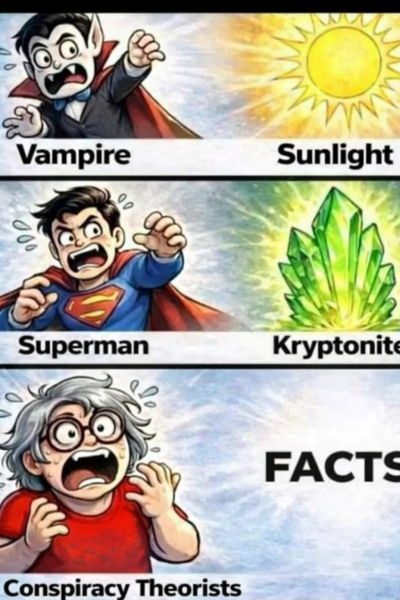
-
Conspiracy theories themselves aren’t a mental illness — but they’re not exactly a sign of healthy thinking either. Research shows they tend to arise from a mix of anxiety, loss of control, low trust, and a need for simple answers in a complicated world. They offer something emotionally attractive especially to those with mental health problems e.g. - certainty, a sense of being “in the know,” and belonging to a group that thinks it has special insight. A kind of unsupervised therapy group. That’s why people who buy into one conspiracy often buy into many — it’s not about the topic, it’s about the mindset. Traits like paranoia, overconfidence, poor analytical thinking, and “jumping to conclusions” all play a role. In extreme cases, this thinking can overlap with psychological distress or even delusional patterns — but most of the time it’s shared, socially reinforced belief, not clinical illness. The problem is, these beliefs don’t actually solve anything. Studies show they feel empowering but tend to increase anxiety, distrust, and disengagement from reality. In some cases, they lead to harmful decisions — from rejecting medical advice to justifying extreme behaviour. Increasingly it is being shown that people with certain kinds of mental illnesses are drawn towards conspiracy theories and the comfort they seek from them along with others who share similar problems. With these people we’re dealing with a mindset that values certainty over truth. That’s why logic alone rarely works — but it’s also why it’s still necessary. Maybe some will recognise this in themselves and seek to address the problem?
-
still awaiting clarification on when real stops and hoax begins Ah yes, the “everything is fake but somehow still works perfectly” school of thought. Always a classic. Let me get this straight: the Apollo 11 Moon Landing—along with every other Apollo mission—was a hoax… but also every modern lunar programme, including Artemis program and China’s Chang'e program, are hoaxes too. The launchings and lead up are real and everything after that is fake? So decades apart, across rival superpowers, with completely different technology stacks… all fake. Coordinated flawlessly. For what, exactly—fun? And we’re meant to believe that thousands of engineers, scientists, contractors, and international tracking stations have all kept this secret for over half a century. Not one credible leak. Not one deathbed confession. Not one rival nation exposing it for the biggest geopolitical win in history. Remarkable discipline for a species that can’t even keep a new iPhone secret for a week. The “they just roll out contraptions and drop them in the ocean” line is particularly impressive. Apparently, rockets don’t go up—they just… arc politely out of sight and vanish into a watery grave. Which is awkward, because independent observers across the globe—amateur astronomers, universities, and even hobbyists with radio gear—regularly track spacecraft well beyond “visual range.” But sure, they’re all either in on it or too dim to notice. Convenient. Also, the idea that “no rocket follows a vertical trajectory” isn’t the mic-drop moment it’s imagined to be. Rockets launch vertically and then pitch over—because that’s how you achieve orbit instead of just going straight up and falling back down. It’s not a conspiracy, it’s basic physics. So we’re left with a choice between two explanations: Tens of thousands of people across multiple countries and generations are engaged in a perfectly executed, motive-free deception that has never slipped. The Moon landings—and ongoing space missions—are exactly what they appear to be. If the hoax theory has a clear boundary—where reality ends and the fakery begins—now would be a great time to hear it. Because at the moment, it’s less a theory and more a blanket assertion that anything inconvenient must be fake… which isn’t scepticism, it’s just denial dressed up as insight or cynicism used to cover ingorance
-
Seriously, how does that fit with the topic?
-
Not all conspiracy theorists are Trump supporters but all Trump supporters are conspiracy theorists